
You finished a Python course — or you’re about to start one — and now the real question hits: will this actually get you a job in the UAE? Skipping this research is how people end up with a certificate and no clear next move, stuck applying to roles that don’t match what they learned. This guide breaks down exactly which jobs Python opens up, what they pay in the UAE in 2026, and the steps to move from “I learned Python” to “I got hired.”
Python has held the #1 spot on the TIOBE Programming Community Index for years, and as of September 2026 it still leads at 17.76% — well ahead of C, C++, and Java. That’s not a marketing claim; it’s an index built from search engine activity around skilled engineers, courses, and vendor demand. For someone choosing a first programming language, that kind of sustained lead is a strong signal of where hiring demand keeps flowing.
This isn’t happening in a vacuum. The UAE’s digital economy already contributes close to 12% of national GDP, and the government is targeting more than 20% by 2031 under its national digital economy strategy. Layered on top of that, PwC estimates artificial intelligence alone could contribute close to $96 billion to the UAE economy by 2030 — nearly 14% of GDP — anchored by the UAE National Strategy for Artificial Intelligence 2031. Every one of these initiatives depends on people who can write Python: it’s the language behind the data pipelines, automation scripts, and AI models driving this shift. If you’re weighing where to invest your training budget, our Data Science & AI course pairs naturally with Python for exactly this reason.
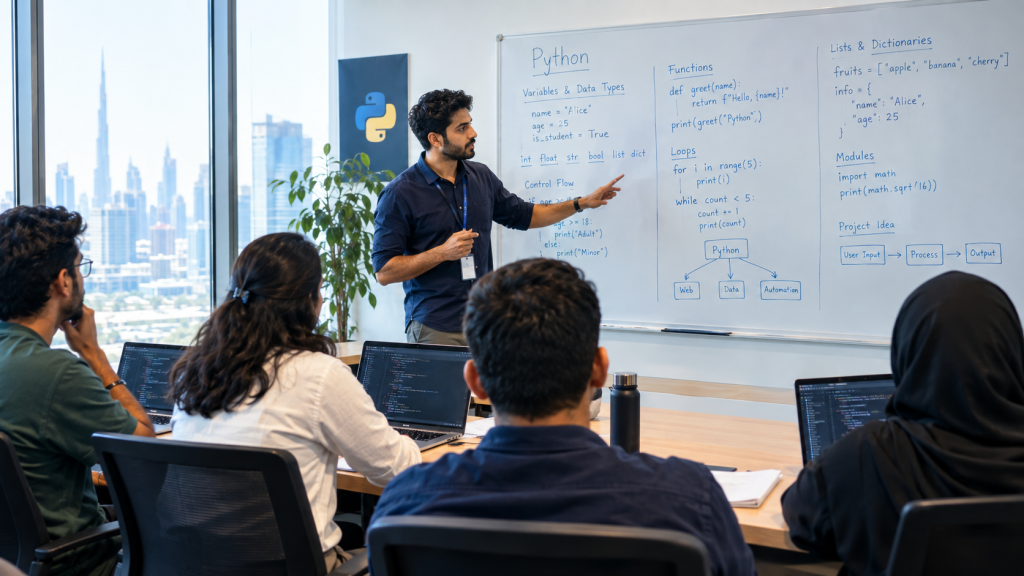
A proper Python course should take you from zero to job-ready, not just “syntax-aware.” AlifByte’s Python Programming course is structured across three levels — Basic, Intermediate, and Advanced — so you can enter with no prior coding experience and leave with a portfolio.
What the curriculum typically covers:
That last point matters more than people expect. Employers hiring for entry-level Python roles in the UAE consistently look for a portfolio of real projects over a certificate alone — it’s the fastest way to prove you can actually build something, not just recite syntax.
Python is unusual in that it doesn’t lock you into one job title. Depending on which direction you push your skills after the course, here are the roles it realistically opens up in the UAE.
The most direct path. You write and maintain application code, work with frameworks like Django or Flask, and often collaborate with a backend or full-stack team. This is the natural first step for most course graduates.
Python (paired with Pandas and Excel/Power BI skills) is one of the fastest routes into data analytics — cleaning data, building reports, and surfacing insights for business teams. If this path interests you, our dedicated Data Analyst career guide for the UAE breaks down the exact skill stack and hiring path, our Data Analyst salary guide covers pay in more depth, and you can build the skill set directly through our Data Analytics courses.
Companies across banking, logistics, and government in the UAE are automating repetitive workflows — reporting, testing, data entry — and Python (often with tools like Selenium or scripting against APIs) is the go-to language for this. It’s one of the quickest wins for someone who wants to apply Python inside a non-tech company rather than a pure software house.
With deeper study (typically after the Advanced level), Python opens the door to ML/AI roles — training models, building data pipelines, and working with libraries like TensorFlow and Scikit-learn. Given the UAE’s National AI Strategy 2031, this is currently one of the fastest-growing and highest-paying directions, especially once paired with our Data Science & AI course. Related roles like prompt engineering are also gaining ground; see our Prompt Engineer salary guide for how these AI-adjacent careers compare.
Using Django or Flask, Python developers build the server-side logic behind websites and apps — handling databases, APIs, and business logic. This path overlaps with software engineering more broadly and often pays a premium once you add cloud or DevOps skills. Browse AlifByte’s full دورات تقنية المعلومات if you want to pair Python with Java or another in-demand language.
Because Python is used everywhere — scripting, automation, data work, web backends — it’s one of the most freelance-friendly languages. UAE-based freelancers commonly pick up remote contracts building automation scripts, dashboards, or small backend services for clients outside the region as well as locally.
Nearly every data, automation, and AI role in the UAE hiring market assumes baseline Python literacy — it’s rarely optional anymore.
Employers filter for demonstrated project work first; a course certificate supports that, it doesn’t replace it.
The UAE National AI Strategy 2031 and digital economy targets are directly translating into more Python-adjacent job postings.

Salary figures for Python-related roles vary widely across job boards, recruiters, and salary-survey providers, so treat any single number with caution — the ranges below are a blended picture drawn from UAE job postings and regional salary-survey data, and actual offers depend heavily on your employer, industry, and specialisation.
| Role | Experience Level | Approx. Monthly Salary (AED) |
|---|---|---|
| Python Developer | Entry-level (0–2 yrs) | 8,000 – 15,000 |
| Python / Software Developer | Mid-level (3–6 yrs) | 15,000 – 22,000 |
| Data Analyst (Python + BI tools) | Entry to mid-level | 8,000 – 18,000 |
| Automation Engineer | Mid-level | 15,000 – 25,000 |
| Machine Learning / AI Engineer | Entry-level | 15,000 – 25,000 |
| Machine Learning / AI Engineer | Mid to senior-level | 25,000 – 55,000+ |
| Senior IT Specialist (general) | Senior | ~28,000 average |
A few things that consistently move the number up:
Since the UAE has no personal income tax, these figures are effectively take-home pay — a meaningful difference compared to equivalent roles in many other countries. For a closer look at how a related data role stacks up, see our full Data Analyst salary in UAE breakdown, and if you’re weighing Power BI as a complementary skill, our Jobs After a Power BI Course guide is a useful companion read.

Short answer: yes, and the data backs it up. Python’s continued lead on the TIOBE Index, combined with the UAE’s active investment in AI and data infrastructure, means demand isn’t slowing down. That said, Python isn’t the only viable route — Java remains dominant in enterprise banking systems (our Java Developer salary guide covers that path), and if you’re coming from a finance or accounting background, our Python for Accounting guide shows how the same language applies directly inside that industry. The honest takeaway: Python’s versatility — spanning web development, data analytics, automation, and AI — makes it the safer first choice for most beginners, with room to specialise later.
Short, honest answer: AI is not eliminating coding jobs, but it is rapidly reshaping which coding jobs exist and what they pay. The real divide isn’t “human vs AI” — it’s between roles that get more valuable because of AI and roles that get automated away.
Common entry points include Python Developer, Data Analyst, Automation Engineer, Junior Software Developer, and — with further study — Machine Learning or AI Engineer roles.
It varies significantly by source and experience level, but a realistic blended range is roughly AED 8,000–15,000/month for entry-level roles, rising to AED 20,000+/month for mid-to-senior developers, with specialised AI/ML roles going well beyond that.
No. Most entry-level Python roles in the UAE prioritise demonstrated skills and project work over formal degrees, especially for junior developer, data analyst, and automation positions.
Yes. Python holds the #1 spot on the TIOBE Index as of September 2026, and Dubai’s ongoing investment in AI, automation, and data infrastructure keeps demand for Python skills consistently high.
It depends on your starting point and study pace, but a structured, level-based course covering fundamentals through advanced concepts and real projects is generally more effective than an open-ended self-study timeline.
Yes — this is one of the most common paths into Python. Professionals from accounting, marketing, and operations backgrounds regularly transition into data analyst or automation roles using Python as their entry skill.
It depends on specialisation and seniority rather than the job title alone. Pure development and ML/AI-focused roles tend to command higher pay at the senior level, while data analyst roles offer a faster, lower-barrier entry point.
Yes. Automation scripts, dashboards, and small backend projects are common freelance Python work, both for local UAE clients and remote international clients.
A certification from a structured, project-based course adds credibility, particularly when paired with a visible portfolio — most UAE employers weigh practical demonstration alongside it, not the certificate in isolation.
Both remain in demand, but for different reasons: Java is deeply embedded in enterprise and banking systems, while Python leads in data, automation, and AI-adjacent roles, which are currently the UAE’s fastest-growing hiring categories.
Complete the advanced level of a Python course, build hands-on projects using libraries like Pandas and Scikit-learn, then progressively add TensorFlow, cloud platform exposure, and a recognised AI/ML certification.
No — data from PwC’s 2026 AI Jobs Barometer and Stack Overflow’s 2025 Developer Survey both show AI is automating routine coding tasks while increasing demand and pay for judgment-heavy work like architecture, debugging, and AI-assisted development, rather than eliminating developer roles outright.
A Python programming course isn’t just a certificate to add to your CV — it’s a genuine entry point into some of the fastest-growing, best-paying roles in the UAE’s job market right now, from Python Developer and Data Analyst to Automation Engineer and Machine Learning Engineer. The language’s continued global lead, combined with the UAE’s active investment in its AI and digital economy strategy, means this demand isn’t a short-term trend. What actually separates a graduate who gets hired from one who doesn’t is a structured curriculum, real project work, and a clear next step — not just finishing a course and hoping. Institutions like AlifByte Educational Institute exist to close exactly that gap.