
Wondering what you should actually be earning as an accountant in Dubai right now? You’re not alone — and the stakes are high. Get the number wrong in a salary negotiation and you could leave AED 3,000–5,000 on the table every single month.
Dubai’s accounting market has changed meaningfully since the UAE’s corporate tax regime came into force. Demand for qualified finance professionals is at its highest point in years. This guide cuts through the noise with salary figures sourced directly from live UAE job platforms and the Hays GCC Salary Guide 2026 — so every number you see here reflects the real market, not an algorithm’s estimate.

Dubai’s finance and accounting sector is in strong hiring mode in 2026. According to the Hays GCC Salary Guide 2026 — sourced from over 1,600 employers and professionals across the region — 66% of organisations increased headcount in 2025, and 90% reported active skills gaps heading into 2026.
The UAE’s 9% Corporate Tax, now fully embedded in business operations, has permanently expanded the scope of accounting work across the country. Companies that deferred compliance are now racing to meet FTA audit timelines. Multinational corporations are building out regional tax teams in Dubai and Abu Dhabi. And free zones like DIFC and ADGM are establishing dedicated finance functions for the first time.
The result: qualified accounting professionals are in genuine demand at every career level, and employers are competing on both salary and benefits to secure the right candidates.
If you’re considering entering or advancing in this market, Alifbyte’s accounting courses are designed specifically around what Dubai employers are hiring for in 2026.

Two accountants with the same job title can earn very different salaries in Dubai. The main drivers are:
Qualifications — ACCA, CPA, CMA, and CA holders command significantly higher starting packages. Employers treat these as Tier 1 requirements for most roles above junior level.
Experience — The jump between 2 years and 5 years of experience often represents AED 3,000–6,000/month in base salary.
Employer type — Multinational corporations, Big Four firms, and banking institutions pay noticeably more than SMEs for equivalent roles.
Industry sector — Oil & Gas and Finance are the top-paying sectors for accountants in Dubai, followed by Manufacturing and Real Estate (GulfTalent, Jun 2026).
Technical skills — UAE Corporate Tax compliance, ERP proficiency (SAP, Oracle), and Power BI are the three skills generating the most consistent salary premiums in 2026.
Language — Arabic-English bilingual professionals earn 5–10% more in client-facing and government-linked roles.

Based on data sourced directly from GulfTalent (updated June 2026, based on 601 registered accountants in Dubai):
| Role | Average Monthly | Range |
|---|---|---|
| Accountant (general) | AED 4,000 | AED 3,000 – AED 5,500 |
| Junior / Assistant Accountant | AED 3,500 – 5,000 | Varies by employer |
| AR / AP Specialist | AED 4,500 – 6,500 | Varies by employer |
| Bookkeeper | AED 4,000 – 6,000 | Varies by employer |
Source: GulfTalent.com, Dubai salary data, June 2026
The highest-paying industry for entry-level accountants in Dubai is Oil & Gas, followed by Finance and Healthcare (GulfTalent, Jun 2026).
A few things push you toward the top of this range early: holding a part-qualification (ACCA Fundamentals, CPA exam progress), proficiency in widely-used platforms like QuickBooks or Sage 50, and UAE-specific experience with VAT filing.
💡 Quick win: Entry-level accountants with software certification typically earn 10–15% above the average. It is one of the fastest-ROI investments at this career stage.

Based on GulfTalent data (updated June 2026, 155 Senior Accountants registered in Dubai):
| Role | Average Monthly | Range |
|---|---|---|
| Senior Accountant | AED 7,500 | AED 5,500 – AED 10,000 |
| Internal Auditor | AED 7,000 | AED 4,000 – AED 11,000 |
| Management Accountant | AED 11,000 | Market rate (GulfTalent) |
Source: GulfTalent.com, Dubai salary data, June 2026
The highest-paying industries for Senior Accountants are Manufacturing, Real Estate, and Construction (GulfTalent, Jun 2026).
At this level, UAE Corporate Tax knowledge is the single biggest salary differentiator. Professionals who can handle FTA compliance, corporate tax filings, and VAT consistently receive offers toward the AED 10,000 ceiling, while those without this specialisation cluster around the average.
Alifbyte’s UAE VAT and corporate tax training is structured to close this gap efficiently for working professionals.

This is where Dubai’s tax-free advantage becomes genuinely compelling. Based on GulfTalent (updated April–June 2026):
| Role | Average Monthly | Range |
|---|---|---|
| Finance Manager | AED 15,000 | AED 9,000 – AED 25,000 |
| Financial Controller | AED 20,000 | AED 11,000 – AED 39,500 |
Source: GulfTalent.com, Dubai salary data, Apr–Jun 2026
The highest-paying industry for Finance Managers in Dubai is Accountancy (professional services), followed by Construction and Real Estate (GulfTalent).
Live job listings on Bayt.com (June 2026) show Finance Manager and Chief Accountant roles in Dubai actively advertising up to AED 30,000/month depending on experience — confirming the upper range is real and accessible for the right candidate profile.
Benefits packages at this level typically include performance bonuses, family health coverage, and housing or transport allowances — meaningfully increasing total compensation beyond base salary.
Looking to close the skills gap for a Finance Manager role? Alifbyte’s advanced Excel and data analytics courses are among the most practical options for Dubai-based finance professionals targeting this tier.

| Role | Average Monthly | Range |
|---|---|---|
| Chief Accountant | AED 13,500 (avg) | AED 10,000 – AED 20,000+ |
| Head of Finance | AED 28,500 | AED 20,000 – AED 40,000 |
Source: GulfTalent.com comparison data, Jun 2026
The Chief Accountant role sits between Senior Accountant and Finance Manager in Dubai’s hierarchy — it typically carries full ownership of the accounting function for a single entity. Professionals in this role with ACCA or CPA qualifications and UAE Corporate Tax expertise reach the top of this band consistently.
Based on GulfTalent (updated June 2026, directly fetched):
| Role | Average Monthly | Range |
|---|---|---|
| Finance Director | AED 40,000 | AED 12,000 – AED 64,000 |
Source: GulfTalent.com, Dubai salary data, June 2026
The Finance Director role in Dubai carries significant variance — the AED 12,000 floor reflects smaller organisations or interim roles, while the AED 64,000 ceiling represents senior FDs in large multinationals, banking, or listed entities.
CFO compensation sits above this range. Experienced CFOs in Dubai with accounting backgrounds earn between AED 260,000–AED 968,000 annually depending on company size and sector.
All of this salary is received tax-free — making Dubai’s executive finance packages directly comparable to significantly higher gross packages in the UK, Australia, or Western Europe.
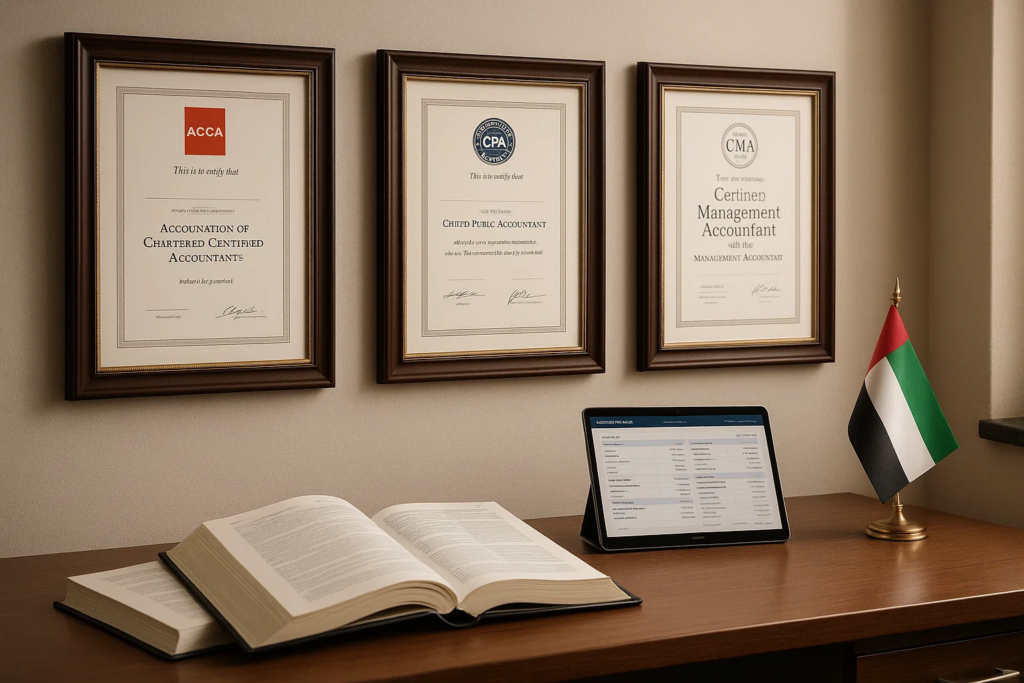
No single investment delivers a faster return in Dubai’s accounting market than the right certification.
ACCA remains the most widely recognised qualification in the UAE. It is effectively expected for roles above Senior Accountant level in multinational employers and Big Four firms. ACCA-qualified professionals consistently earn toward the top of any salary band. Learn how building a career with ACCA works in the UAE context.
CPA (US) is highly valued in free zones (DIFC, ADGM) and multinationals. With UAE Corporate Tax now prominent, CPAs who understand tax planning and compliance are receiving premium offers.
CMA holders typically earn 15–20% more than non-certified counterparts in management accounting and FP&A roles.
CA (India / UK / Australia) qualifications are well-respected and treated as equivalent to ACCA for most Dubai hiring purposes.
CIA carries a specific premium in internal audit roles, particularly in banking and insurance.
The pattern is consistent: certifications do not just get you hired faster — they determine which salary band you start in and how quickly you progress through it. Professionals without a Tier 1 certification are almost always offered the lower end of any posted range.
For a clear roadmap on how to start an accounting career in the UAE — including which qualification path suits your background — Alifbyte’s career guidance resources are worth reviewing.

Beyond qualifications, these specific technical skills are generating the most consistent salary premiums across Dubai right now:
UAE Corporate Tax & FTA Compliance — The single highest-premium skill set in 2026. Accounting professionals with hands-on CT filing experience earn noticeably more than generalist peers at every level.
ERP Systems (SAP, Oracle Financials, Microsoft Dynamics) — ERP proficiency opens the door to MNC-level roles. Certified users consistently earn at the upper end of any salary range.
Advanced Excel & Financial Modelling — Non-negotiable at mid-level and above. Advanced Excel for accountants remains one of the highest-ROI short courses available to Dubai finance professionals.
Power BI & Data Analytics — Increasingly expected at Finance Manager level and above. Accountants who can build dashboards and generate financial insights are being repositioned as strategic advisors. Power BI training directly supports this transition.
IFRS Knowledge — With the UAE aligned to international reporting standards, IFRS awareness is expected for roles above junior level. IFRS 17 and 18 are particularly relevant in financial services.
Business Communication in English — Underrated, but strong communication skills visibly accelerate progression to management roles where total compensation increases significantly.

If you are already working in Dubai’s accounting sector, these are the moves that actually shift compensation in 2026:
Alifbyte’s professional development programmes are built around points 1 through 4 specifically for Dubai-based accounting professionals.

Your sector matters as much as your title. Here’s how Dubai’s industries stack up for accounting roles:
Oil & Gas — The top-paying industry for accountants at every level in Dubai (GulfTalent, Jun 2026). Premium packages and strong benefits.
Finance & Banking — Consistently second-highest. Internal audit, financial control, and FP&A roles in banking sit well above market averages.
Manufacturing — The highest-paying sector for Senior Accountants specifically (GulfTalent, Jun 2026).
Real Estate & Construction — Strong demand for professionals with project costing and contract accounting experience. Among the top sectors for both Senior Accountants and Finance Managers.
Professional Services (Big Four & Mid-Tier Firms) — Excellent career development and fast-track progression. Salary is closely tied to client billing and qualification level.
Healthcare — Growing sector with increasing compliance requirements. Stable and competitive salaries at all levels.
Retail & Hospitality — Generally lower base salaries, though larger groups offer performance incentives and structured progression.
Accounting professionals based in other emirates should note that salary benchmarks are comparable, with some variation. Explore locally relevant course options in Abu Dhabi, Sharjah, Ajman, and Ras Al Khaimah.
Based on GulfTalent data (June 2026, 601 accountants registered in Dubai), the average monthly salary for an Accountant in Dubai is AED 4,000, with a range of AED 3,000–5,500 depending on industry and experience.
The average Senior Accountant salary in Dubai is AED 7,500/month, reaching up to AED 10,000 for the highest-earning profiles. Manufacturing, Real Estate, and Construction are the top-paying sectors for this role.
Finance Managers in Dubai earn an average of AED 15,000/month, with a range of AED 9,000–25,000. The highest-paying industry for this role is Accountancy/professional services . Live job listings show roles advertising up to AED 30,000/month for experienced candidates.
The average Financial Controller salary in Dubai is AED 20,000/month, with a range of AED 11,000–39,500 depending on company size, industry, and experience .
Yes. Personal income in the UAE remains tax-free. There is no personal income tax, meaning every dirham of salary is take-home pay — a substantial advantage over equivalent gross salaries in the UK, Australia, or Canada.
Oil & Gas is the highest-paying industry for accountants in Dubai in 2026, followed by Finance and Healthcare at entry level, and Manufacturing at senior level .
The most reliable routes are: obtaining a Tier 1 certification (ACCA, CPA, CMA), developing UAE Corporate Tax expertise, moving to an MNC employer, building ERP and data analytics skills, and making strategic job moves (which deliver 15–25% salary increases vs 3–7% internal increments).
Yes — the ROI is among the highest of any professional development investment available to Dubai-based finance professionals. Targeted certifications and skills courses consistently move professionals into the upper salary band of their role within 12–24 months.
The accountant salary landscape in Dubai in 2026 is genuinely rewarding — but the gap between average and top earners is wide, and it is driven by specific, learnable things: the right certification, sector-specific knowledge, technical skills, and strategic career decisions.
Whichever level you are at now, the data in this guide — sourced directly from GulfTalent and the Hays GCC Salary Guide 2026 — gives you a reliable, honest baseline for your next negotiation or career move.
If there is a gap between where you are and where you want to be, Alifbyte’s accounting and finance courses are built specifically for professionals navigating Dubai’s finance market. Every programme is designed around the qualifications, tools, and UAE-specific knowledge that employers are actively hiring for right now.
The difference between AED 7,500 and AED 15,000 a month is not luck — it is the right qualification, the right skills, and the right training behind you.
Alifbyte Education offers professional accounting and finance courses built specifically for the UAE job market — covering ACCA preparation, UAE Corporate Tax, Advanced Excel, Power BI, QuickBooks, Sage, and more.
Whether you are just starting out, stuck at mid-level, or targeting a Finance Manager role, there is a programme designed for exactly where you are right now.
👉 Explore All Accounting Courses — Alifbyte Education
Don’t negotiate your next salary without the credentials to back it up. Start your course today.