
A finance degree alone no longer gets you hired in the UAE. Employers across Dubai, Abu Dhabi, and Sharjah are filtering CVs the moment they see a candidate cannot name a single accounting software platform with confidence — and the gap between candidates who know exactly what software skills to highlight and those who don’t is now costing thousands of dirhams in starting salary. With VAT, Corporate Tax, and EmaraTax compliance now woven directly into daily accounting work, software fluency has shifted from a “nice to have” to the first thing recruiters screen for. This guide breaks down exactly which accounting software skills UAE employers expect in 2026, how to build them in the right order, and how they translate into real salary leverage.
Table of Contents
Three structural shifts in the UAE finance landscape have permanently raised the bar on software competency for accountants:
The practical result: a candidate who can talk fluently about double-entry bookkeeping in theory, but cannot demonstrate hands-on software proficiency, is now a weaker candidate than one with less theoretical depth but strong, demonstrable tool skills. UAE employers are hiring for immediate productivity, not potential.
💡 Key Insight
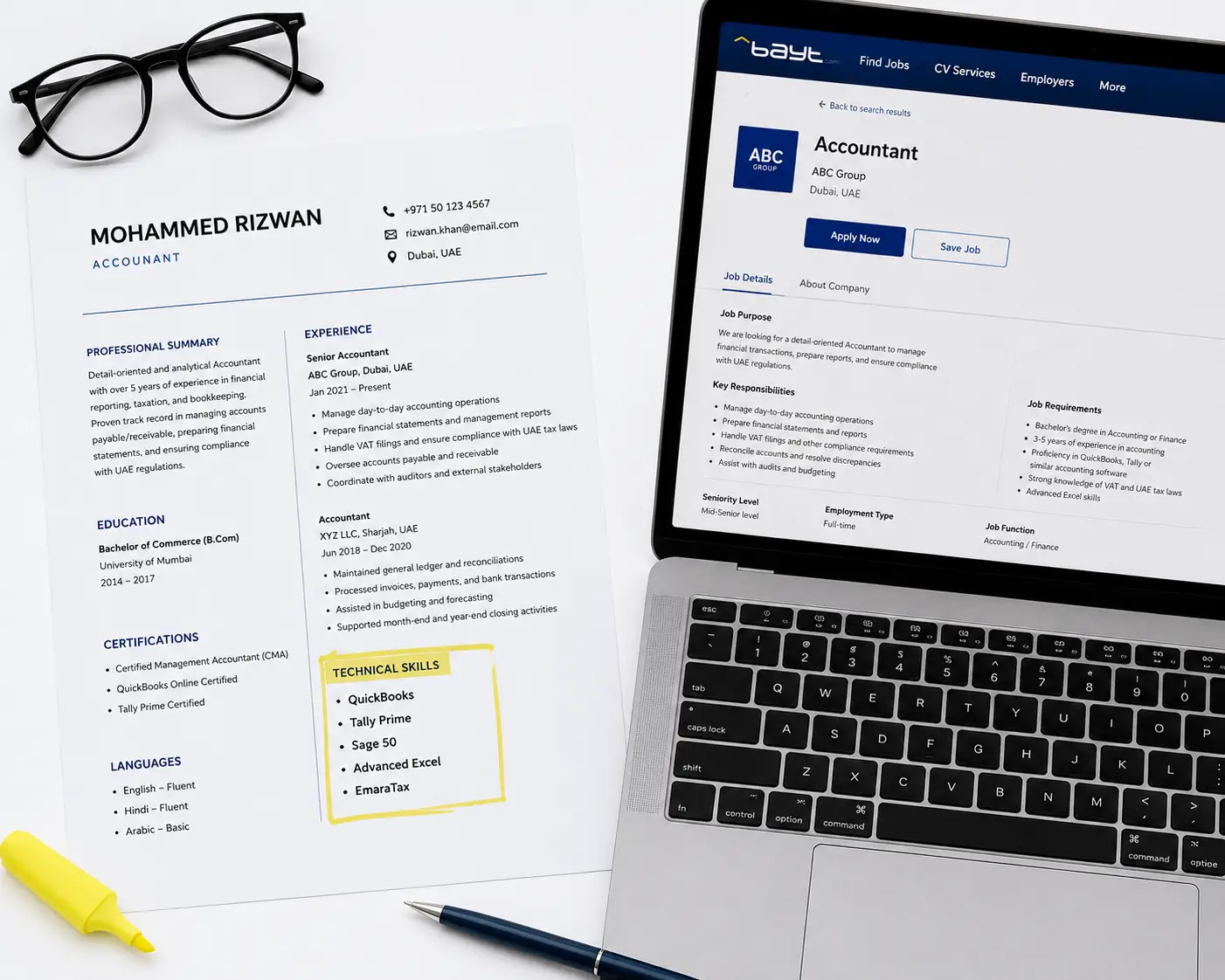
Recruiters in UAE increasingly screen CVs by searching for specific software names before reading anything else. A CV listing “QuickBooks, Advanced Excel, EmaraTax” in the skills section gets noticed in the first five seconds. A CV listing only “strong accounting knowledge” often doesn’t survive the first filter.
Not every accountant needs every tool — but understanding the full landscape helps you prioritise your learning based on the industries and roles you’re targeting. Here is the complete stack, ranked by overall UAE market demand:
| Software | Primary Use | Dominant Industries in UAE | UAE Demand |
|---|---|---|---|
| QuickBooks | Bookkeeping, invoicing, VAT reporting | SMEs, services, consultancies, retail | ⭐⭐⭐⭐⭐ Very High |
| Tally Prime | Inventory, trading accounts, VAT | Trading, import-export, wholesale | ⭐⭐⭐⭐⭐ Very High |
| Sage 50 | Full-cycle accounting, payroll, reporting | Manufacturing, distribution, mid-size firms | ⭐⭐⭐⭐ High |
| Advanced MS Excel | Analysis, reconciliation, reporting, modelling | Every industry, every role | ⭐⭐⭐⭐⭐ Universal |
| EmaraTax Portal | VAT/CT registration, filing, payments | Every FTA-registered business | ⭐⭐⭐⭐⭐ Mandatory |
| SAP / Oracle / Zoho Books | Enterprise resource planning, group reporting | Multinationals, government, large corporates | ⭐⭐⭐⭐ High (enterprise roles) |
The most efficient strategy for most UAE job seekers is to build strong competency in one core bookkeeping platform (QuickBooks, Tally Prime, or Sage 50), pair it with Advanced Excel, and add EmaraTax familiarity — this combination satisfies the vast majority of UAE accounting job descriptions at junior to mid-level. ERP exposure becomes relevant once you’re targeting senior or multinational roles.
QuickBooks is the most widely adopted accounting software among UAE’s small and medium-sized service businesses — consultancies, marketing agencies, retail outlets, restaurants, and professional services firms. Its intuitive interface and strong VAT-compliance features have made it the default choice for thousands of UAE SMEs since VAT was introduced.
As an accountant, your QuickBooks responsibilities typically include managing the chart of accounts, recording invoices and bills, reconciling bank feeds, generating VAT reports for FTA filing, and producing profit and loss statements for management review. Employers specifically look for candidates who can demonstrate end-to-end transaction processing, not just basic data entry.
For UAE job seekers, QuickBooks is the single highest-leverage software skill to learn first if you’re targeting roles in service-based industries, startups, or SME accounting departments — which represent the largest segment of the UAE accounting job market. Alifbyte’s dedicated QuickBooks course covers the full platform from setup through to UAE VAT-compliant reporting.
Tally Prime holds a dominant position in a specific but very large segment of the UAE economy: trading, import-export, and wholesale distribution businesses — particularly those owned or managed by the South Asian business community, which represents a substantial share of UAE’s commercial sector.
Tally’s strength lies in inventory-heavy accounting — tracking stock movements, managing multiple warehouses, handling multi-currency trading transactions, and generating detailed VAT reports aligned with UAE’s tax requirements. Accountants working with Tally are expected to manage stock valuation, purchase and sales registers, and bank reconciliation alongside standard bookkeeping tasks.
If you are targeting roles in trading companies, general trading LLCs, or wholesale and distribution businesses in UAE — an extremely common business category across Dubai, Sharjah, and Ajman — Tally Prime proficiency is frequently a non-negotiable requirement in job postings, sometimes listed even above QuickBooks for these specific sectors.
Sage 50 occupies the space between SME-level software and full enterprise ERP systems. It is particularly common in manufacturing companies, distribution businesses, and mid-size firms that have outgrown basic bookkeeping tools but don’t yet need the complexity (and cost) of SAP or Oracle.
Sage 50’s strengths include integrated payroll processing, multi-currency accounting, detailed cost-centre and project-based reporting, and robust audit trail features — all valuable in UAE’s regulatory environment. Accountants working with Sage 50 are typically responsible for month-end close processes, payroll reconciliation, fixed asset management, and generating management reports beyond basic P&L statements.
Sage 50 proficiency is a strong differentiator for mid-level accounting roles, particularly in manufacturing and distribution sectors where the software’s specific strengths — inventory costing and multi-entity consolidation — are directly relevant. Alifbyte’s Sage 50 course covers the platform’s full feature set with UAE-specific VAT and compliance training built in.
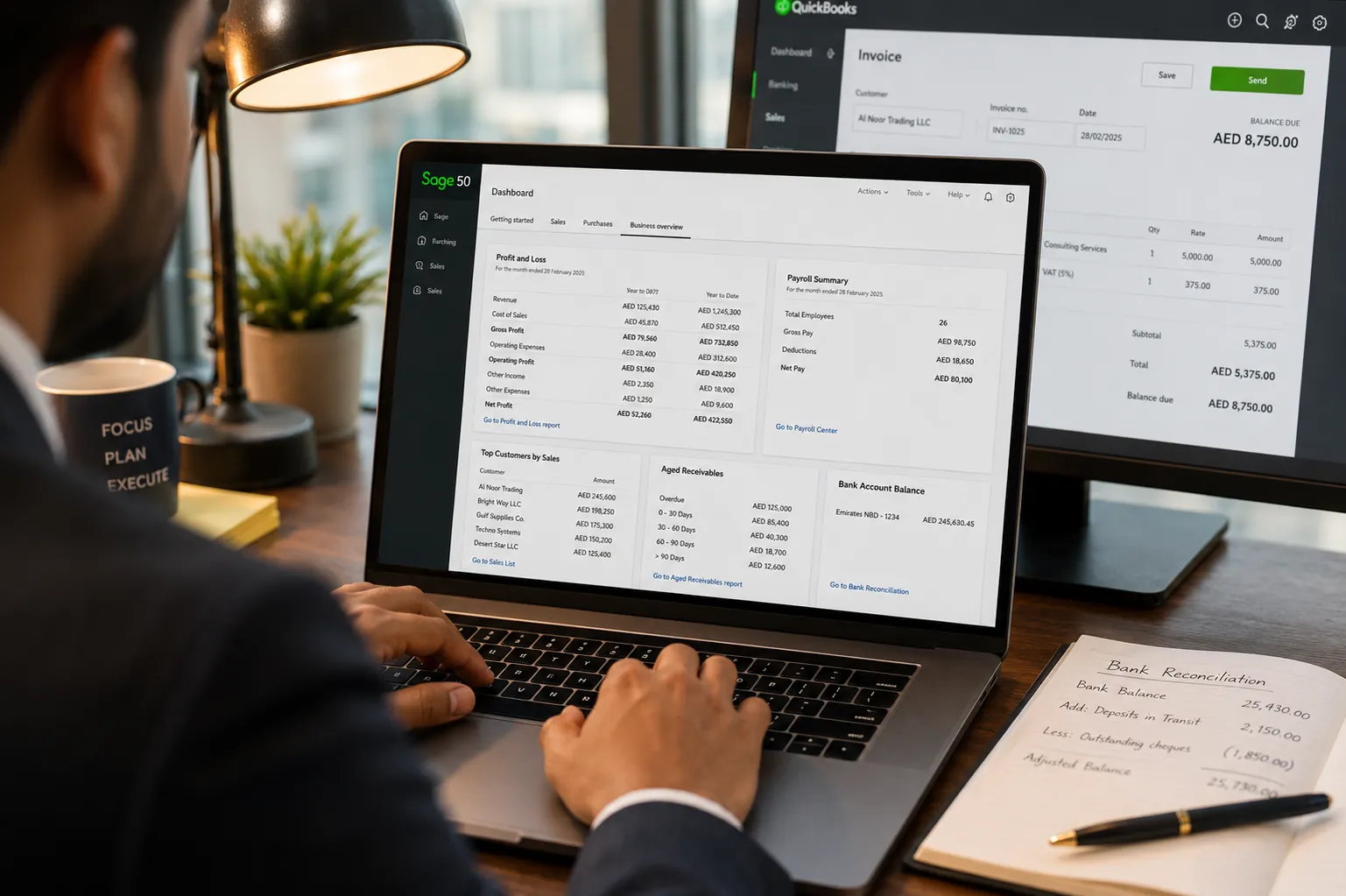
Here is what many job seekers underestimate: accounting software handles the recording and storage of transactions, but it rarely handles the deep analysis, custom reporting, and presentation that management actually wants to see. That gap is filled almost universally by Microsoft Excel — regardless of which core accounting software a company uses.
UAE employers expect accountants to be confident with:
Nearly every accounting job description in UAE — regardless of seniority — lists “Advanced Excel” as a required or strongly preferred skill. It is, in practice, the universal connective layer between whatever accounting software a company uses and the actual business decisions that data informs.
Since the UAE Federal Tax Authority consolidated its digital services onto the EmaraTax platform, direct portal familiarity has become an expected accounting skill — not just a “back office” task handled by tax consultants.
Accountants are now routinely expected to handle, or at minimum understand, the following EmaraTax functions:
Candidates who can speak confidently about EmaraTax during interviews — even at junior level — consistently stand out from those who only discuss accounting software. This skill pairs directly with broader UAE Corporate Tax knowledge, covered in depth in our تدريب ضريبة الشركات resources.
Use this checklist to identify exactly which skills you need at your current career stage, and which ones to prioritise next as you progress:
| Career Level | Software Skills Expected |
|---|---|
| Junior Accountant / Accounts Assistant (0–2 years) | ✔ One accounting platform (QuickBooks, Tally, or Sage 50) — transaction entry and basic reporting ✔ Basic Excel — formulas, simple PivotTables ✔ Awareness of VAT coding within the software |
| Accountant (2–5 years) | ✔ Confident, independent use of core accounting platform — full module range ✔ Intermediate-to-advanced Excel — XLOOKUP, PivotTables, conditional formatting ✔ EmaraTax — VAT return preparation and filing ✔ Bank reconciliation across software and Excel |
| Senior Accountant (5–8 years) | ✔ Multi-software fluency — at least 2 platforms (e.g., QuickBooks + Sage 50) ✔ Advanced Excel — financial modelling, variance analysis, dashboard building ✔ EmaraTax — full VAT and Corporate Tax filing management ✔ Exposure to ERP reporting modules (SAP/Oracle) is a strong advantage |
| Finance Manager / Controller (8+ years) | ✔ ERP system proficiency (SAP, Oracle, or Microsoft Dynamics) — expected, not optional ✔ Expert-level Excel — complex modelling, automation via Power Query ✔ Full EmaraTax compliance oversight across VAT and Corporate Tax ✔ Ability to evaluate and recommend software/system upgrades for the organisation |
Trying to learn every platform separately and sequentially wastes time. Here is the most efficient learning sequence for UAE job seekers, based on overlapping concepts and market demand:
Before any software makes sense, you need a working understanding of double-entry bookkeeping, the chart of accounts, and basic VAT principles. The CMCA (Certified Management Computerised Accountant) programme is specifically designed to teach manual accounting principles alongside computerised software training — making it one of the most efficient single courses for building both the conceptual foundation and the practical software skills simultaneously.
If you’re targeting service businesses, consultancies, or retail — start with QuickBooks. If you’re targeting trading or wholesale businesses — prioritise Tally Prime. If you’re targeting manufacturing or distribution — start with Sage 50. Most professionals can become functionally proficient in their first platform within 4–8 weeks of structured coursework.
Excel skills compound with every other tool you learn — strong Excel makes you faster and more capable in every accounting software platform. Dedicate consistent practice time to formulas, PivotTables, and reconciliation templates alongside your primary software training.
Once comfortable with your core software, spend time understanding the EmaraTax portal directly — even using the FTA’s public guidance documents and sample walkthroughs. Being able to discuss VAT and Corporate Tax filing processes confidently in an interview is a low-effort, high-impact addition to your skill set.
Once you have 1–2 years of experience and have mastered your first software platform, add a second one. Many job postings list two or more accepted platforms (“QuickBooks or Tally Prime experience required”) — being fluent in both significantly widens the roles you qualify for.
For a comprehensive route covering manual accounting, multiple software platforms, and UAE compliance together, explore Alifbyte’s full range of accounting courses in UAE.
Software skills are not just a hiring filter — they are a direct, quantifiable lever in salary negotiation. Here is how they typically play out across a UAE accounting career:
| Skill Combination | Negotiation Impact |
|---|---|
| Single accounting software only (e.g. QuickBooks) | Baseline market rate — meets minimum requirement only |
| Accounting software + Advanced Excel | +5–10% above baseline — meets the standard expected combination |
| Software + Excel + EmaraTax familiarity | +15–25% above baseline — strong differentiator at junior-mid level |
| Multi-software fluency (2+ platforms) + EmaraTax | +20–30% above baseline — strong mid-senior positioning |
| ERP experience (SAP/Oracle) added | Significant premium — opens multinational and large corporate roles |
⚠ Negotiation Tip
Don’t just list software names on your CV — quantify your impact. “Managed VAT filing for 3 entities using QuickBooks and EmaraTax, reducing reconciliation time by 40%” carries far more negotiating weight than “Proficient in QuickBooks.” UAE employers respond strongly to measurable, software-enabled outcomes during salary discussions.

Build the Software Skills UAE Employers Actually Pay For
Whether you’re starting your accounting career or upgrading your current skill set, Alifbyte’s hands-on courses in QuickBooks, Sage 50, and the CMCA give you exactly the software fluency UAE employers are hiring and paying for in 2026.
→ QuickBooks Training Course UAE
→ Sage 50 Accounting Course UAE
→ CMCA — Certified Management Computerised Accountant
UAE employers most commonly look for proficiency in QuickBooks, Tally Prime, Sage 50, and Advanced Microsoft Excel. Increasingly, familiarity with the EmaraTax portal for VAT and Corporate Tax filing is also expected. ERP knowledge (SAP, Oracle, Zoho Books) is valued for mid-to-senior roles and in larger organisations.
Both are highly valued, but their importance depends on industry. QuickBooks dominates service-based SMEs, consultancies, and retail. Tally Prime dominates trading, import-export, and wholesale businesses. Many job postings list both as desirable, so learning both widens your opportunities significantly.
Yes. Accounting software handles bookkeeping and ledger management, but Advanced Excel is still essential for financial analysis, reconciliations, custom reporting, and budgeting. Nearly every UAE accounting job description lists Advanced Excel as a required skill regardless of which accounting software the company uses.
EmaraTax familiarity has become increasingly important since UAE Corporate Tax came into effect in 2023. Accountants are now expected to handle VAT registration, VAT return filing, and Corporate Tax submission directly through the portal. Candidates who demonstrate EmaraTax proficiency in interviews have a clear advantage.
Demonstrated proficiency in core accounting software combined with EmaraTax and Advanced Excel skills can increase starting salary offers by 15–25% compared to candidates without these skills. At senior levels, ERP software experience (SAP, Oracle) can add a further premium.
Junior accountants are typically expected to know at least one accounting software platform for transaction entry, basic Excel skills (formulas, VLOOKUP, PivotTables), and basic awareness of VAT coding within their software. Building these three skills before applying significantly improves employability. The CMCA course is designed to build all three together.
Yes, particularly for those targeting mid-to-senior roles or multinational companies. ERP systems are standard in large corporations, government entities, and multinational subsidiaries in UAE. While not essential at junior level, ERP exposure becomes a significant career differentiator from 3–5 years of experience onward.
With a structured course, most learners become functionally proficient in any one platform within 4–8 weeks. Reaching advanced proficiency, including VAT and Corporate Tax reporting features, typically takes 2–3 months. Learning through an integrated course like CMCA is more time-efficient than learning platforms separately.
Yes, particularly for bookkeeping, accounts assistant, and junior accounting roles. UAE employers at this level often prioritise demonstrated software proficiency and accuracy over academic credentials. A professional certification combining software training with accounting principles, such as the CMCA, significantly improves employability without requiring a university degree.
Alifbyte Educational Institute offers dedicated courses in QuickBooks, Sage 50, and the CMCA, which combines multiple software platforms with manual accounting principles and UAE VAT compliance. Explore the full range of accounting courses available in Dubai and Sharjah with flexible scheduling for working professionals.
Also available in: دبي · الشارقة · أبوظبي · عجمان · رأس الخيمة · أم القيوين · الفجيرة