
Choosing from the many types of accounting software can feel overwhelming — spreadsheets, cloud apps, ERP suites, payroll tools — and picking wrong means wasted money, messy books, and VAT filings that don’t add up. Left unsolved, that confusion slows month-end close and puts compliance at risk. This guide fixes that: you’ll get all 10 types of accounting software explained in plain English, real examples, a comparison table, and a simple framework to choose (or learn) the right tool for 2026.
Popular tools like QuickBooks and Sage serve very different needs, so understanding the options is crucial. See our detailed Sage vs QuickBooks comparison and, if you work in the region, the accounting software skills UAE accountants need most. Tally is also hugely popular here — explore our Tally Prime guide and whether Tally or QuickBooks is better for an accounting career in Dubai.
Choosing the right software depends on your business size, industry, reporting needs, and budget.
| Software | Best For | Deployment | Key Features | Difficulty | Ideal Business Size |
|---|---|---|---|---|---|
| QuickBooks | SMEs & Startups | Cloud & Desktop | Invoicing, VAT, Expense Tracking, Reporting | Easy | Small to Medium Businesses |
| Xero | Remote Teams | Cloud | Bank Reconciliation, Multi-Currency, Integrations | Easy | Small to Medium Businesses |
| Tally Prime | Trading & Manufacturing | Desktop | Inventory Management, GST/VAT, Payroll | Medium | Small to Mid-Sized Businesses |
| Sage 50 | Growing Companies | Desktop & Cloud | Financial Reporting, Payroll, Inventory | Medium | Medium Businesses |
| Zoho Books | UAE SMEs | Cloud | Automation, VAT Compliance, CRM Integration | Easy | Small Businesses |
| FreshBooks | Freelancers | Cloud | Invoicing, Time Tracking, Client Billing | Easy | Freelancers & Consultants |
| SAP ERP | Large Enterprises | Cloud & On-Premise | Advanced Finance, Supply Chain, Analytics | Advanced | Large Organizations |
| Oracle NetSuite | Multi-Entity Businesses | Cloud | ERP, Financial Planning, Global Reporting | Advanced | Medium to Large Enterprises |
| Microsoft Dynamics 365 | Microsoft-Stack Firms | Cloud & On-Premise | GL, AP/AR, Budgeting, Office 365 Integration | Advanced | Mid to Large Enterprises |
| Odoo (Open-Source) | Custom / Budget Setups | Cloud & Self-Hosted | Modular Accounting, Invoicing, Inventory | Medium | Startups to Mid-Sized |
Learn Tally Prime, QuickBooks, Sage 50 & Advanced Excel at AlifByte — KHDA-accredited, UAE VAT-ready, with job-placement support.
Enrol in the Accounting Courses →If you’re starting an accounting career in the UAE, QuickBooks, Tally Prime, Sage 50, and Advanced Excel are the most requested skills by employers. Large organizations often need ERP experience (SAP or Oracle NetSuite), while freelancers lean on QuickBooks, FreshBooks, or Zoho Books. Not sure where to begin? Our guide on how to choose the right accounting course and the best accounting courses in Dubai for 2026 can help.

General accounting software is the backbone of financial management for businesses of every size, handling bookkeeping and general ledger, accounts payable/receivable, bank reconciliation, financial reporting, and basic inventory. If you’re new to the fundamentals, start with what bookkeeping is and the difference between a bookkeeper vs an accountant in the UAE.
QuickBooks remains one of the most widely used tools globally, especially for SMEs — it’s a must-have skill for modern accountants. New to it? Follow our guide on how to learn QuickBooks as a beginner, or get certified with AlifByte’s QuickBooks training.
Sage 50 offers strong inventory and job-costing features for construction, manufacturing, and distribution. Learn the common challenges in Sage 50 and how to overcome them, or master it with AlifByte’s Sage 50 course.
Xero is a cloud-first platform known for unlimited users, multi-currency support, and slick bank reconciliation — ideal for remote and collaborative teams.
Some industries need purpose-built tools. Manufacturing requires bill of materials, WIP tracking, and raw-material inventory (IQMS, Fishbowl, JobBOSS). Healthcare needs insurance billing, patient payments, and HIPAA compliance — which is why career opportunities in medical coding and the medical coder salary in the UAE are rising. Construction relies on job costing and progress billing (Jonas, Foundation, Viewpoint).

For larger organizations, accounting lives inside a broader ERP that runs the whole business. SAP covers financial and management accounting, treasury, and risk. Oracle NetSuite suits multi-entity, international, e-commerce-heavy operations. Microsoft Dynamics 365 adds general ledger, AP/AR, fixed assets, and budgeting with tight Office 365 integration. (This is one of the most searched distinctions online — see the FAQ on ERP vs accounting software below.)
Tax compliance is critical in the UAE. With VAT and corporate tax now in force, dedicated tax tools are essential. Build the skills with UAE VAT training and corporate tax training — start with our beginner’s guide to corporate tax training and the practical walkthrough on how to file a UAE corporate tax return.
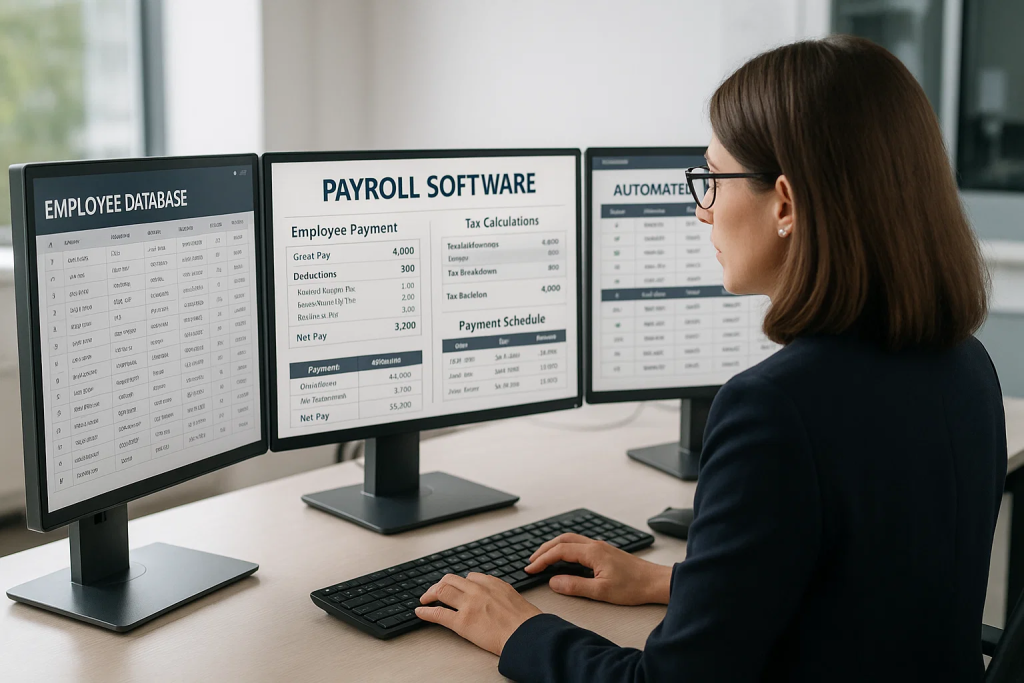
Payroll tools automate salaries, tax withholdings, and benefits — with automated calculations, direct deposit, self-service portals, leave management, and compliance reporting. This includes standalone apps (Gusto, ADP) and payroll modules inside larger suites.
Expense tools streamline tracking, approvals, and reimbursements: mobile receipt capture, policy enforcement, approval workflows, accounting-system integration, and spend analytics. Popular options include Expensify, Concur, and Zoho Expense.
Service businesses often need more than a general ledger: recurring billing, time-tracking, client payment portals, custom templates, and multi-currency/tax handling. Think FreshBooks, Invoice2go, and Zoho Invoice — and with UAE e-invoicing rolling out, consider e-invoicing training to stay compliant.
Project-based firms track finances by project and organization: budgeting/forecasting, resource costing, milestone billing, profitability analysis, and time/expense by project. Many smaller teams still run this in Excel — level up with top Excel skills for accountants, Excel for accounting purposes, and Power Query. For automation-minded accountants, Python for accounting is a growing edge.
Non-profits, government agencies, and schools need fund accounting that tracks money by donor or grant restriction: fund segregation, grant tracking, encumbrance accounting, FASB/GASB reporting, and donor management (Blackbaud Financial Edge, MIP, Sage Intacct).
Small businesses want the sweet spot of affordability, simplicity, scalability, tax compliance, and basic inventory. Even non-finance staff benefit — see why non-accountants should learn basic accounting and why every professional should understand basic accounting principles. AlifByte’s accounting for non-accounting professionals course is built exactly for this.
Beyond function, the types of accounting software also split by how they run:
Prefer a structured path? Our manual vs computerized accounting guide explains both approaches.
Today’s accountants blend financial knowledge with software fluency: proficiency in at least one core platform (QuickBooks, Sage, Tally), strong MS Excel for accounting (see how to learn it and fixing nested IF errors), and data tools like Power BI and data analytics. Standards matter too — brush up on IFRS vs GAAP.
Software skill directly affects pay: see the accountant salary in Dubai, the ACCA salary in Dubai, how to start an accounting career in the UAE, and career paths after a Tally course. Aiming higher? The CMCA certification and practical financial reporting specialist programs are strong next steps.
Accounting software has grown from simple bookkeeping into full financial ecosystems. Knowing the types of accounting software — and which fits your industry, size, and compliance needs — is now essential for both businesses and professionals. In the UAE’s competitive market, software proficiency directly shapes career prospects and earning potential.
Whether you’re picking a tool for your business or upskilling your career, explore AlifByte’s accounting courses — KHDA-accredited, UAE VAT-ready, with job-placement support.
Got questions about the types of accounting software? Here are the answers our experts at AlifByte get asked most.
Talk to an AlifByte advisor and get a personalised learning path for your accounting career in the UAE.
Thousands of finance professionals in the UAE have boosted their careers with AlifByte’s training. Join the next batch — Tally Prime, QuickBooks, Sage 50, Zoho Books & more.