


Choosing between English proficiency tests feels overwhelming when your academic future hangs in the balance. Thousands of students waste months preparing for the wrong exam, discovering too late that their target university prefers the alternative test. This costly mistake delays admissions, drains financial resources, and creates unnecessary stress during an already challenging application process.
The wrong test choice means retaking exams, extending preparation timelines, and potentially missing application deadlines that could derail your education plans entirely. Understanding TOEFL and IELTS differences ensures you invest your time and money wisely, maximizing your chances of achieving the scores needed for your specific goals.
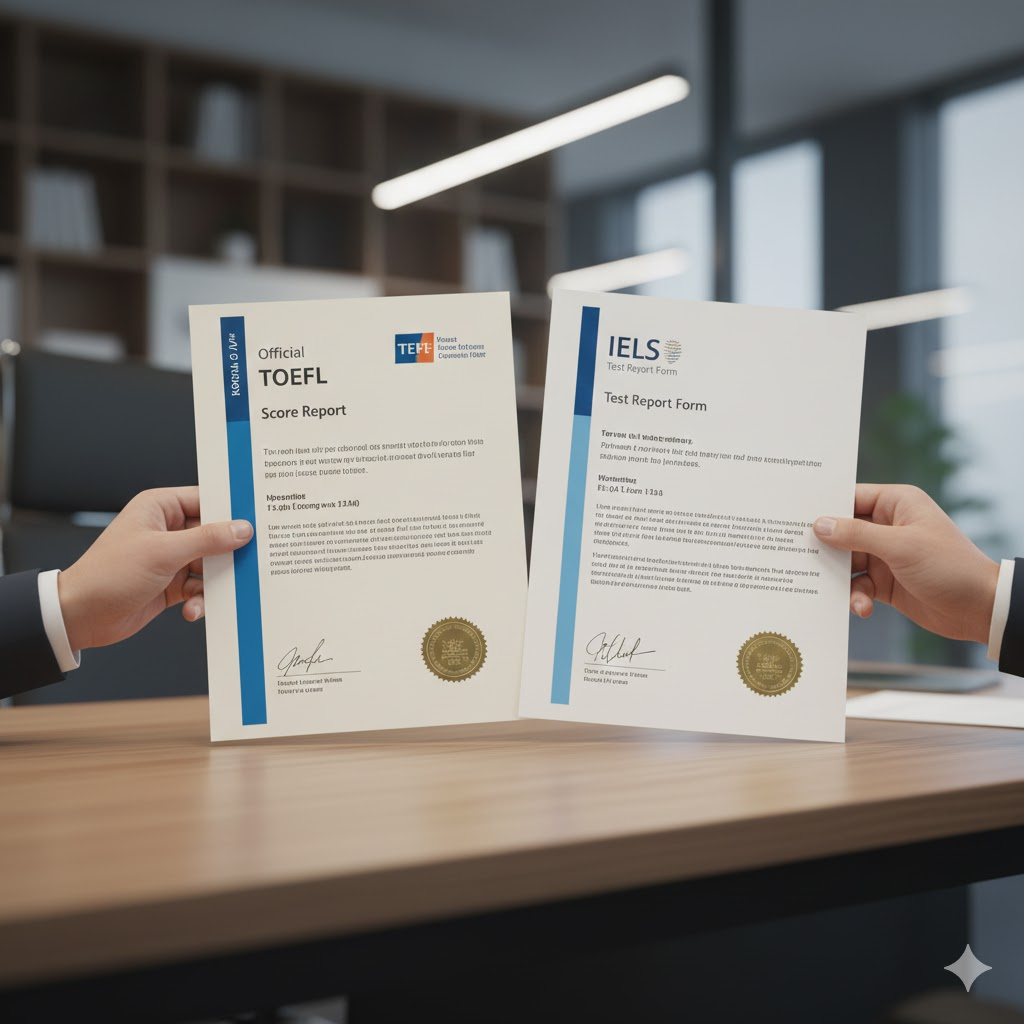
The Test of English as a Foreign Language (TOEFL) serves as the standardized assessment developed by Educational Testing Service (ETS) to evaluate English language proficiency for non-native speakers. Primarily designed for academic contexts, TOEFL measures your ability to understand and use English in university settings, making it the preferred choice for North American institutions.
TOEFL iBT (Internet-Based Test) represents the most common format, administered entirely on computer at authorized testing centers worldwide. The test evaluates four core language skills through integrated tasks that mirror actual academic scenarios students encounter in English-speaking universities. This computer-based approach provides consistent testing conditions and rapid score reporting, typically delivering results within 6 days of your test date.
The exam’s academic focus means reading passages come from university-level textbooks, listening materials include lectures and campus conversations, and writing tasks require synthesizing information from multiple sources. This authentic academic content helps universities assess whether candidates possess sufficient English skills to succeed in their programs without requiring additional language support.
TOEFL’s global reach extends to over 11,500 institutions across 160+ countries, with more than 150 test centers operating throughout the UAE alone. This widespread availability makes scheduling convenient for test-takers in major emirates like Dubai, Abu Dhabi, and Sharjah, with multiple test dates offered throughout the year.
The International English Language Testing System (IELTS) functions as a comprehensive English proficiency assessment jointly managed by the British Council, IDP: IELTS Australia, and Cambridge Assessment English. Unlike TOEFL’s predominantly academic focus, IELTS offers two distinct versions addressing different purposes: Academic and General Training.
IELTS Academic targets students applying to undergraduate and postgraduate programs at English-speaking universities, evaluating language skills necessary for academic success. The test content reflects typical university scenarios including lectures, seminars, textbooks, and academic discussions that students regularly encounter during their studies.
IELTS General Training serves individuals migrating to English-speaking countries for work or immigration purposes, assessing practical everyday English skills. This version includes workplace scenarios, social situations, and general interest topics more relevant to daily life than academic environments.
The test combines computer-delivered and paper-based options depending on location and test center capabilities, though the Speaking section always occurs face-to-face with a certified examiner. This human interaction element distinguishes IELTS from TOEFL’s fully automated speaking assessment, appealing to candidates who prefer personal conversation over speaking into a microphone.
IELTS enjoys particularly strong recognition in the United Kingdom, Australia, New Zealand, and increasingly across Canadian institutions. The test’s acceptance has grown significantly in recent years, with over 11,000 organizations worldwide recognizing IELTS scores for admissions, immigration, and professional registration purposes.

TOEFL operates entirely through computer-based testing, requiring all sections including speaking to be completed at a computer terminal. Test-takers type written responses, click multiple-choice answers, and record spoken responses through a headset microphone. This fully digital approach ensures standardized conditions but requires comfort with typing and computer navigation under timed pressure.
IELTS offers format flexibility with both paper-based and computer-delivered options for Reading, Listening, and Writing sections. However, the Speaking test always occurs as a face-to-face conversation with a trained examiner in a separate room, creating a more personal interactive experience. Some candidates find this human element less intimidating than speaking to a computer, while others prefer TOEFL’s automated consistency.
The listening experience differs significantly between tests. TOEFL requires answering questions while simultaneously listening to lectures and conversations, with note-taking permitted throughout. IELTS provides the complete audio first, followed by dedicated time to answer questions, reducing the multitasking demand but requiring stronger short-term memory retention.
TOEFL requires approximately 3 hours to complete all four sections in a single sitting, with a mandatory 10-minute break between Reading/Listening and Speaking/Writing sections. The continuous testing format demands sustained concentration and stamina, particularly challenging for test-takers unaccustomed to extended computer work.
IELTS totals approximately 2 hours and 45 minutes, though the Speaking section may occur on a different day depending on test center scheduling. This potential separation allows candidates to focus entirely on one skill area at a time, reducing mental fatigue but requiring multiple trips to the test center in some locations.
Section timing also varies considerably. TOEFL allocates 54-72 minutes for Reading (3-4 passages), 41-57 minutes for Listening (3-4 lectures, 2-3 conversations), 17 minutes for Speaking (4 tasks), and 50 minutes for Writing (2 tasks). IELTS provides 60 minutes for Reading (3 passages), 30 minutes for Listening (4 sections), 11-14 minutes for Speaking (3 parts), and 60 minutes for Writing (2 tasks).
TOEFL emphasizes multiple-choice questions throughout Reading and Listening sections, with some sentence insertion and summary tasks requiring deeper comprehension. This format favors test-takers skilled at eliminating wrong answers and making educated guesses when uncertain, as TOEFL doesn’t penalize incorrect responses.
IELTS incorporates diverse question types including multiple-choice, matching, sentence completion, diagram labeling, short answers, and true/false/not given statements. This variety requires different skills and strategies for each question type, potentially challenging students who struggle with format transitions but offering multiple opportunities to demonstrate comprehension.
Speaking task structures reveal fundamental philosophical differences. TOEFL’s Speaking section requires responses to integrated tasks combining reading and listening stimuli, with answers recorded and evaluated by multiple trained raters. IELTS Speaking proceeds as a natural conversation covering personal topics, descriptive tasks, and abstract discussions, assessed immediately by the interviewer based on detailed criteria.
Writing requirements diverge similarly. TOEFL’s integrated writing task demands synthesizing information from a reading passage and lecture, while the independent task requires developing a position on a general topic. IELTS Academic Writing Task 1 involves describing visual information (graphs, charts, diagrams), and Task 2 presents an argumentative essay similar to TOEFL’s independent writing.
For students seeking comprehensive preparation strategies, exploring resources on how to improve TOEFL scores provides valuable insights applicable to test-taking success across various formats.
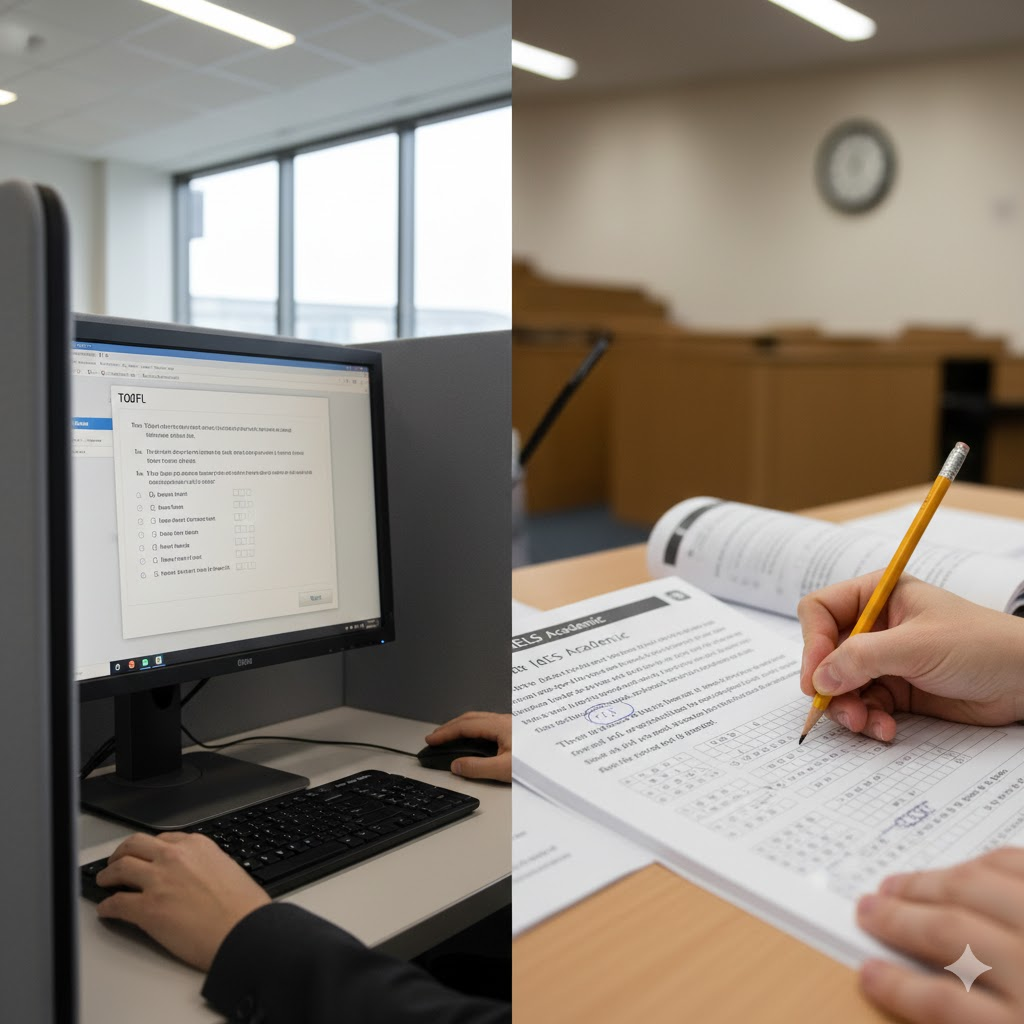
TOEFL Reading presents 3-4 academic passages totaling approximately 700 words each, covering topics from natural sciences, social sciences, arts, and humanities. Questions assess literal comprehension, inference ability, vocabulary in context, and text organization understanding. The computer interface allows highlighting text and eliminating answer choices, with previous questions inaccessible once you proceed forward.
IELTS Reading includes 3 passages of increasing difficulty, with 40 questions total requiring various response types. Academic passages come from books, journals, magazines, and newspapers, featuring descriptive, factual, discursive, and analytical content. The paper-based format permits writing on the test booklet, underlining passages, and jumping between questions freely, though computer-delivered versions restrict this flexibility.
Time management challenges differ considerably. TOEFL’s 54-72 minute allocation for Reading means approximately 18 minutes per passage, though the system doesn’t enforce per-passage timing. IELTS provides exactly 60 minutes for all three passages with no additional transfer time, requiring strict self-pacing to complete all questions adequately.
Vocabulary demands vary between tests. TOEFL includes dedicated vocabulary questions testing academic word knowledge, while IELTS embeds vocabulary assessment within comprehension questions. Both require strong academic vocabulary, though IELTS occasionally includes more British English terms and spellings that may challenge test-takers more familiar with American English.
TOEFL Listening incorporates 3-4 academic lectures (3-5 minutes each) and 2-3 conversations (2-3 minutes each), totaling 41-57 minutes including question response time. Note-taking is permitted and encouraged, as test-takers cannot replay audio segments. Questions appear after each listening passage, requiring recall of specific details, main ideas, speaker attitudes, and implied meanings.
IELTS Listening contains 4 sections with 10 questions each, progressing from easier to more difficult. Sections 1 and 2 feature social contexts (phone conversations, everyday situations), while Sections 3 and 4 present academic scenarios (student discussions, university lectures). Test-takers hear recordings only once but receive time before each section to preview questions, during the recording to answer, and afterward to review responses.
Accent variety represents another distinction. TOEFL predominantly uses North American accents (American and Canadian), occasionally including British accents. IELTS intentionally incorporates diverse English accents from Britain, Australia, New Zealand, North America, and other regions, reflecting global English usage but potentially challenging students trained primarily with one accent variety.
The practical difference in difficulty often relates to multitasking demands. TOEFL requires simultaneous listening, note-taking, and mental processing without seeing questions beforehand. IELTS allows previewing questions first, enabling focused listening for specific information, though the single-play policy demands concentrated attention throughout.
TOEFL Speaking comprises 4 tasks completed in 17 minutes: 1 independent task expressing personal opinions and 3 integrated tasks combining reading/listening with spoken responses. Preparation time ranges from 15-30 seconds, with response time of 45-60 seconds per task. Responses record through a headset microphone and undergo evaluation by multiple certified raters using standardized rubrics.
IELTS Speaking unfolds as an 11-14 minute face-to-face conversation with a certified examiner covering three parts: introduction and familiar topics (4-5 minutes), individual long turn with topic card (3-4 minutes including 1 minute preparation), and two-way discussion exploring abstract ideas (4-5 minutes). The examiner assesses fluency, vocabulary range, grammatical accuracy, and pronunciation in real-time.
The psychological experience differs dramatically. TOEFL’s computer-based format eliminates human interaction but may feel impersonal and awkward speaking into a microphone in a room with other test-takers simultaneously recording responses. IELTS’s conversation format feels more natural but introduces variability based on examiner personality and the dynamic created during the interaction.
Preparation approaches vary accordingly. TOEFL Speaking preparation focuses on structured response templates, time management, and clear articulation into recording equipment. IELTS preparation emphasizes conversation skills, extended discourse ability, and adapting to unexpected follow-up questions in the interactive discussion.
TOEFL Writing includes 2 tasks completed in 50 minutes: Integrated Writing (20 minutes) requiring synthesis of reading passage and lecture content, and Independent Writing (30 minutes) developing an argumentative essay. Both responses must be typed, with word count targets of 150-225 and 300+ words respectively. Spelling, grammar, organization, and development receive evaluation alongside content quality.
IELTS Academic Writing also contains 2 tasks in 60 minutes: Task 1 (20 minutes, 150+ words) describing visual information such as graphs, charts, tables, or diagrams, and Task 2 (40 minutes, 250+ words) presenting an argumentative essay. Test-takers write by hand in paper-based exams or type in computer-delivered versions, with Task 2 weighted twice as heavily in the final Writing score.
The fundamental skill differences matter for preparation. TOEFL’s integrated task tests summarization and comparison abilities alongside writing mechanics, while IELTS Task 1 requires data interpretation and trend description skills. Both independent/Task 2 essays demand similar argumentative writing abilities, though IELTS questions occasionally require more specific position-taking on contemporary issues.
Typing speed significantly impacts TOEFL performance, as handwriting is not permitted. Students uncomfortable with keyboard composition face disadvantages in expressing complex ideas within time constraints. IELTS offers choice between handwriting and typing depending on test format selected, though handwriting requires legibility for accurate scoring.
Students looking to enhance their English communication abilities across all skill areas might benefit from comprehensive spoken English courses that build foundational fluency supporting test performance.

TOEFL employs a 0-120 point scale combining scores from four sections: Reading (0-30), Listening (0-30), Speaking (0-30), and Writing (0-30). Each section receives independent scoring, with the total score representing a simple sum of sectional scores rather than a weighted average. This straightforward calculation makes score interpretation relatively simple for institutions and test-takers alike.
Universities typically establish minimum total score requirements alongside minimum sectional scores ensuring balanced proficiency across all skills. Common requirements range from 80-100 total score for undergraduate programs and 90-110 for graduate programs, with competitive institutions demanding higher thresholds. Sectional minimums frequently require 20-25 points in each area, preventing students from compensating for weak speaking skills with strong reading abilities.
Score validity extends for two years from the test date, after which institutions no longer accept the scores for admissions or placement purposes. This limited validity reflects ETS’s position that language skills may deteriorate without regular use, requiring recent assessment for accurate proficiency evaluation.
The scoring rubrics emphasize different criteria across sections. Reading and Listening evaluate comprehension accuracy through automated scoring of multiple-choice responses. Speaking and Writing undergo human evaluation based on detailed rubrics assessing task completion, coherence, language use, and delivery quality, with multiple raters reviewing each response to ensure consistency.
IELTS uses a 9-band scoring scale with half-point increments (e.g., 6.5, 7.0, 7.5), providing more granular differentiation than TOEFL’s integer scoring. Each section receives an individual band score, with the overall band calculated as the average of the four sectional scores, rounded to the nearest half band.
The rounding system sometimes creates surprising results. For example, sectional scores of 6.5, 6.5, 7.0, and 7.0 average to 6.75, which rounds to 7.0 overall. Understanding this rounding mechanism helps set realistic score targets based on your strengths and weaknesses across different skills.
Band descriptors provide detailed explanations of proficiency levels, with Band 9 representing expert user, Band 7 indicating good user, Band 6 showing competent user, and lower bands reflecting decreasing proficiency. Most universities require minimum overall bands of 6.0-7.5, with individual sectional requirements often set at similar or slightly lower levels.
Score validity also lasts two years, consistent with TOEFL’s policy. Test-takers receive a Test Report Form displaying individual and overall band scores, issued 13 days after the test date for paper-based exams and 3-5 days for computer-delivered tests.
The half-band precision allows more subtle distinctions between candidates than TOEFL’s whole number scoring. However, this precision sometimes creates confusion when converting between TOEFL and IELTS scores for institutions accepting either test, as direct equivalencies remain approximate rather than exact.
Approximate conversions suggest TOEFL 94-101 equals IELTS 7.0, TOEFL 79-93 corresponds to IELTS 6.5, and TOEFL 60-78 matches IELTS 6.0. However, these equivalencies vary by institution and purpose, with no official universal conversion table. Some universities establish their own equivalency standards, potentially creating discrepancies in how they evaluate similar proficiency levels across different tests.
Individual section comparisons prove even more complex, as question types, scoring criteria, and skill emphases differ substantially between tests. A student scoring 25 on TOEFL Reading may not necessarily achieve the equivalent IELTS Reading band, depending on their specific strengths in different question formats and content types.
Understanding your target institution’s specific requirements remains crucial rather than relying on general conversion tables. Some programs accept either test but establish different minimum scores for each, reflecting their assessment of which test better predicts student success in their particular academic environment.
TOEFL dominates North American acceptance, with virtually all U.S. and Canadian universities recognizing TOEFL scores for admissions decisions. American institutions particularly prefer TOEFL due to its development by U.S.-based ETS and its focus on American English and academic contexts familiar to their programs.
IELTS enjoys stronger recognition in the United Kingdom, Australia, New Zealand, and throughout Europe, where British English and Commonwealth educational systems predominate. UK universities overwhelmingly prefer IELTS, though most now also accept TOEFL. Australian immigration specifically requires IELTS for visa applications, making it mandatory for students planning to work while studying in Australia.
The Middle East and Asia show mixed preferences, with institutions in the UAE accepting both tests equally. Many universities in Dubai, Abu Dhabi, and Sharjah establish equivalent minimum requirements for TOEFL and IELTS, allowing students to choose based on personal preference and test format compatibility rather than institutional mandate.
Increasingly, global universities accept both tests, though they may establish different score thresholds reflecting perceived difficulty or equivalency differences. Checking specific institutional requirements for your target programs ensures you select the test most aligned with their evaluation preferences.
Beyond academic admissions, both tests serve professional registration and immigration purposes, though acceptance varies by country and profession. IELTS particularly dominates immigration applications for the UK, Australia, Canada, and New Zealand, where it’s often the only accepted English proficiency proof for visa applications.
Professional bodies including medical boards, nursing councils, and engineering associations may specify one test over another for licensure purposes. Healthcare professionals migrating to English-speaking countries particularly encounter IELTS requirements, with specialized versions like OET (Occupational English Test) sometimes preferred for medical contexts. For healthcare professionals, exploring OET preparation resources may provide more targeted training for medical English proficiency.
Canadian immigration through Express Entry and Provincial Nominee Programs accepts both IELTS General Training and CELPIP (Canadian English Language Proficiency Index Program), with TOEFL generally not accepted for immigration purposes despite its acceptance for academic admissions.
Understanding your long-term goals beyond immediate academic plans helps select the most versatile test. Students planning potential immigration or professional registration after completing their studies should research relevant requirements early to avoid needing multiple English proficiency tests.
Students who excel at reading comprehension, process information better through text, and feel comfortable with computer-based testing generally find TOEFL more aligned with their strengths. The heavily multiple-choice format allows strategic test-taking approaches including process of elimination and educated guessing.
TOEFL’s integrated tasks requiring reading and listening together suit learners who can synthesize information from multiple sources simultaneously. The computer interface provides tools like highlighting and note-taking that organized, methodical students can leverage effectively.
However, visual learners who struggle with sustained computer screen time or experience digital fatigue may find TOEFL’s 3-hour continuous computer testing mentally exhausting. Those who prefer seeing the full test layout and jumping between questions flexibly might feel constrained by TOEFL’s section-by-section progression.
IELTS appeals to students who learn better through listening and conversation, particularly those comfortable with face-to-face interactions. The Speaking section’s conversational format suits individuals who think better on their feet during dialogue than when speaking into a recording device.
The diverse question types throughout IELTS Reading and Listening sections engage students who appreciate variety and become bored with repetitive multiple-choice formats. Those with strong short-term memory who can retain detailed information from single listening plays may find IELTS Listening more manageable than TOEFL’s note-taking demands.
Students preferring paper-based testing benefit from IELTS’s option to physically write on test materials, circle answers, and strategize spatially across the exam booklet. This tactile engagement helps some learners organize thoughts and manage time more effectively than purely digital interfaces.
TOEFL’s predictable structure and consistent question patterns suit analytical students who prefer clear frameworks and systematic approaches. The ability to practice extensive question banks with familiar formats helps these learners optimize performance through repeated exposure and refinement.
The objective, algorithm-scored sections (Reading and Listening) appeal to students who want transparent scoring criteria without subjective human judgment variability. Knowing that computers evaluate your multiple-choice responses identically regardless of when or where you test provides reassurance about fair assessment.
Conversely, students who think more flexibly and adapt well to varied situations may appreciate IELTS’s diverse question types and human interaction elements. Those who perform better in conversations than prepared speeches often excel in IELTS Speaking compared to TOEFL’s recorded response format.
Students with strong sustained concentration who perform well during extended testing sessions may prefer TOEFL’s single-sitting format that completes everything in one day. The 10-minute break provides brief recovery time before the second half, though the overall 3-hour duration demands significant mental endurance.
Those who prefer focusing on fewer tasks at once might choose IELTS’s potentially split format, particularly when Speaking occurs separately from the other sections. This division allows complete attention to specific skills without the fatigue accumulation from testing all four areas consecutively.
Typing speed significantly impacts TOEFL performance in ways that handwriting speed affects paper-based IELTS differently. Fast, accurate typists gain substantial advantages on TOEFL Writing, while slower keyboard users struggle to express complex ideas within tight timeframes. IELTS handwriting, while potentially slower than typing for some, allows more personal expression and natural thought flow for others.
For students seeking to develop well-rounded English communication abilities that transcend specific test requirements, comprehensive advanced English courses build the deep proficiency that makes any test format manageable.

TOEFL registration costs vary by country but typically range from $180-$300 USD, with UAE centers charging approximately $245 USD (900 AED). This fee covers the test administration, score reporting to four institutions of your choice, and online score access. Additional score reports sent to institutions beyond the initial four cost $20 each.
IELTS fees also vary geographically, with UAE registration approximately $275-$290 USD (1,010-1,065 AED) depending on whether you choose paper-based or computer-delivered format. The fee includes the test, Test Report Form delivery, and online score access. Additional Test Report Forms cost approximately $14 each for extra copies sent to institutions.
Late registration fees, test date changes, and test center changes incur additional charges for both exams. TOEFL charges $40 for registration within 3 days of the test date and $60 for rescheduling within 3 days. IELTS similarly charges premium fees for changes made close to the test date, varying by test center and timing.
These costs exclude preparation materials, courses, and practice tests that many students purchase to maximize performance. Budgeting for comprehensive preparation often doubles or triples the total investment when including study resources, practice exams, and potentially tutoring or courses.
TOEFL offers extensive test center availability throughout the UAE, with locations in Dubai, Abu Dhabi, Sharjah, and other major cities conducting regular test sessions. Weekend and weekday options provide flexibility for working professionals and students balancing other commitments. The computer-based format allows frequent testing dates, sometimes with multiple sessions per week at major centers.
IELTS test centers similarly operate throughout the UAE, offering both paper-based and computer-delivered options depending on location. Test dates occur multiple times monthly, though paper-based sessions may have less frequent scheduling than computer-delivered options. Major cities provide more date flexibility than smaller locations where testing occurs less regularly.
Both tests allow online registration through official websites, with test center selection, date preference, and payment processing completed digitally. Registration typically opens months in advance, with popular dates and locations filling quickly during peak application seasons (typically September-December for spring admissions).
TOEFL permits unlimited retakes but enforces a 3-day waiting period between test attempts. This policy allows motivated students to test repeatedly until achieving desired scores, though each attempt requires full fee payment. Strategic retaking can focus improvement efforts on specific weak sections while maintaining strong performances in other areas.
IELTS imposes no formal restrictions on retake frequency or waiting periods, allowing students to register for any available test date regardless of previous attempts. However, the logistics of testing preparation and score processing practically limit how frequently most students realistically retake the exam.
Neither test formally indicates on score reports how many times you’ve taken the exam, though institutions receiving multiple score reports can infer repeated attempts. Most universities accept your highest scores across all attempts, either considering total scores or sometimes allowing “superscoring” that combines best sectional performances from different test dates.
The financial implications of retaking deserve consideration. Multiple attempts at $245-$290 per test quickly escalate total costs, making thorough initial preparation more economical than repeated testing with inadequate preparation. Investing in quality study materials and potentially professional instruction often proves more cost-effective than multiple test attempts.
Adequate preparation typically requires 2-4 months of consistent study for students with intermediate English proficiency targeting competitive scores. Those with stronger baseline skills might achieve target scores with 1-2 months of focused preparation, while students with foundational language gaps may need 6+ months of comprehensive English development before test-specific preparation.
Daily study commitments vary based on starting proficiency and target scores, but most successful test-takers dedicate 1-3 hours daily to structured preparation. This includes practice exercises, vocabulary building, skill development, and regular timed practice tests simulating actual exam conditions.
The preparation timeline should account for score reporting delays when planning test dates relative to application deadlines. TOEFL scores arrive within 6 days but may take longer to reach institutions through official reporting. IELTS paper-based results require 13 days, while computer-delivered scores arrive within 3-5 days. Building buffer time prevents missed deadlines due to processing delays.
Official preparation materials from ETS (for TOEFL) and the British Council/IDP/Cambridge (for IELTS) provide the most authentic practice experiences, using actual retired test questions or items developed by the test creators. These materials accurately reflect current test formats, difficulty levels, and scoring criteria, making them essential components of effective preparation.
TOEFL Official Guide, TOEFL Practice Online, and TOEFL Go! Official App offer comprehensive official resources including practice tests, sample responses with scoring explanations, and skill-building exercises. Free resources available through the ETS website supplement these paid materials with sample questions and video tutorials.
IELTS offers Official Cambridge IELTS practice books (volumes 1-18+), Road to IELTS online preparation, and IELTS Progress Check scored practice tests. The British Council, IDP, and Cambridge websites provide free practice materials including sample tests, video tutorials, and scoring criteria explanations.
Third-party preparation materials from publishers like Kaplan, Barron’s, Manhattan Prep, and Princeton Review offer additional practice volume and alternative explanations that some students find helpful. However, quality varies significantly, with some materials presenting questions that don’t accurately reflect actual test difficulty or format. Combining official materials with carefully selected third-party resources provides comprehensive preparation while maintaining authenticity.
Formal preparation courses offer systematic instruction, expert guidance, and structured learning paths that independent study sometimes lacks. Experienced instructors identify common weaknesses, provide targeted feedback, and share proven strategies that accelerate improvement beyond self-directed preparation.
Group courses create accountability through regular class attendance, homework assignments, and progress monitoring that helps maintain study momentum. Interaction with fellow test-takers provides motivation, collaborative learning opportunities, and emotional support during the challenging preparation process.
One-on-one tutoring delivers personalized attention addressing your specific weaknesses and learning style preferences. Private instruction allows flexible pacing, customized practice focus, and immediate feedback that group settings cannot match, though at significantly higher cost than group courses.
For students in the UAE seeking comprehensive preparation, enrolling in specialized IELTS training programs or TOEFL courses provides structured learning environments with experienced instructors familiar with local student needs and target score requirements.
Begin by researching specific requirements for every institution and program on your target list. Create a spreadsheet documenting minimum total scores, sectional requirements, and test preferences for each program. This comprehensive mapping reveals whether one test serves all your applications or if specific programs mandate particular tests.
Consider application timelines and how test date availability aligns with your deadlines. If applying for spring admission with November deadlines, ensure your selected test offers sufficient dates in September-October allowing time for score reporting and potential retakes if necessary.
Geographic considerations matter when planning international education. Students targeting primarily North American institutions may find TOEFL slightly advantageous given its development context and widespread U.S. acceptance. Those focusing on UK, Australian, or European programs might prefer IELTS’s stronger recognition in those regions.
Take official practice tests for both TOEFL and IELTS under timed conditions to directly compare your performance across formats. This empirical approach removes guesswork, revealing which test naturally aligns better with your current skills and test-taking preferences.
Analyze your results section by section, identifying where format differences impact your performance. Perhaps you excel at IELTS Reading’s varied question types but struggle with TOEFL’s longer passages. Maybe you find TOEFL Listening’s note-taking approach easier than IELTS’s preview-and-focus method.
Consider your comfort level with technology and typing versus handwriting. If computer-based testing feels unnatural or you type slowly with frequent errors, IELTS’s paper-based option might yield better results. Conversely, strong typing skills and comfort with digital interfaces make TOEFL’s format less intimidating.
Reflect on the Speaking section formats honestly. Do you prefer structured prepared responses or conversational flexibility? Does face-to-face interaction energize or intimidate you? These psychological factors significantly influence performance beyond pure English proficiency.
Calculate total costs including registration fees, preparation materials, courses, and potential retakes. If budget constraints exist, factor in which test requires less preparation investment based on your natural strengths. Sometimes choosing the test format you’ll likely pass on the first attempt proves more economical than selecting the slightly preferred test requiring multiple attempts.
Access to quality preparation resources varies by location and test. UAE students generally find abundant IELTS preparation options given the test’s regional popularity, while TOEFL materials also enjoy widespread availability through online platforms and local bookstores. Both tests offer robust official preparation materials accessible regardless of geographic location.
Free preparation resources differ in quantity and quality between tests. TOEFL provides extensive free practice through the official app and website, while IELTS offers free materials through British Council, IDP, and Cambridge platforms. Evaluate which free resources best match your learning style before investing in paid materials or courses.
For students with balanced skills across all four areas, choose based on institutional preferences and test format comfort. If your target schools equally accept both tests, select whichever format feels more natural during practice sessions.
Students with stronger reading and writing skills relative to speaking may find TOEFL’s computer-based speaking less intimidating than IELTS’s face-to-face conversation. Conversely, strong conversational skills and interpersonal comfort favor IELTS Speaking success.
Those with excellent listening skills but weaker reading abilities might prefer IELTS’s shorter reading passages and varied question types over TOEFL’s longer, more complex texts. Test your actual performance rather than assuming which format suits you better.
Consider preparing for both tests simultaneously if time and resources permit, then taking official practice tests for each before committing to one for your actual exam. This dual preparation ensures you understand both formats and can make an informed decision based on real performance data.
If achieving your target score proves challenging on your first choice test, don’t hesitate to switch to the alternative. Many successful students initially prepared for one test before discovering the other format better suited their skills, ultimately achieving higher equivalent scores on their second-choice test.
Neither test is objectively easier; difficulty depends entirely on individual strengths and weaknesses. TOEFL’s multiple-choice format favors students comfortable with process of elimination strategies and computer-based testing. IELTS’s varied question types and face-to-face speaking suit those who excel in conversational settings and prefer diverse task formats. Take practice tests for both exams to determine which format naturally aligns with your skills.
Yes, you can take both tests and submit whichever scores better serve your applications. Some students strategically prepare for both exams, taking official practice tests to identify which format yields higher equivalent scores. However, this dual approach requires significantly more time and financial investment than focusing on a single test, so most students choose one based on institutional requirements and personal format preferences.
Both TOEFL and IELTS scores remain valid for exactly two years from the test date. After this period, institutions no longer accept the scores for admissions, placement, or immigration purposes. Plan your test date strategically to ensure score validity covers your entire application period and potential enrollment, particularly if applying across multiple admission cycles.
UAE institutions generally accept both TOEFL and IELTS equally, establishing equivalent minimum requirements for each test. Universities in Dubai, Abu Dhabi, and Sharjah typically list both options in their admissions requirements, allowing students to choose based on personal preference. However, specific programs may occasionally prefer one test, so always verify individual program requirements directly with admissions offices.
This depends on personal comfort levels. IELTS Speaking occurs as a face-to-face conversation with a trained examiner, creating a natural dialogue that many find less intimidating than speaking into a recording device. However, some students prefer TOEFL’s structured, computer-based format that eliminates human interaction variability and provides clear time limits for each response. Practice both formats to determine which feels more comfortable.
No, calculators are not permitted during either exam. Both tests prohibit all electronic devices except the computer used for test administration in TOEFL or computer-delivered IELTS. Any numerical calculations required during the exams (rare and typically simple) must be performed mentally or on provided scratch paper. The tests primarily assess language proficiency rather than mathematical abilities.
TOEFL provides faster score reporting, with results available online within 6 days of the test date and official score reports sent to institutions shortly thereafter. IELTS computer-delivered tests provide results within 3-5 days, while paper-based IELTS requires 13 days for score processing. Consider these timelines when planning test dates relative to application deadlines, allowing buffer time for unexpected delays
Preferences vary by institution and region. North American universities traditionally favored TOEFL, while UK, Australian, and European institutions preferred IELTS. However, most universities now accept both tests with established equivalent score requirements. Some programs specify preferred tests or accept only one option, making research into specific institutional requirements essential before choosing which test to prepare for.
Possibly, depending on how well each format aligns with your strengths. Students who struggle with TOEFL’s computer-based format sometimes achieve higher equivalent scores on IELTS after switching. Conversely, those finding IELTS’s varied question types challenging may perform better on TOEFL’s more consistent multiple-choice format. Take official practice tests for both exams to compare performance before making strategic decisions about switching.
Score requirements vary widely by institution and program competitiveness. Undergraduate programs typically require TOEFL 80-100 or IELTS 6.0-7.0, while graduate programs often demand TOEFL 90-110 or IELTS 6.5-7.5. Highly competitive programs at prestigious universities may require TOEFL 100+ or IELTS 7.5+. Research specific requirements for every program on your target list rather than assuming general benchmarks apply universally.
The TOEFL versus IELTS decision ultimately depends on your unique combination of English proficiency, learning style, institutional requirements, and personal preferences. Neither test is inherently superior; each serves its purpose effectively while appealing to different student strengths and contexts.
Thorough research into your target institutions’ specific requirements eliminates guesswork and ensures your test selection aligns with admission standards. Taking official practice tests for both exams provides empirical data about which format naturally suits your skills, removing assumptions about theoretical preferences.
Invest adequate time in comprehensive preparation regardless of which test you choose. Quality study materials, structured practice, and potentially professional instruction significantly impact performance beyond format selection alone. The difference between achieving and missing target scores often relates more to preparation quality than test choice.
Remember that English proficiency represents the ultimate goal beyond any specific test score. Building genuine communication abilities serves you far beyond admissions requirements, supporting academic success and professional achievement throughout your career. Tests measure current proficiency; continuous learning develops the deep competence that creates long-term opportunities.
Ready to begin your English test preparation journey? Explore comprehensive IELTS training programs or TOEFL courses designed specifically for UAE students targeting international education. Professional instruction, proven strategies, and structured practice transform test anxiety into confident performance.
For students seeking to strengthen foundational English skills before intensive test preparation, consider business English courses or public speaking training that build the communication confidence essential for test success and beyond.