
Two of the most commonly confused roles in the UAE finance sector — and yet they are fundamentally different in scope, responsibility, qualification, and earning potential. Many aspiring finance professionals in the UAE don’t know whether to position themselves as a bookkeeper vs accountant, which path to study for, or whether one can lead to the other. Getting this wrong means either overqualifying for the roles you’re applying to, or underselling the skills you already have. This guide cuts through the confusion — covering exactly what each role does, what each pays in UAE, what qualifications you need, and which career path makes more sense for your background and goals in 2026.
Table of Contents
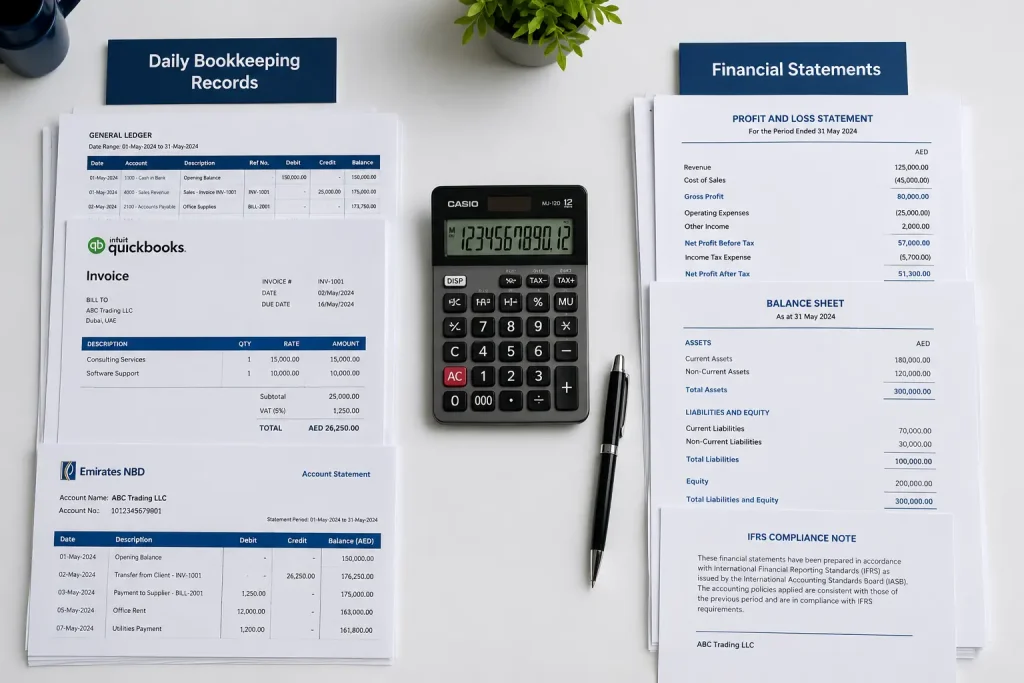
The simplest way to understand the relationship between these two roles: bookkeeping is the foundation that accounting is built on. They are not competing alternatives — they are sequential stages of the same financial process. But at any given point in a business’s finance function, they require different people doing fundamentally different work.
A bookkeeper is responsible for the accurate and timely recording of all financial transactions in a business. Every sale, purchase, payment, receipt, payroll entry, and bank transaction flows through the bookkeeper’s records. The goal is a clean, up-to-date, accurate set of books that reflects exactly what has happened in the business financially.
Bookkeeping is primarily a data entry and records maintenance function — but in the UAE context, it carries significant compliance weight. With VAT, corporate tax, and FTA reporting requirements all dependent on accurate underlying records, a bookkeeper’s errors don’t just affect the books — they flow directly into tax returns and regulatory submissions. For a fuller understanding of what bookkeeping involves, see our dedicated guide: What is Bookkeeping? A Complete Guide.
An accountant works with the data that bookkeeping produces — but their role is fundamentally one of interpretation, analysis, and strategic application. Where a bookkeeper records that AED 50,000 was spent on materials, an accountant analyses whether that expenditure was efficient, how it should be categorised for tax purposes, how it affects the company’s cost structure, and what it implies for future financial planning.
Accountants prepare financial statements (profit and loss accounts, balance sheets, cash flow statements), ensure compliance with accounting standards such as IFRS, calculate and file tax returns, advise on financial strategy, and communicate financial performance to business owners, boards, and external stakeholders including auditors and regulators.
💡 The Simplest Distinction
Bookkeeper: Records what happened financially. Keeps the books clean and current.
Accountant: Analyses what happened, explains why it matters, and advises what to do next.
Understanding the practical, day-to-day difference between these roles is the clearest way to know which one matches your skills, experience, and career interests.
| Task / Responsibility | Bookkeeper | Accountant |
|---|---|---|
| Recording daily transactions | ✔ Primary responsibility | Oversight only |
| Processing invoices and bills | ✔ Primary responsibility | Reviews and approves |
| Bank reconciliations | ✔ Regular task | ✔ Reviews output |
| Payroll processing | ✔ Often managed by bookkeeper | ✔ Oversees and approves |
| VAT coding of transactions | ✔ Day-to-day responsibility | ✔ Reviews VAT position |
| VAT return preparation and filing | Prepares supporting data | ✔ Prepares, reviews, files |
| Financial statement preparation | Not in scope | ✔ Core responsibility |
| Corporate tax calculation and filing | Not in scope | ✔ Core responsibility |
| IFRS compliance and application | Basic awareness only | ✔ Applied expertise required |
| Financial analysis and reporting | Not in scope | ✔ Core responsibility |
| Budgeting and forecasting | Not typically in scope | ✔ Expected at senior level |
| Audit coordination and support | Provides records and documents | ✔ Manages audit process |
| Business financial advice | Not in scope | ✔ Strategic advisory role |
One of the clearest practical differences between bookkeepers and accountants in UAE is the qualification level expected by employers. Understanding this helps you plan your study investment accurately.
Bookkeeping roles in UAE generally have lower formal qualification requirements than accounting roles. Most employers prioritise practical software skills and demonstrated accuracy over academic credentials at this level. Typical requirements include:
Accounting roles carry higher qualification expectations, and senior roles are increasingly competitive with regard to professional certifications:
For a structured pathway into the accounting profession, explore Alifbyte’s accounting courses in UAE — covering everything from bookkeeping foundations through to professional qualification preparation.
The salary gap between bookkeepers and accountants in UAE reflects the difference in qualification, analytical responsibility, and business impact of each role. Here is a realistic comparison based on current UAE job market data:
| Level | Bookkeeper (AED/month) | Accountant (AED/month) | Salary Gap |
|---|---|---|---|
| Entry Level (0–2 years) | AED 2,500 – 5,000 | AED 4,000 – 8,000 | +AED 2,000–3,000/mo |
| Mid-Level (3–5 years) | AED 5,000 – 8,000 | AED 9,000 – 18,000 | +AED 6,000–10,000/mo |
| Senior Level (5–8 years) | AED 6,000 – 10,000 | AED 15,000 – 28,000 | +AED 15,000–18,000/mo |
| Finance Manager / Controller | Not typical career end point | AED 25,000 – 45,000+ | Uncapped ceiling |
| CFO (Chief Financial Officer) | Not accessible from bookkeeping alone | AED 50,000 – 150,000+ | Significant ceiling |
⚠ Key Salary Insight for UAE
The salary gap between bookkeeping and accounting widens dramatically with seniority. At entry level, the difference is meaningful but manageable. By mid-career, an accountant with a professional qualification like ACCA can earn 2–3x the salary of a peer who remained at bookkeeping level with equivalent experience years. This compounding gap is the most powerful financial argument for transitioning from bookkeeping to accounting as early as possible in your UAE career.
The UAE’s regulatory landscape has changed significantly since 2018, and these changes have reshaped what both bookkeepers and accountants are expected to know and do. Understanding this context is essential for anyone planning a finance career in the UAE.
When UAE introduced VAT at 5% in January 2018, it fundamentally elevated the importance of accurate bookkeeping. Before VAT, a bookkeeping error was primarily an internal records problem. After VAT, that same error becomes an FTA compliance issue with penalty implications. UAE bookkeepers must now:
The introduction of UAE Corporate Tax (effective June 2023) has had a more significant impact on accountants than bookkeepers, but both roles are affected:
For accountants: CT requires IFRS-compliant financial statements as the starting point for all tax calculations. Accountants must now apply CT Law adjustments — non-deductible expenses, exempt income exclusions, interest limitation rules, and transfer pricing disclosures — to arrive at the correct taxable income figure. This requires significantly deeper technical knowledge than was previously required in the UAE’s tax-free environment.
For bookkeepers: CT has raised the bar for record quality. Financial records must be maintained for 7 years (under CT Law) and must support the adjustments an accountant will make when preparing the CT return. Bookkeepers who understand the difference between capital and revenue expenditure, who can correctly code entertainment expenses, and who maintain proper documentation for related-party transactions are significantly more valuable in the post-CT UAE market.
Both roles are now directly connected to FTA compliance in UAE. Bookkeepers produce the underlying records that flow into FTA submissions. Accountants prepare, review, and file those submissions. Errors at the bookkeeping level compound at the accounting level — which is why UAE employers increasingly expect both roles to have a working understanding of FTA requirements, not just internal accounting accuracy.

In the UAE job market, software proficiency is a decisive factor in employability for both bookkeepers and accountants. Here is what each role is typically expected to know:
| Software | Bookkeeper | Accountant | UAE Demand |
|---|---|---|---|
| QuickBooks | ✔ Core tool — daily use | ✔ Review and reporting | ⭐⭐⭐⭐⭐ Very High |
| Tally Prime | ✔ Core tool — daily use | ✔ Reporting and analysis | ⭐⭐⭐⭐⭐ Very High |
| Sage 50 | ✔ Core tool — daily use | ✔ Reviews and journals | ⭐⭐⭐⭐ High |
| Microsoft Excel (Advanced) | ✔ Intermediate level expected | ✔ Advanced level required | ⭐⭐⭐⭐⭐ Very High |
| EmaraTax Portal (FTA) | Awareness and data preparation | ✔ Filing and compliance | ⭐⭐⭐⭐⭐ Mandatory |
| SAP / Oracle / Dynamics | Basic data entry in larger firms | ✔ Reporting and analysis modules | ⭐⭐⭐⭐ High (enterprise) |
For bookkeepers, proficiency in QuickBooks and Sage 50 is often the single most important factor in getting hired in UAE. Both tools are covered comprehensively within Alifbyte’s CMCA programme alongside manual accounting principles, VAT application, and payroll processing.
Bookkeeping offers a clear progression ladder, though the ceiling is lower than in accounting without additional qualifications:
The accounting career ladder in UAE offers significantly more progression, salary ceiling, and career diversification:
The right starting point depends on your current qualifications, experience, career goals, and how quickly you need to enter employment. Here is a practical guide:
| Your Background | Recommended Starting Point | Next Step |
|---|---|---|
| High school diploma, no finance experience | Start with CMCA + QuickBooks → apply for bookkeeping roles | Pursue ACCA alongside work |
| Non-accounting bachelor’s degree | CMCA + software courses → accounts assistant or junior bookkeeper | ACCA exemptions available — move to accounting faster |
| Accounting / finance degree (fresh graduate) | Apply directly for junior accountant roles | Start ACCA while working — complete Part 2 within 2 years |
| Working bookkeeper (1–3 years experience) | Upgrade software skills — QuickBooks, Sage 50 | Begin ACCA or CMCA to transition to accounting |
| Career changer from another field | Start with CMCA — practical route into finance without a degree | Gain 1–2 years bookkeeping experience, then pursue ACCA |
| Experienced accountant from another country | Target mid-level accountant roles — UAE VAT & CT knowledge is key differentiator | UAE-specific compliance training, ACCA if not already held |
Transitioning from bookkeeping to accounting is one of the most common and rewarding career moves in UAE’s finance sector. Bookkeeping experience is genuinely valuable as a foundation — you already understand how transactions work, how the books are structured, and how financial data flows through a business. What you need to add is the analytical, technical, and regulatory layer that accounting requires.
Here is the most practical transition roadmap for UAE professionals:
Identify which accounting concepts you already understand from your bookkeeping work (double-entry, VAT treatment, bank reconciliations, basic P&L) and which are new territory (IFRS application, financial statement preparation, corporate tax calculations, audit processes). This gap analysis drives your study priorities.
The most respected and widely recognised path for UAE professionals transitioning from bookkeeping to accounting is the ACCA qualification. ACCA offers exemptions from its foundational papers (Applied Knowledge level) for candidates who can demonstrate prior learning — meaning experienced bookkeepers often enter ACCA at a more advanced level than complete beginners, saving time and money. Alifbyte’s ACCA programme is specifically structured for working UAE professionals, with flexible scheduling to study alongside employment.
Regardless of your global accounting qualification, UAE employers expect specific local knowledge:
Alifbyte’s accounting courses in UAE include dedicated modules on UAE-specific compliance requirements that international qualifications do not always cover in depth.
As you build accounting qualifications, begin applying for hybrid roles that bridge bookkeeping and accounting — Accounts Executive, Finance Executive, or Junior Accountant positions that value your bookkeeping experience but ask for growing accounting capability. These roles pay better than pure bookkeeping while you complete your qualification.
Newly qualified accountants without hands-on transaction experience are common in UAE. Your bookkeeping background means you understand how financial data is generated at source — something many accounting graduates lack. Frame this explicitly in interviews: “I understand financial statements both from the analysis side and from the transaction level, because I’ve built the books myself.”

Start Your Accounting or Bookkeeping Career in UAE Today
Whether you are starting from scratch as a bookkeeper or ready to transition into a full accounting career, Alifbyte has the right programme for your level, your timeline, and the UAE job market.
→ CMCA — Certified Management Computerised Accountant (Bookkeeping + Software)
→ QuickBooks Training Course UAE
Also available in: Abu Dhabi · Dubai · Ajman · Sharjah · Fujairah · Ras Al Khaimah · Umm Al Quwain
→ Sage 50 Accounting Course UAE
Also available in: Abu Dhabi · Dubai · Ajman · Sharjah · Fujairah · Ras Al Khaimah · Umm Al Quwain
→ ACCA Qualification — UAE’s Most Recognised Accounting Pathway
A bookkeeper records and organises daily financial transactions — ensuring the books are accurate and up to date. An accountant interprets, analyses, and reports on that financial data to support business decisions, ensure compliance with tax laws, and prepare financial statements. Bookkeeping is the foundation; accounting is the analysis built on top of it. For a deeper understanding of what bookkeeping involves, read our full guide: What is Bookkeeping?
Accountants consistently earn more. Entry-level bookkeepers earn AED 2,500–5,000 per month while junior accountants start at AED 4,000–8,000. The gap widens significantly at senior levels — senior accountants earn AED 15,000–28,000+ versus senior bookkeepers at AED 6,000–10,000. Finance managers and CFOs (accounting career paths) earn AED 25,000–150,000+, a ceiling not accessible from bookkeeping alone.
A formal degree is not mandatory for bookkeeping roles in UAE. Practical software skills in QuickBooks, Tally, or Sage 50, combined with a professional certificate such as the CMCA and demonstrated accuracy, are often more important than academic credentials at this level.
Yes — and it is a well-travelled path. The most effective route is pursuing the ACCA qualification alongside your bookkeeping work. Bookkeeping experience is genuinely valuable for accounting study — it builds practical familiarity with financial transactions before theoretical frameworks are applied. ACCA offers exemptions from its foundational papers for candidates with prior learning.
UAE accountants are typically expected to hold a bachelor’s degree in accounting or finance, combined with a professional qualification such as ACCA, CPA, CMA, or CA. ACCA is among the most widely recognised in the UAE. UAE-specific knowledge of VAT, corporate tax, and IFRS is also an increasingly stated requirement in job descriptions.
UAE VAT significantly elevated the importance of accurate bookkeeping. Bookkeepers must now correctly code every transaction with the right VAT treatment, maintain FTA-compliant tax invoices, and ensure input VAT is only claimed on qualifying expenses. Errors in bookkeeping flow directly into FTA submissions, creating compliance risk for the business.
The most in-demand software for bookkeepers in UAE is QuickBooks (widely used in SMEs), Tally Prime (dominant in trading and retail), and Sage 50 (popular in manufacturing and distribution). UAE-specific VAT functionality in each platform is an essential skill. All three are covered in Alifbyte’s CMCA programme.
UAE Corporate Tax has raised the standard required for bookkeeping records. Financial records must be IFRS-compliant and maintained for 7 years. Bookkeepers who understand CT-related record-keeping — proper expense categorisation, related-party transaction documentation, and capital versus revenue expenditure — are significantly more valuable to UAE employers in 2026.
Yes — bookkeeping is one of the most accessible entry points into the UAE finance sector. It requires lower qualifications than accounting, has a shorter training timeline, and provides a practical foundation from which progression into accounting roles is achievable. Completing a CMCA or accounting software course before applying dramatically improves employability for freshers.
Alifbyte Educational Institute offers a full range of accounting courses in UAE — from the foundational CMCA and software courses in QuickBooks and Sage 50, through to ACCA qualification preparation. Courses are available at Alifbyte’s Dubai (Al Karama) and Sharjah branches with flexible evening and weekend batches for working professionals.