
If you’ve spent months building spreadsheets and dashboards, you’ve probably hit the same wall: should you go deeper into Data Analyst vs Power BI Developer territory, or is one clearly the smarter move for the UAE job market? Picking wrong means wasted training hours and a CV that doesn’t match live job postings. This guide breaks down both roles honestly — responsibilities, tools, and real UAE salary data — so you can choose the path that actually fits your goals.

A Data Analyst turns raw business data into decisions. In a typical UAE company — a retail chain in Dubai, a logistics firm in Sharjah, a bank in Abu Dhabi — the analyst pulls data from spreadsheets, CRMs, or databases, cleans it, and builds reports that answer specific business questions: Which product line is underperforming? Which branch has the highest customer churn?
Typical Data Analyst responsibilities:
A strong foundation in Advanced MS Excel is where almost every UAE data analyst career UAE journey starts, because Excel is still the tool most businesses use daily before they scale up to dedicated BI platforms. From there, most analysts move into Power Query to automate the data-cleaning step that otherwise eats hours every week.
If you want the full breakdown of how to break into this role, our dedicated guide on how to become a data analyst in the UAE walks through the exact entry-level path.

A Power BI Developer builds the systems that Data Analysts (and everyone else in the company) eventually use. Instead of manually pulling numbers each week, a Power BI Developer designs automated pipelines, data models, and live dashboards that refresh on their own.
Typical Power BI Developer responsibilities:
This is a more technical, engineering-adjacent role. In the UAE, most Power BI Developer job postings ask for hands-on Power BI expertise, working knowledge of DAX, and SQL fluency. If you want to understand exactly what DAX involves before committing to this path, this beginner’s guide to DAX in Power BI is a good starting point.
The two roles overlap heavily at the entry level, which is exactly why the confusion exists. Here’s where they actually diverge:
| Attribute | Data Analyst | Power BI Developer |
|---|---|---|
| Primary focus | Interpreting data to answer business questions | Building systems that deliver data automatically |
| Core tools | Excel, Power Query, basic SQL | Power BI, DAX, SQL, ETL tools |
| Output | Reports, insights, recommendations | Dashboards, data models, automated pipelines |
| Technical depth | Moderate | High |
| Typical background | Business, finance, commerce | IT, computer science, engineering (or upskilled analysts) |
| Reporting style | Ad-hoc and periodic reports | Live, self-service dashboards |
| Career ceiling | Senior Analyst → Analytics Manager | Senior Power BI Developer → BI Architect / Data Engineer |
Key takeaway: A Data Analyst answers “what happened and why.” A Power BI Developer builds the system that lets anyone in the company answer that question themselves, in real time.
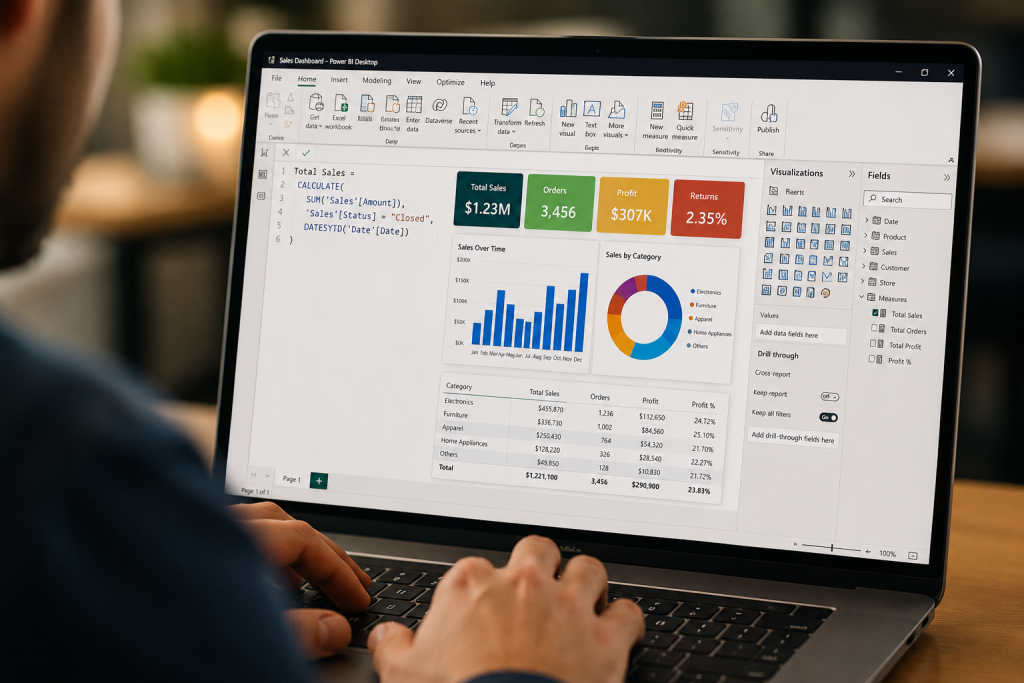
Both paths share one non-negotiable starting point: Excel. Employers in the UAE consistently list Excel fluency as a baseline requirement even for Power BI Developer job postings, because it’s still the interface most business users touch first. Our guide on the career benefits of learning Advanced Excel covers why this single skill still opens more doors than people expect.
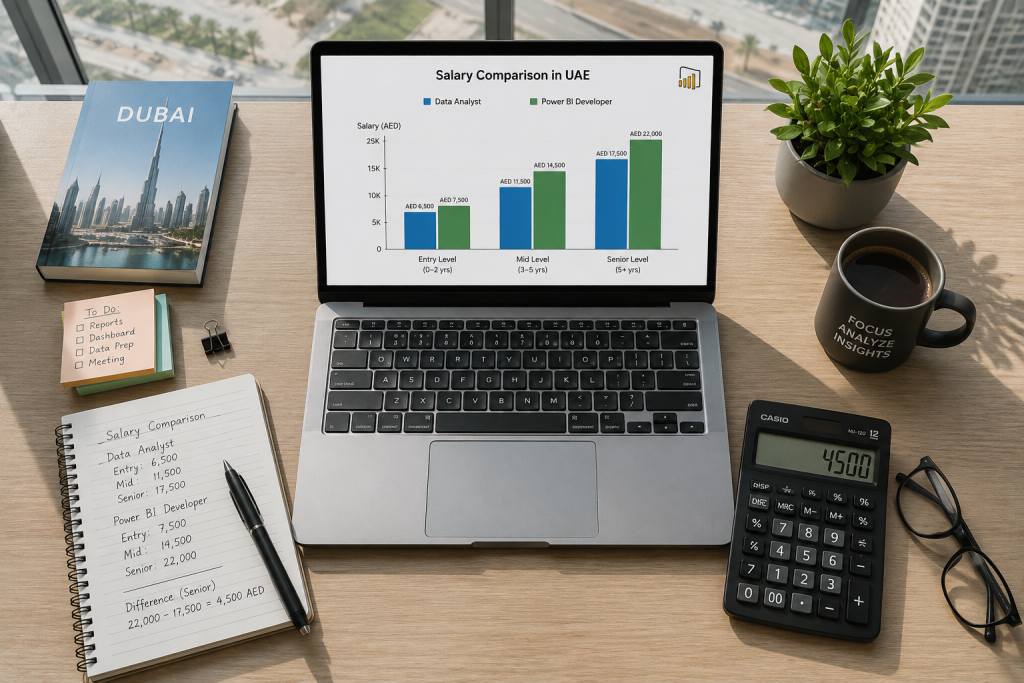
Real UAE salary data (2026) tells a clear story:
For a deeper breakdown specific to the Data Analyst path, see our dedicated Data Analyst salary in UAE guide. If you’re also weighing a Data Scientist track against these two, our Data Analyst vs Data Scientist career guide covers that comparison in detail.

Most professionals don’t pick one path and stay there forever — the two careers connect:
This is one of the reasons Power BI training consistently ranks among the most practical upskilling moves in the UAE right now — see the range of roles covered in jobs after a Power BI course in UAE for real examples of where graduates land.
Ask yourself these questions honestly:
Neither path is “better” — they reward different strengths. Many of the highest earners in UAE data teams started as Data Analysts and grew into Power BI Developers over 2–3 years, layering Power BI and DAX on top of the Excel and reporting skills they already had.
Data Analyst is generally the easier entry point since it relies more heavily on Excel and business reasoning rather than deep technical modeling.
Not full software development, but you do need DAX (Power BI’s formula language) and working SQL knowledge — both are learnable without a computer science degree.
Yes — this is the most common progression path in the UAE. Analysts who add Power BI and DAX skills typically transition within 1–2 years.
Power BI Developers generally out-earn Data Analysts once they reach mid-to-senior level, largely because their work overlaps with technical/engineering pay bands.
No specific degree is mandatory — practical skills in Excel, Power Query, basic SQL, and data visualization matter more to UAE employers than the degree title.
Yes. Excel remains the first tool most business users interact with, and Power BI Developers are expected to understand how data looks in Excel before modeling it in Power BI.
Banking and finance, retail, logistics, real estate, and government-linked entities are the biggest employers of both roles across Dubai, Abu Dhabi, and Sharjah.
With focused training in Excel, Power Query, and basic SQL, most learners are job-ready for entry-level roles within 2–4 months.
Power BI alone gets you into entry-level BI roles, but SQL significantly widens your options and is expected for most Power BI Developer vs Data Analyst skills comparisons employers make during interviews.
Start with Advanced Excel and Power BI — both roles need them, so this keeps your options open while you decide.
Yes, especially for Power BI Developers building dashboards for SMEs that don’t need a full-time in-house hire — this is a growing niche across the UAE market.
There’s no universally “right” answer in the Data Analyst vs Power BI Developer debate — only the right answer for where you are right now. If you want to start working with data quickly, using skills you can build on Excel and Power Query within a few months, Data Analyst is your fastest entry point. If you’re drawn to building systems, automating reporting, and eventually commanding a higher salary ceiling, Power BI Developer is worth the extra technical investment in Power BI, DAX, and SQL. Either way, your starting point is the same: strong, practical Excel skills, followed by Power BI.
Whether you’re leaning toward Data Analyst or Power BI Developer, Alifbyte’s hands-on Excel, Power BI, and Data Analytics courses in Dubai and Sharjah are designed to get you job-ready — with flexible in-person and online schedules.
Master dashboards, DAX, and data modeling to become job-ready as a Power BI Developer.
Excel, Power Query, and Power BI together — the complete Data Analyst career path.