

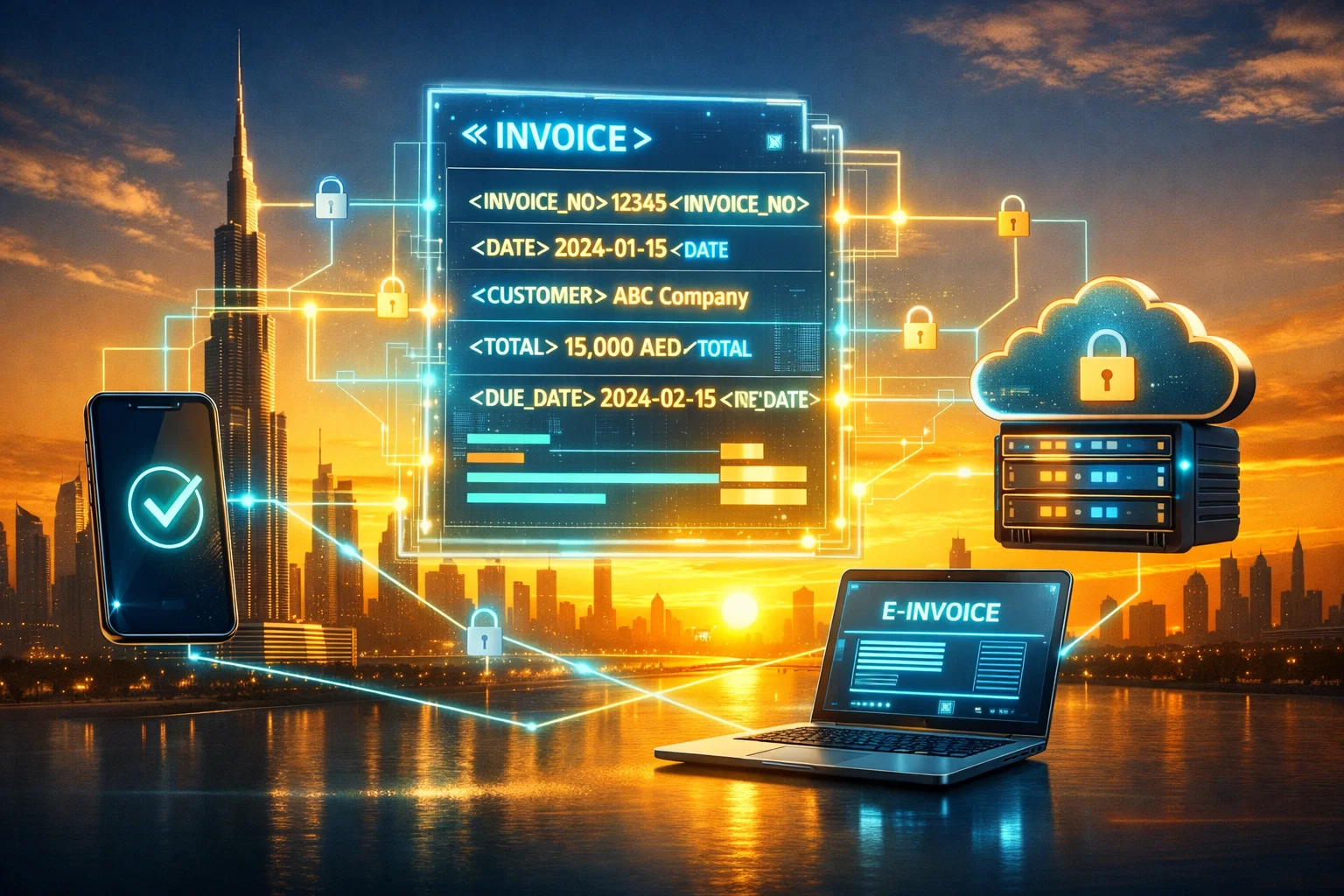
E-invoicing is transforming how companies in the UAE handle transactions. As Dubai continues to lead in digital transformation, understanding e-invoicing has become essential for every business owner, accountant, and finance professional. This comprehensive guide answers the most important questions about e-invoicing in the UAE context, explains the upcoming changes, and shows exactly how your business can stay compliant and gain a competitive edge.
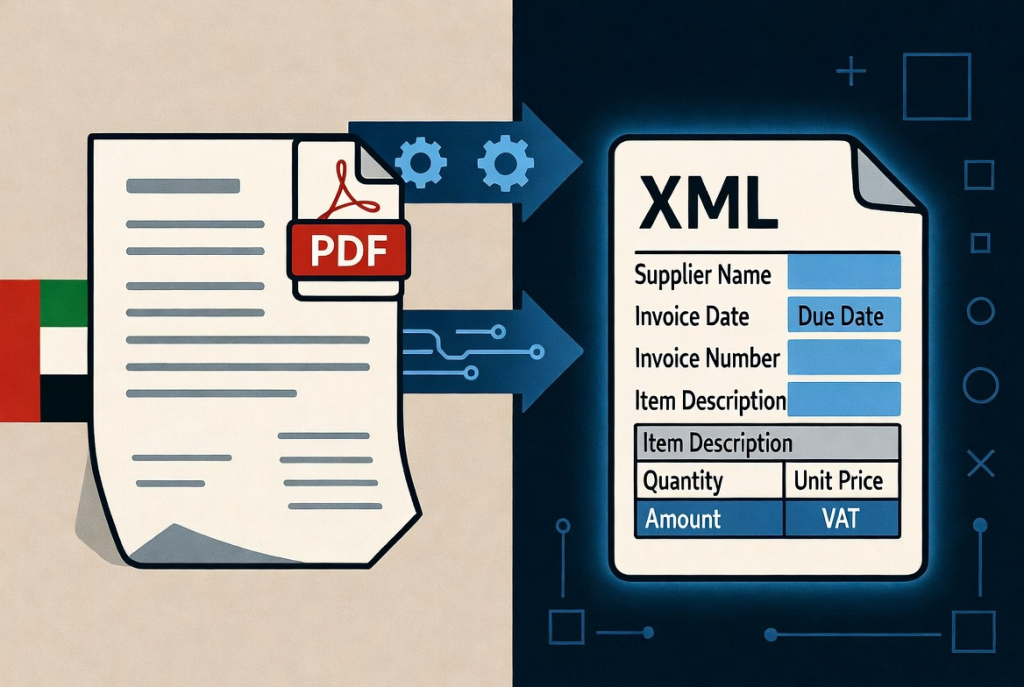
E-invoicing refers to the creation, exchange, and storage of invoices in a fully structured, machine-readable digital format. Unlike a traditional PDF sent by email or a scanned paper invoice, an e-invoice is a data file (typically in XML or JSON) that accounting systems and tax authorities can automatically read and process without any manual data entry.
In simple terms, it is not just a digital copy of a paper invoice — it is a standardized electronic document that contains all the required invoice information in a predefined structure. This allows seamless integration between the seller’s system, the buyer’s system, and the Federal Tax Authority (FTA) for real-time visibility and validation.
The UAE is moving toward a fully digital tax ecosystem to boost transparency, reduce administrative burdens, minimize errors, and strengthen VAT compliance. By implementing the Electronic Invoicing System (EIS), the government aims to:
The decentralized “5-corner” model based on the global Peppol network ensures that businesses retain control while the FTA receives only the necessary tax data.
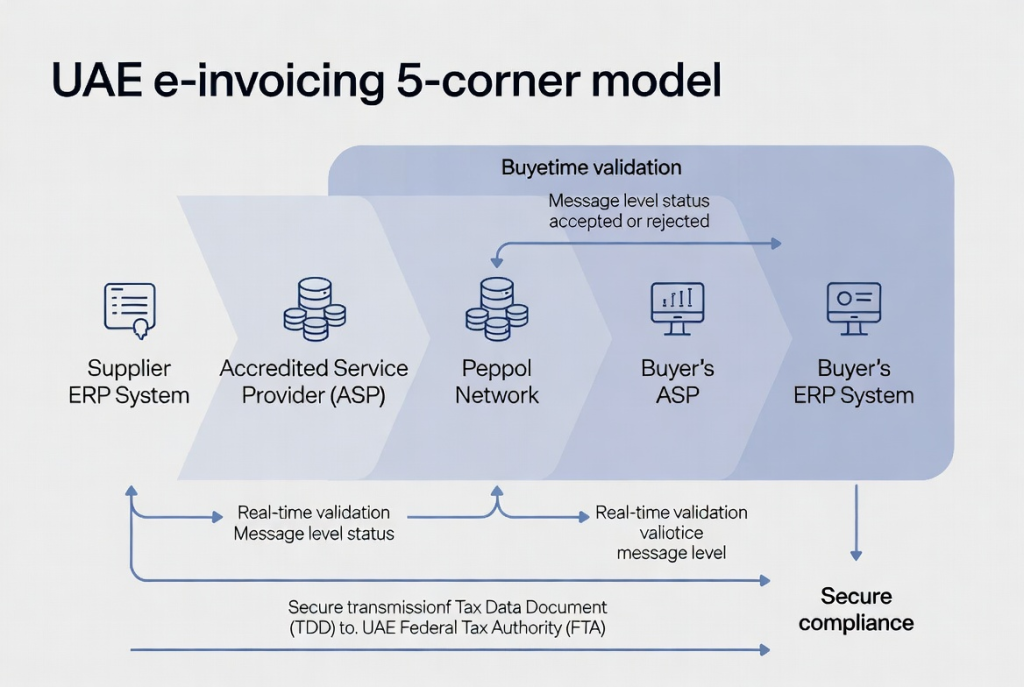
The flow follows a secure, standardized 5-corner model:
Both parties receive instant status messages (Message Level Status – MLS), so everyone knows immediately if the invoice was accepted or rejected. This entire process happens in seconds and leaves a complete, tamper-proof audit trail.
The UAE has adopted the Peppol Invoice Notation Template – Abu Dhabi Edition (PINT-AE) as the national standard. Invoices must be issued in a structured XML format that follows the PINT-AE data dictionary. Key mandatory fields include supplier and buyer details, invoice number and date, currency, VAT rates and amounts, line-item descriptions, and total payable amounts.
Only invoices exchanged through Ministry of Finance-accredited service providers on the Peppol network qualify as compliant e-invoices. Plain PDFs, Word documents, images, or emails do not count.
The phased rollout is clearly defined:
Businesses are strongly encouraged to start preparing now — early movers will face far fewer disruptions.
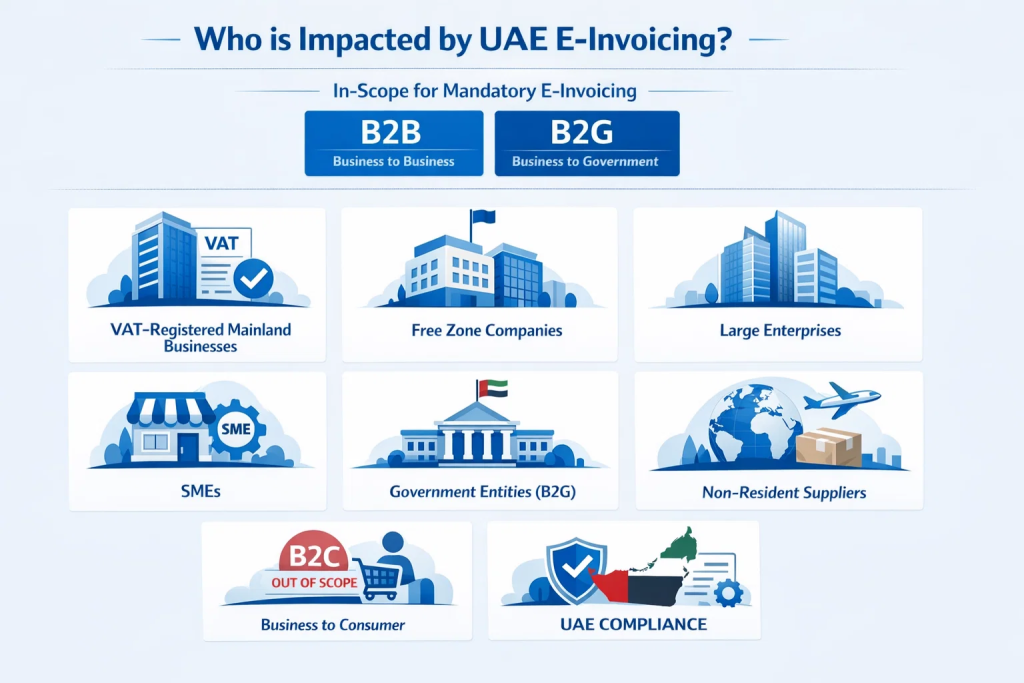
Almost every business operating in the UAE will eventually be affected:
Currently, B2C (business-to-consumer) transactions are out of scope, but B2B and B2G are fully covered. Certain exempt supplies (e.g., specific financial services, sovereign activities) may have limited exclusions.
Companies that adopt e-invoicing early report:
Many businesses also discover operational efficiencies that go far beyond tax compliance.
Common hurdles include:
The good news is that most modern accounting platforms already offer e-invoicing connectors or can be upgraded easily.
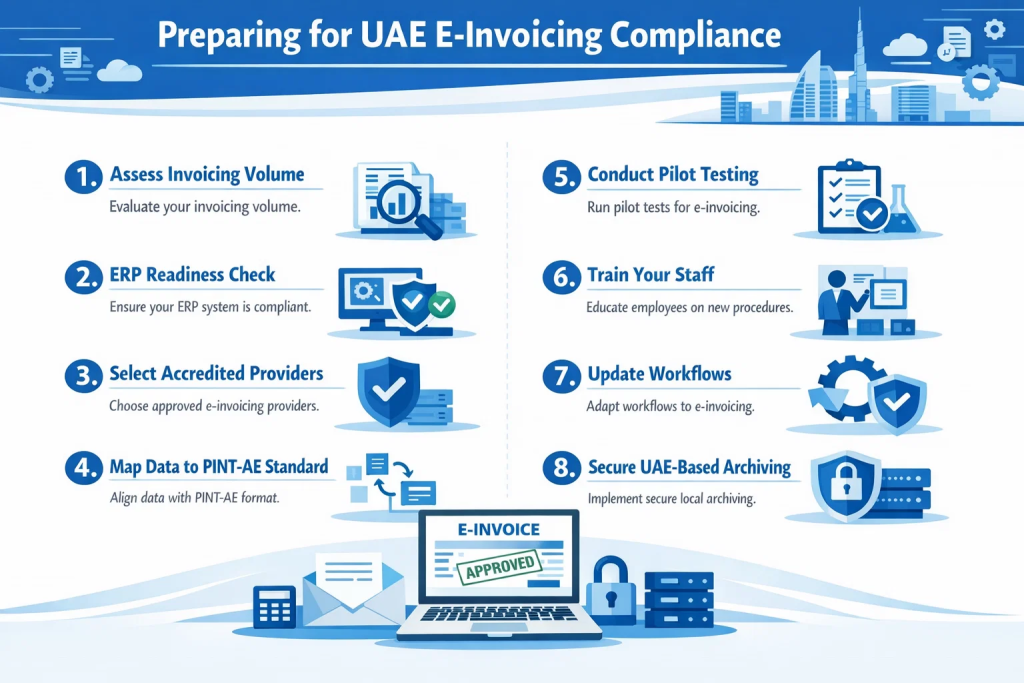
Follow this practical 8-step checklist:
Starting preparation in 2026 gives you plenty of time to test and refine processes before the deadlines hit.
Leading solutions such as QuickBooks, TallyPrime, SAP, Oracle NetSuite, Xero, and many local UAE ERP systems are already building or have released native e-invoicing modules. Integration typically involves:
Businesses using modern cloud-based accounting software usually find the transition surprisingly smooth.
Understanding the theory is important, but hands-on experience with real systems is what matters most. Training programs that combine accounting principles, software mastery, and compliance knowledge give professionals a massive advantage in the post-2027 job market.
PDF is just a picture of an invoice. Real e-invoice is structured XML data (PINT-AE format) sent via accredited ASP on Peppol network — automatically readable by systems and FTA.
It’s your mandatory gateway. You connect your software to an FTA-approved ASP to send/receive compliant e-invoices you cannot do it directly.
Yes, fully supported. Credit/debit notes are also sent as structured e-invoices through your ASP.
No. Eventually all VAT-registered businesses in the UAE must comply — from large enterprises to small and medium businesses.
Both sender and receiver get instant notification with the reason (via Message Level Status). You correct and resend the invoice through your ASP.
Yes — you must keep the original structured file (XML) in a secure, accessible format for the legally required retention period, usually 5 years or more.
Not exactly. E-invoicing enables real-time clearance/validation, while the tax data is reported to FTA almost instantly together they support better compliance and transparency.
Yes. Your ASP delivers both the structured file (for the buyer’s system) and usually a human-readable PDF version at the same time.
E-invoicing is not just another regulation it is a fundamental shift toward a digital-first economy. Businesses that embrace it early will operate faster, smarter, and with greater confidence. At Alifbyte Educational Institute in Dubai, we specialize in practical, job-ready training that prepares you for exactly these kinds of changes. Our courses on QuickBooks, Tally, advanced accounting, and VAT compliance include modules that directly address the upcoming e-invoicing requirements. If you want to understand how to generate compliant e-invoices, integrate with ASPs, and turn regulatory change into a competitive advantage, explore our upcoming programs.