


Your competitors are not just hiring better people — they’re building them. Yet many businesses in the UAE still treat employee training as an optional expense rather than a strategic investment. The result? Stagnant teams, rising attrition, and a growing skills gap that quietly erodes company performance. The benefits of corporate employee training and development go far beyond a one-day workshop. Done right, structured workplace learning transforms how your workforce thinks, performs, and stays. This guide breaks down the five most impactful advantages backed by real-world reasoning — and shows exactly where to start.
It’s a fair question, and one that finance directors and business owners in the UAE ask more often than HR managers would like to admit. Training budgets get cut first when margins tighten. The assumption is that skills can be hired in from outside, or that employees will figure things out on the job.
The reality tells a different story. Organisations that invest consistently in employee skill development programs outperform those that don’t — not just in output metrics, but in employee satisfaction, customer experience, and regulatory compliance. The UAE’s fast-evolving business environment, shaped by Vision 2031 economic diversification, FTA compliance requirements, and rapid digital transformation, makes this investment even more urgent.
Think of it this way: a machine that isn’t maintained eventually breaks down. The same principle applies to your workforce. Training is not a cost centre. It’s maintenance, upskilling, and future-proofing rolled into one.

Corporate employee training and development refers to the structured programmes a business delivers — or sponsors employees to attend — to improve job-specific knowledge, professional skills, and career potential. It spans everything from technical software training to communication skills, compliance certifications, leadership development, and data analytics.
In the UAE context, this often means enrolling staff in accredited short courses covering tools like QuickBooks, Power BI, or Advanced Excel; certifications such as ACCA or UAE VAT compliance; or language and communication programmes like Business English.
At Alifbyte Educational Institute, a KHDA-approved and ISO-certified training provider in Dubai, corporate training programmes are designed to align directly with business needs — whether a company wants to upskill a single department or deploy organisation-wide learning initiatives.
The most direct benefit of corporate employee training and development is exactly what it sounds like: employees become better at their jobs. This sounds obvious, but the depth of impact is often underestimated.
When an accountant in your finance team completes a structured QuickBooks course, they stop making reconciliation errors. When your operations manager learns Advanced Excel, reporting that once took three days gets done in three hours. When your team understands UAE VAT regulations inside out, costly misfiling becomes a thing of the past.
The performance improvement from targeted training is measurable and often immediate. Consider these dimensions:
For UAE businesses navigating mandatory compliance obligations — from corporate tax to e-invoicing requirements — the gap between a trained and an untrained team can be measured in AED penalties, not just productivity percentages.
Professional development for employees doesn’t need to be an annual retreat. The most effective organisations embed short, targeted, certification-backed training into the normal work rhythm. When staff see that their employer actively invests in their growth, performance naturally improves — not just because they know more, but because they care more.
Replacing a skilled employee in the UAE costs more than most organisations account for. Recruitment fees, visa processing, onboarding time, and the productivity dip while a new hire settles in can add up to months of that employee’s annual salary. And yet, one of the most powerful retention tools is consistently underused: training.
Employees who feel their professional growth is supported are significantly less likely to look elsewhere. A team member who has been sponsored for a Power BI certification or an ACCA qualification has a tangible, ongoing reason to stay. They associate their career progress with the organisation — not with a job offer from a competitor.
This is particularly critical in the UAE, where the workforce is highly mobile and competitive. Skilled professionals in finance, technology, and data analytics have options. If your company does not offer structured growth pathways, another company will.
Key insight: Training does not just keep employees happy — it builds loyalty through perceived investment. When someone feels their employer sees their potential and is actively developing it, the psychological contract between employee and organisation deepens. That is far harder to break than a salary match.
Workforce capability building through ongoing learning also creates internal promotion pipelines. Instead of hiring externally for every senior vacancy, businesses that train consistently can promote from within — retaining institutional knowledge while reducing recruitment costs.
Training is one of the few investments that pays dividends before the budget period closes. When employees are equipped with the right skills and tools, they work faster, smarter, and with less supervision. That reduction in dependency on managers frees up leadership bandwidth and accelerates decision-making across the organisation.
Consider a finance department where staff have completed structured training in Tally Prime or Sage 50. Processes that previously relied on workarounds, manual data entry, or constant IT support begin to run smoothly. Month-end closings happen on time. Reports are accurate on the first pass. The downstream effect on organisational efficiency is substantial.
Workplace learning and development also reduces the internal training burden. When employees lack formal training, senior staff end up spending disproportionate time answering basic questions, correcting errors, or supervising tasks that should be self-managed. Structured programmes eliminate this hidden productivity drain.
From a technology adoption standpoint, this matters enormously. Many UAE businesses invest in enterprise software — accounting platforms, CRM tools, data dashboards — but see poor ROI because staff adoption is weak. The software works; the skill gap doesn’t. Pairing technology investment with proper training is what actually unlocks the return.
Quick wins from upskilling programmes:

In the UAE, regulatory compliance is not a suggestion — it is a business obligation. From FTA-mandated VAT filing and corporate tax regulations to mandatory e-invoicing for qualifying businesses, the compliance landscape is complex and evolving. Non-compliance carries real financial and reputational risk.
Employee training is your first line of defence.
A finance team that has completed up-to-date UAE VAT training understands input and output tax, zero-rated vs. exempt supplies, VAT return filing cycles, and how to handle credit and debit notes correctly. A team that hasn’t? They’re guessing — and the FTA penalties for errors can be significant.
The same logic applies to corporate tax training and e-invoicing compliance. As the UAE continues rolling out Phase 2 of its e-invoicing mandate, businesses that have trained staff in system integration and data format requirements will navigate the transition smoothly. Those that haven’t will scramble.
Beyond financial compliance, training reduces operational risk. Staff trained in data security practices, for instance, are less likely to expose sensitive business information. Teams trained in professional communication and Business English are less likely to cause misunderstandings in high-stakes client or regulatory interactions.
Training ROI for businesses is rarely more clearly demonstrated than in compliance contexts — where the cost of a training programme is a fraction of what a single regulatory penalty or reputational incident would cost.

Skilled professionals do not just evaluate a job offer based on salary. They evaluate the organisation. They ask: Will I grow here? Does this company invest in its people? Is there a learning culture?
Businesses that embed staff upskilling initiatives into their identity — not just their HR policy — become employers of choice. Word travels fast in the UAE’s connected professional community. When candidates know that your company actively funds certifications, sponsors professional development, and values learning, applications improve in both quantity and quality.
This is the compounding benefit of corporate employee training and development. In the short term, you train the people you have. In the medium term, those people perform better and stay longer. In the long term, your reputation as a learning organisation attracts the next generation of talent — reducing hiring costs, improving cultural fit, and accelerating your growth trajectory.
A corporate learning culture also shapes how employees carry themselves day to day. Teams that are continuously learning are more curious, more adaptive, and more willing to tackle new challenges. In an environment where industries shift quickly — from AI disruption to new accounting software standards to evolving digital marketing platforms — adaptability is a competitive advantage.
Organisational growth through learning is not a nice-to-have. It is a multiplier on every other business investment you make.
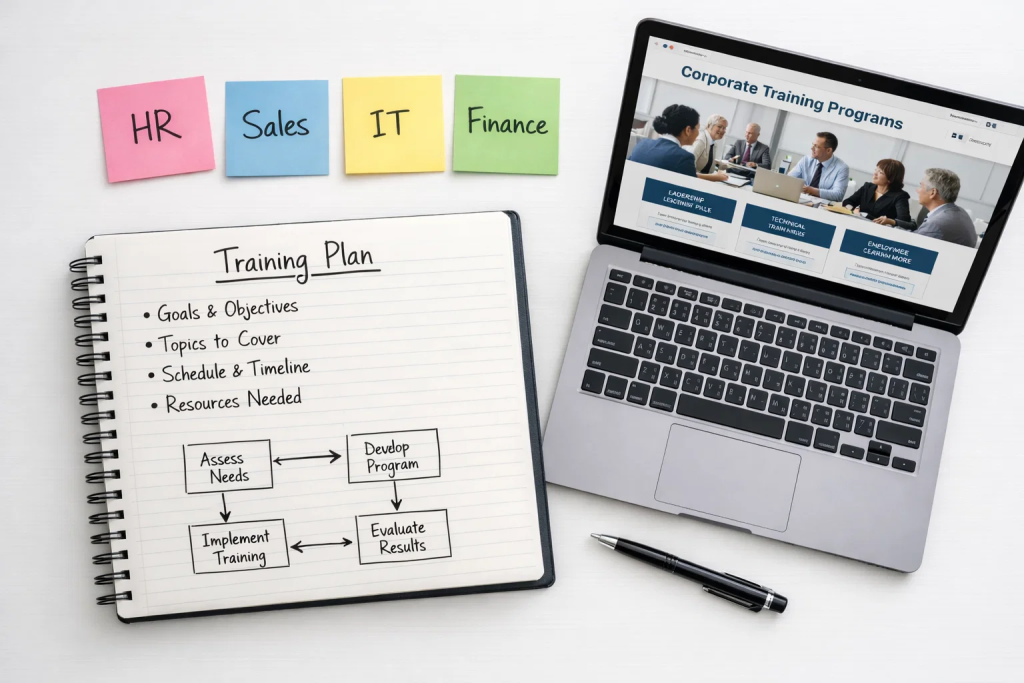
Knowing the benefits is one thing. Knowing where to start is another. Here’s a practical framework for selecting the right training for your workforce:
Step 1 — Identify the skill gap Survey managers and conduct a simple skills audit. Where are tasks being done slowly, incorrectly, or by the wrong people? This tells you where training will have the highest immediate impact.
Step 2 — Match training to business goals If your business goal is UAE VAT compliance, prioritise VAT training. If it is financial reporting quality, look at ACCA programmes or accounting software certifications. If it is data-driven decision-making, explore Power BI or Advanced Excel.
Step 3 — Choose accredited, results-oriented providers In the UAE, KHDA-approved and ISO-certified training centres offer programmes that carry recognised credibility. This matters for both employee motivation and organisational credibility. Alifbyte’s corporate training division delivers customised group programmes across accounting, technology, compliance, data analytics, and communication — aligned to actual UAE business environments.
Step 4 — Measure and reinforce Training without follow-through has a short shelf life. Set measurable post-training outcomes (fewer errors, faster processing, higher test scores), review them at 30 and 90 days, and reinforce learning through on-the-job application.
The primary benefits include improved employee performance, higher retention rates, greater productivity, better regulatory compliance, and the development of a company culture that attracts skilled professionals. Each of these contributes directly to business profitability and sustainability.
When employees receive structured training and see clear professional growth pathways, they feel valued by their employer. This sense of investment significantly reduces the likelihood of them seeking opportunities elsewhere — especially in competitive markets like the UAE.
UAE businesses most commonly invest in accounting software training (QuickBooks, Tally Prime, Sage), VAT and tax compliance, data analytics tools (Power BI, Advanced Excel), ACCA certifications, digital marketing, and professional communication programmes.
Structured corporate training replaces ad hoc on-the-job learning with intentional, goal-oriented programmes. This ensures consistency, measurability, and alignment between what employees learn and what the business actually needs.
While it is not universally mandated, certain roles — particularly those involving VAT filing, corporate tax, and financial reporting — are subject to compliance requirements that make relevant training practically essential. Beyond compliance, it is increasingly expected as a standard benefit in competitive UAE workplaces.
Training typically refers to learning specific, job-relevant skills in the short term — such as learning to use accounting software. Development is a broader, longer-term process focused on career growth, leadership ability, and professional maturity. Effective corporate programmes combine both.
Yes. Alifbyte Educational Institute offers tailored corporate training solutions for teams of all sizes across a range of disciplines — including accounting software, compliance, data analytics, and language skills. Group programmes are designed around the specific needs and schedules of the organisation.
Investing in the benefits of corporate employee training and development is one of the highest-leverage decisions a business can make — especially in the UAE’s competitive, compliance-intensive environment. The returns are measurable: stronger performance, better retention, higher productivity, reduced compliance risk, and a talent-attracting culture that compounds over time.
The businesses winning in the UAE right now are not just hiring talented people. They are systematically building them. Whether your team needs to master a new accounting software, navigate evolving VAT regulations, or develop data analytics capabilities, the right training partner makes all the difference.
Alifbyte Educational Institute offers a full suite of corporate training programmes — from QuickBooks and Tally Prime to Power BI, UAE VAT, Business English, and beyond. All programmes are KHDA-approved and delivered by certified industry professionals. Whether you’re training one team member or your entire department, Alifbyte is equipped to support your workforce development goals.