


You know your English is decent — but the moment you step into a boardroom or write a client email, something feels off. You hesitate, second-guess your words, and wonder if you’re really coming across the way you intend to. That gap between everyday English and professional English is real, and ignoring it quietly costs people promotions, deals, and opportunities. This guide gives you a straight path to fix that — no fluff, just what works.

Business English is not a fancier version of general English. It is a specific style of communication built for professional environments — meetings, emails, negotiations, presentations, and formal reports. The vocabulary is different. The tone is different. The way you structure a message is different.
If you have been using conversational English at work and hoping it is enough, here is the truth: it might be holding you back more than you realize. In competitive job markets like the UAE, where professionals from over 200 nationalities work side by side, how you communicate in English directly influences how you are perceived — whether you sound confident, credible, and capable, or unsure and unprepared.
The good news? Business English is a learnable skill. You do not need to be born into it. You just need the right approach.
If you have been exploring your options for language training in Dubai, you likely already know that business English is one of the most in-demand courses among working professionals in the region.
Learning business English is not about memorizing textbook phrases. It is about building real habits that rewire how you communicate at work. Here is where to start.
The biggest beginner mistake is trying to learn “business vocabulary” as a giant list. That is overwhelming and ineffective. Instead, focus on the vocabulary that actually shows up in your industry.
If you work in finance, focus on terms like fiscal year, cash flow projections, due diligence, accounts payable, and profit margin. If you are in marketing, words like KPIs, conversion rate, value proposition, and target demographics matter more. Start with the 50–100 words that are most common in your specific field and get really comfortable using them naturally.
A useful starting point: pull up five professional emails you have received recently. Highlight every phrase you would not use in casual conversation. That is your first vocabulary list.
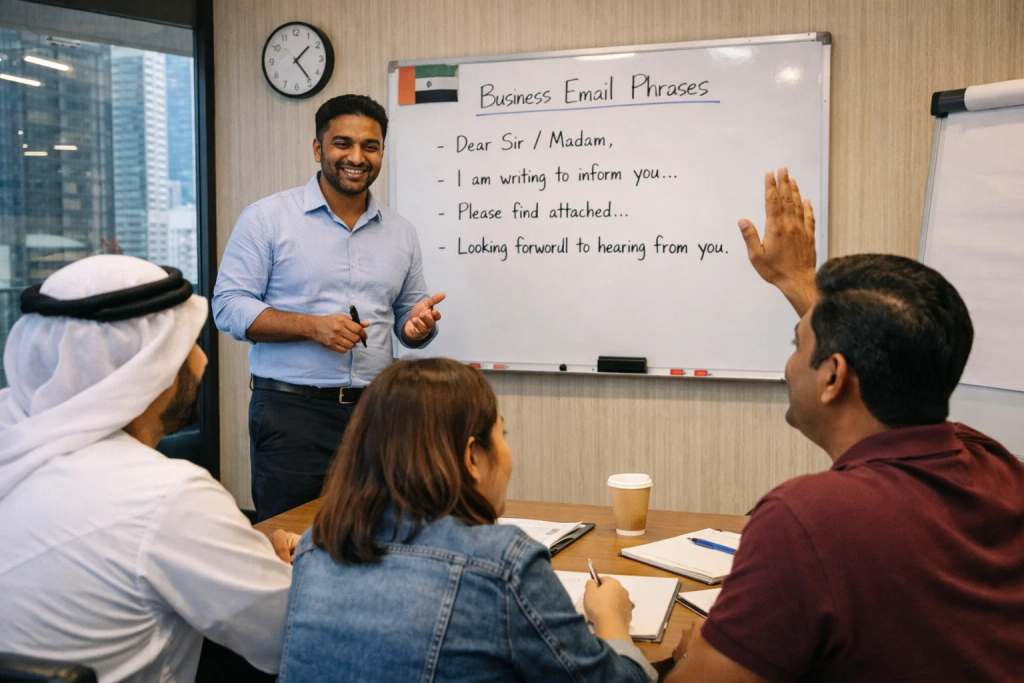
Emails are the most common form of business communication, and they are where beginners reveal their skill level most clearly. The structure of a professional email follows a predictable pattern:
Practice by rewriting emails you have already sent. Look at them critically — is every sentence necessary? Is the tone professional without being cold? Are you being direct without being rude?
Most people try to speak before they have listened enough. Before you can produce fluent business English, you need to consume it. This means:
The pattern recognition you build from consistent input is what eventually makes speaking feel natural rather than forced. Check out these tips on how to improve spoken English for a more detailed breakdown of building the input habit.
People often treat business English as one skill. It is actually a bundle of four. You need to develop each one.
This is where most non-native speakers feel the most pressure. The goal is not to sound like a native speaker — it is to sound clear, confident, and organized. In meetings, that means:
The public speaking course at AlifByte is specifically designed to help professionals become comfortable presenting and speaking in formal business settings, which directly feeds into your business English confidence.
Professional writing includes reports, proposals, minutes of meetings, LinkedIn posts, and internal documentation. The principles are the same across all of them:
With remote and hybrid work now standard, phone and video communication is critical. Business English for calls includes knowing how to open formally (“Good morning, this is [Name] calling from…”), how to manage a poor connection (“I’m sorry, I didn’t quite catch that — could you repeat?”), and how to close professionally (“I’ll follow up with a summary email shortly. Thank you for your time.”).
Whether you are negotiating a contract, pitching an idea, or pushing back on a deadline, the language you use shapes the outcome. Key patterns to learn: hedging (“It might be worth considering…”), framing (“The benefit here is…”), and concession language (“We can certainly look at that, provided…”).

Fluency in business English is not about being perfect — it is about being automatic. When you stop mentally translating and start thinking directly in professional English, that is fluency. Here is how you build it.
Translation is a crutch. Every time you form a thought in your native language and then convert it to English, you add a delay and increase the chance of errors. The fix is deliberate practice: force yourself to think in English during routine tasks. Narrate your commute mentally in English. Think through your to-do list in English. It feels strange at first — that strangeness is the learning happening.
Consistency beats intensity. Fifteen minutes of focused daily practice will advance your business English faster than a three-hour session once a week. Your daily habit could look like this:
Over three months, this adds up to over 65 hours of structured practice without disrupting your schedule.
Self-study gets you far, but there is a ceiling. A structured course gives you guided feedback, real conversation practice, and accountability. It also fast-tracks the process significantly because you learn from a trainer who can identify exactly where your gaps are — something no app or YouTube video can do.
If you are in Dubai, Abu Dhabi, or Sharjah, the Business English course at AlifByte Education is built specifically for working professionals. It is practical, not academic — the sessions are designed around workplace scenarios you actually encounter.
For professionals also considering broader language certifications, reading about the TOEFL vs IELTS comparison can help you decide which credential adds more value to your career profile.
Language learning apps are fine for vocabulary, but they cannot replicate the pressure and unpredictability of a real conversation. Find a language exchange partner, join a professional networking event in English, or enroll in a course where you practice with other learners in realistic scenarios.
If you are already studying spoken English, improving your spoken English skills naturally feeds into your business English development — the two are closely connected.
Knowing what not to do saves you months of bad habits. These are the patterns that slow down most beginners.
Overly formal language in casual business settings. Writing “I am writing to inform you of the fact that…” when “Just a quick heads-up — …” is more appropriate for an internal Slack message. Read the room. Business English is not always stiff and formal.
Translating idioms directly. Phrases like “break a leg” or “touch base” make no sense when translated word-for-word. Build a separate list of business idioms and phrasal verbs and understand their actual meaning in context.
Avoiding speaking for fear of mistakes. Silence is not neutral — in business settings, staying quiet when you have something to contribute makes you invisible. Make peace with imperfect English. Professionals respect effort and clarity more than grammatical perfection.
Ignoring tone. A message that is grammatically correct but tonally wrong can still damage a professional relationship. “You need to send this by Friday” and “Could you please ensure this is with me by Friday?” say the same thing with very different effects.
Not learning the vocabulary of your specific industry. General business English will only take you so far. The people who stand out are those who can communicate fluently in the specific language of their field. Explore the benefits of learning advanced level English to understand how industry-specific language mastery elevates your entire professional profile.
This depends on your current level, how consistently you practice, and how immersive your learning environment is. As a rough guide:
| Starting Level | Consistent Daily Practice | Estimated Time to Professional Fluency |
|---|---|---|
| Intermediate English | 30 min/day | 4–6 months |
| Upper-Intermediate | 20 min/day | 2–3 months |
| Advanced General English | 15 min/day | 6–8 weeks |
Structured courses with qualified trainers can compress this timeline significantly because they remove the guesswork of what to learn next.
For professionals pursuing career advancement in the UAE, pairing business English with financial or technical qualifications creates a compelling skill set. If you are exploring what qualifications are required for accountants in the UAE or looking at whether finance is a good career path in the UAE, business English fluency is almost always listed as a prerequisite for senior roles.
Business English is a professional register of English used in workplace settings — emails, meetings, reports, presentations, and negotiations. It differs from everyday English in vocabulary, tone, structure, and formality level.
Yes. If your general English is at a basic-to-intermediate level, you can begin building business English skills simultaneously. Start with professional email writing and simple meeting phrases before advancing to presentations and negotiations.
Fifteen to thirty minutes of focused daily practice — roughly two hours per week — is enough to see consistent improvement within three months.
Both work, but classroom or instructor-led training provides real-time feedback and speaking practice that online self-study cannot replicate. For professionals in the UAE, in-person courses offer the additional benefit of practicing with peers in a real professional context.
Start with professional email writing, meeting phrases, and workplace vocabulary specific to your industry. These have the highest immediate impact on how you are perceived at work.
You need at least an intermediate level of general English (roughly A2–B1 on the CEFR scale). Business English builds on top of your general foundation, so the stronger your base, the faster you will progress.
Consistent listening, structured conversation practice, and real workplace usage. Joining a business English course gives you all three in a structured environment. You can also explore ways to improve spoken English as a foundational step.
Yes. In the UAE job market, communication skills — especially in English — are consistently cited by hiring managers as a key differentiator between candidates of similar technical ability.
If your employer or target role requires an English proficiency certificate, then yes. IELTS and TOEFL are recognized credentials, and combining them with business English training strengthens both your score and your professional communication. Read the full TOEFL vs IELTS comparison to decide which suits you better.
You have the roadmap now. The difference between people who stay stuck at “decent English” and those who genuinely advance in their careers often comes down to one decision: committing to structured learning rather than hoping improvement happens on its own.
If you are serious about building professional English communication skills — in a setting designed for working adults in the UAE — explore the Business English course at AlifByte Education. You can also browse the full range of language courses available in Dubai to find the right fit for where you are right now.
The career you want communicates the way you need to. Start there.
Explore more at AlifByte Education — professional training courses in Dubai, Abu Dhabi, and Sharjah.