
Running a business in UAE without understanding bookkeeping is like driving blindfolded — you will not see the cliff until it is too late. Whether you are a small business owner, a fresh graduate, or a professional switching careers, this guide breaks down what bookkeeping actually means, how it differs from accounting, and how you can start building real skills today.
At its simplest, bookkeeping is the process of recording every financial transaction your business makes — every sale, every purchase, every payment received, and every expense paid. It is the foundation on which all financial decisions in a business are built.
Think of it this way: if your business were a story, bookkeeping would be the act of writing down every chapter, word for word, as it happens. Without that written record, the story is lost.
In the context of UAE businesses — where VAT compliance, corporate tax (effective since June 2023), and free zone regulations all demand meticulous financial records — understanding what is bookkeeping is not optional. It is essential.
A bookkeeper records data in journals or ledgers (physical or digital), maintaining a clear trail of:
Key Takeaway: Bookkeeping is about recording financial data accurately and consistently. It is the daily discipline that keeps your business’s financial health visible and your compliance obligations met.
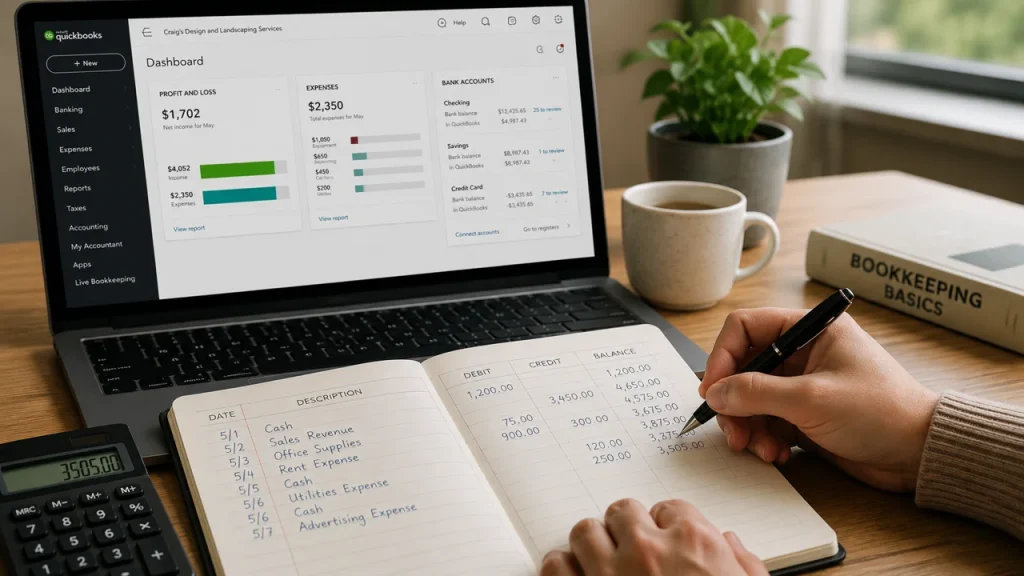
One of the most common points of confusion for beginners is the difference between bookkeeping and accounting. These two terms are often used interchangeably — but they are actually two distinct functions within the financial management ecosystem.
Here is a simple way to understand it: bookkeeping is the input; accounting is the output. Bookkeepers record what happens. Accountants interpret what it means.
| Role | Bookkeeper | Accountant |
|---|---|---|
| Primary Function | Records daily financial transactions | Analyzes, interprets, and reports financial data |
| Focus Area | Data entry, ledger maintenance, reconciliation | Financial statements, tax planning, audit support |
| Tools Used | QuickBooks, Tally, Excel spreadsheets | Accounting software + financial analysis tools |
| Education Level | Diploma or short certification course | Degree in accounting, CPA, CA, or equivalent |
| Decision Making | Minimal — follows set processes | High — guides business strategy with data |
| Output | Organized journals, ledgers, trial balance | P&L statements, balance sheets, cash flow reports |
| UAE Salary Range | AED 3,000 – AED 7,000/month | AED 7,000 – AED 20,000+/month |
| Entry Point | Lower — accessible to beginners | Higher — requires formal qualifications |
The bookkeeper vs accountant distinction is also important for small business owners hiring their first finance professional. If your business is in its early stage, a skilled bookkeeper may be all you need. As financial complexity increases, a qualified accountant becomes critical.
To bridge the gap between both roles, many professionals in UAE pursue accounting courses in UAE that cover both the practical recording skills of bookkeeping and the analytical skills of accounting.

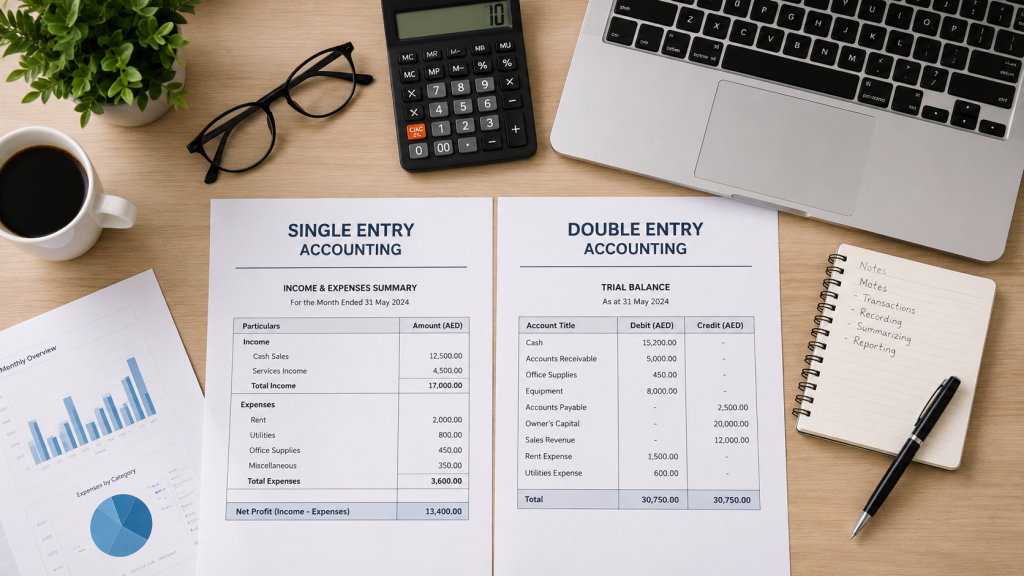
Not all bookkeeping is done the same way. The two primary methods — single entry vs double entry bookkeeping — differ significantly in complexity, accuracy, and the type of business they suit.
In single-entry bookkeeping, each financial transaction is recorded once — either as income or as an expense. It is similar to how you might track your personal budget in a notebook. Simple, fast, but limited in scope.
Double-entry bookkeeping is the gold standard. Every transaction is recorded in two accounts — as a debit in one account and a credit in another. This ensures the accounting equation (Assets = Liabilities + Equity) always balances.
Pro Tip: If your business is registered in UAE or planning to apply for UAE corporate tax compliance, double-entry bookkeeping is non-negotiable. Learn this method from day one.
Understanding what bookkeeping covers in practice helps both business owners and aspiring finance professionals know what to expect. Here are the core tasks that define daily bookkeeping work:
Whether you are just starting out or managing your own small business finances, these are the mistakes that cost businesses money, compliance penalties, and credibility:
Whether you are targeting a role as a bookkeeper, accounts assistant, or qualified accountant in UAE, certain foundational skills will separate you from the competition and determine how fast you progress.
| Skill | Why It Matters |
|---|---|
| Attention to detail | Spotting errors before they compound is the single most important skill in any accounting role |
| Numerical aptitude | Comfort with numbers, ratios, percentages, and basic financial calculations — not just data entry |
| Software proficiency | Hands-on experience with QuickBooks, Tally Prime, Sage 50, and Excel — UAE employers expect this on day one |
| VAT & tax knowledge | UAE-specific knowledge of VAT regulations, corporate tax basics, and FTA compliance requirements |
| Communication skills | Explaining financial data clearly to non-finance stakeholders — a skill that accelerates career growth |
| Organizational discipline | Managing multiple ledgers, deadlines, and filing requirements simultaneously without errors |
| Ethical judgment | Financial data is sensitive. Integrity and confidentiality are non-negotiable in any finance role |
| Analytical thinking | Moving beyond recording data to asking: what does this number mean for the business? |
If you are building these accounting skills for beginners, the most effective approach is a structured course combining theory with software practice. An MS Excel Accounting course is particularly valuable since Excel remains the most universally used tool across all finance departments in UAE.
The UAE finance job market in 2026 shows clear preference for candidates who bring both traditional accounting knowledge and digital tool proficiency. Based on job postings across Dubai, Abu Dhabi, and Sharjah, here are the skills employers are actively prioritizing:
Learning bookkeeping is one thing. Becoming genuinely good at it — the kind of professional UAE employers compete to hire — requires a deliberate approach:

Choosing the right bookkeeping software for your UAE business or career depends on your business size, industry, and budget. Here is a quick comparison of the most widely used platforms:
| Software | Best For | Key Strength | Learn More |
|---|---|---|---|
| QuickBooks | SMEs, free zone companies | VAT reporting, invoicing, multi-currency | QuickBooks training |
| Tally Prime | Trading & manufacturing firms | Inventory, payroll, offline reliability | Tally Prime course |
| Sage 50 | Mid-size & international businesses | Fixed assets, multi-company consolidation | Sage 50 training |
| MS Excel | All finance roles | Financial modelling, budgeting, data analysis | MS Excel Accounting |
Employer Insight: In UAE job postings for bookkeepers and accounts assistants, QuickBooks and Tally Prime are the two most frequently requested software skills. Earning a certification in either — or both — significantly strengthens your CV.
The path from zero knowledge to job-ready bookkeeper in UAE is more structured and achievable than most people expect:
Before touching any software, get clear on the fundamental concepts: the accounting equation, types of accounts (assets, liabilities, equity, income, expenses), debits and credits, and the difference between cash and accrual accounting.
Enrolling in a formal bookkeeping course UAE with certified instructors gives you structured learning, hands-on software practice, and a recognized credential to present to employers.
Start with QuickBooks (most universally applicable) or Tally Prime (high demand in trading sectors). Practice using dummy company accounts to build speed and accuracy.
Understand VAT registration thresholds, how to prepare a VAT return, and the basics of UAE corporate tax. This knowledge separates a generic bookkeeper from a UAE-ready finance professional.
Complete an MS Excel Accounting course covering financial templates, pivot tables, VLOOKUP, and data analysis. Excel skills are expected in virtually every finance job advertisement in UAE.
The CMCA certification is an excellent stepping stone for management accounting roles, while QuickBooks and Tally certifications are valuable for job-ready bookkeepers entering the UAE market immediately.
Volunteer to manage books for a small business, freelance for a startup, or apply for an internship. Real-world application cements your learning faster than any textbook.
Q: What is bookkeeping in simple terms? Bookkeeping is the systematic process of recording all financial transactions of a business — sales, purchases, payments, and receipts — in an organized manner on a daily basis. It is the financial diary of your business, ensuring every dirham in and out is accounted for.
Q: Is bookkeeping and accounting the same thing? No. Bookkeeping focuses on recording financial transactions, while accounting involves analyzing, interpreting, and reporting those records to guide business decisions. Bookkeeping is the foundation; accounting builds the insights on top of it.
Q: Can I learn bookkeeping with no prior experience? Absolutely. Bookkeeping is one of the most accessible financial skills to learn from scratch. With a structured course and consistent practice with software tools like QuickBooks or Tally, most beginners grasp the fundamentals within four to six weeks.
Q: What qualifications do I need for bookkeeping in UAE? There is no mandatory degree for bookkeeping roles in UAE, but completing a recognized accounting course in UAE — such as QuickBooks, Tally Prime, or CMCA certification — significantly improves your employability and earning potential.
Q: How much does a bookkeeper earn in UAE? Entry-level bookkeepers in UAE typically earn between AED 3,000 to AED 6,000 per month. Experienced bookkeepers with software certifications and UAE-specific knowledge can earn AED 8,000 or more depending on industry and company size.
Q: What is the difference between single-entry and double-entry bookkeeping? Single-entry bookkeeping records each transaction once — either as income or expense. It is simple but limited. Double-entry bookkeeping records every transaction in two accounts (debit and credit), providing a complete, balanced financial picture. For UAE businesses, double-entry is required for VAT and corporate tax compliance.
Q: What bookkeeping software is most used in UAE? QuickBooks, Tally Prime, Sage 50, and MS Excel are the most widely used. QuickBooks training is particularly valuable for SME roles, while Tally Prime is dominant in trading and manufacturing businesses.
Q: How long does it take to learn bookkeeping? With a structured bookkeeping course, most beginners can grasp the core principles within 4 to 8 weeks. Mastering one or two software tools adds another 2 to 4 weeks of hands-on practice.
Q: Is bookkeeping a good career in UAE? Yes — and the demand is growing. With thousands of SMEs, free zones, and multinational companies operating across all seven emirates, demand for skilled bookkeepers and finance professionals remains consistently high year-round.
Q: What is the best bookkeeping course in UAE for beginners? Alifbyte Education offers structured accounting courses in UAE covering QuickBooks, Tally Prime, Sage 50, MS Excel Accounting, and CMCA certification — designed for working professionals, career switchers, and complete beginners across Dubai, Abu Dhabi, Sharjah, and other UAE emirates.
Q: Do small businesses in UAE need a bookkeeper? Yes. UAE’s VAT system and corporate tax framework make accurate financial record-keeping a legal requirement for all businesses above the registration threshold. Even businesses below VAT threshold benefit enormously from clean financial records for decision-making and investor credibility.
Q: What is a chart of accounts in bookkeeping? A chart of accounts is a structured, organized list of all financial accounts used by a business — covering assets, liabilities, equity, income, and expenses. It is the backbone of any bookkeeping system and determines how transactions are categorized and reported.
Alifbyte Education offers expert-led accounting and bookkeeping courses in UAE — from beginner-level software training to professional certifications recognized by UAE employers. Whether you want to master QuickBooks, Tally Prime, Sage 50, or earn your CMCA certification, there is a pathway designed for your goals.
Explore All Accounting Courses →
Also available in:
Abu Dhabi ·
Dubai ·
Ajman ·
Sharjah ·
Fujairah ·
Ras Al Khaimah ·
Umm Al Quwain
Published by Alifbyte Education. Financial regulations referenced are based on UAE Federal Tax Authority guidelines current as of 2026