
You don’t need to be an accountant to understand money — but in the UAE’s business environment, not understanding even the basics of accounting is quietly holding professionals back every day. Managers who can’t read a P&L. Business owners who can’t tell if their company is profitable. Sales executives who miscalculate VAT on a quote. HR leads who struggle through budget reviews. If any of this sounds familiar, accounting for non-accountants is exactly what you need — and this guide gives you the core concepts, the UAE-specific context, and a clear path to building that knowledge without going back to school.
Table of Contents
The UAE’s business environment is uniquely demanding on financial literacy — and not just for people with “finance” in their job title. Three structural realities make accounting knowledge relevant for almost every professional in the country:
💡 Key Point
You do not need to be able to prepare financial statements. You need to be able to read them, question them, and use them. That is what accounting for non-accountants teaches — and it is a different, much more accessible skill than professional accounting.
These are the foundational concepts that appear in every business financial conversation. Understanding them properly — not just recognising the words — is what separates professionals who contribute to financial discussions from those who sit silently through them.
The most fundamental equation in accounting: Assets = Liabilities + Equity. Assets are what the business owns — cash, property, stock, receivables. Liabilities are what it owes — loans, supplier bills, tax obligations. Equity is what belongs to the owners after all liabilities are paid. Every balance sheet is built on this equation.
Revenue is income earned from business activity — sales, service fees, rental income. Expenses are the costs incurred to generate that revenue — salaries, rent, utilities, marketing. The difference between revenue and expenses is profit (or loss). This is the core of the income statement (P&L).
Gross profit = Revenue minus the direct cost of goods sold (COGS). Net profit = Gross profit minus all operating expenses, interest, and tax. A business can have strong gross margins but poor net profit if overheads are excessive — a critical distinction that non-finance managers often miss.
Cash accounting records income when cash is received and expenses when cash is paid. Accrual accounting records income when it is earned and expenses when they are incurred, regardless of when cash moves. Most UAE businesses use accrual accounting under IFRS — meaning a company’s profit figure in its accounts may look very different from its actual bank balance.
Accounts receivable (AR) — money owed to your business by customers who have been invoiced but not yet paid. Accounts payable (AP) — money your business owes to suppliers. Managing AR and AP effectively determines the cash health of a business, even when it is profitable on paper.
Cash flow measures the actual movement of cash into and out of a business. A profitable business can still fail if it runs out of cash — for example, if customers are slow to pay while suppliers demand immediate settlement. Understanding cash flow statements helps non-finance managers avoid this trap.
The break-even point is the level of revenue at which the business covers all its costs with zero profit or loss. Understanding break-even helps managers make pricing decisions, evaluate new products or services, and assess whether a department is contributing positively to the business.
Depreciation is the accounting method of spreading the cost of a long-term asset (machinery, vehicles, IT equipment) over its useful life. It affects both the P&L (as an expense) and the balance sheet (reducing asset value over time). Non-finance managers in operations and procurement frequently encounter depreciation in budget discussions without fully understanding its impact.
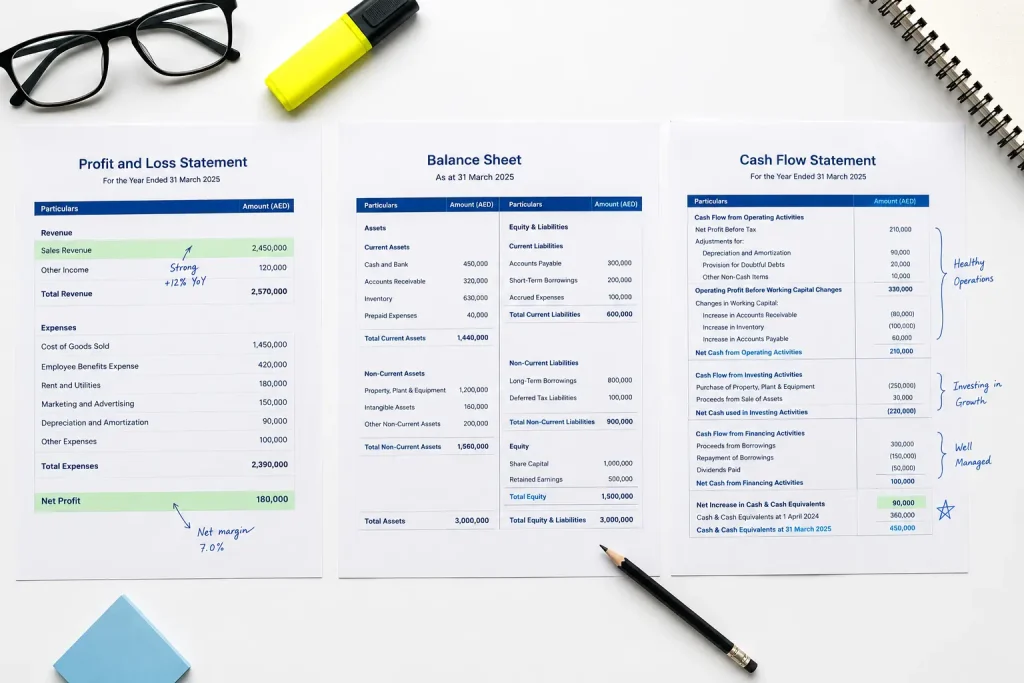
Most non-accountants are handed financial statements and asked for their input with almost no guidance on what to look for. Here is a practical guide to the three statements every professional in UAE should be able to navigate:
Answers the question: Did the business make money during this period?
Read it top-down: Revenue → Gross Profit (after direct costs) → Operating Profit (after overheads) → Net Profit (after interest and tax). The most important questions to ask: Is revenue growing or declining? Are costs growing faster than revenue? Is the net profit margin healthy for this industry?
Answers the question: What does the business own and owe at this point in time?
Key things non-accountants should check: Is cash position adequate? How large is the accounts receivable balance — are customers paying on time? Is debt increasing faster than equity? Is the business solvent (can it pay its debts)?
Answers the question: Where did the cash actually go?
Divided into three sections: Operating activities (cash from core business), Investing activities (cash spent on/from assets), and Financing activities (loans, equity, dividends). A business showing strong net profit but negative operating cash flow is a warning sign that should prompt immediate questions to the finance team.
For professionals working in the UAE, basic VAT literacy is not optional — it is a practical business necessity. Here are the most important concepts every non-accountant should understand about UAE VAT:
For a deeper understanding of UAE VAT, explore Alifbyte’s UAE VAT Training course, which covers all compliance requirements in practical, application-focused sessions.
One of the most common professional situations where non-accountants feel underprepared is the departmental budget review. Here is a practical framework for non-finance managers:
A departmental budget has three components: fixed costs (expenses that don’t change with activity — rent, salaries, fixed subscriptions), variable costs (expenses that change with activity — commissions, materials, shipping), and allocated overhead (your department’s share of company-wide costs like facilities and IT). Knowing which category each cost falls into tells you which costs you can actually control.
Variance analysis compares actual spend against budgeted spend. A favourable variance means you spent less than planned (or earned more). An adverse variance means you spent more (or earned less). Non-finance managers who can explain variances — not just report them — demonstrate financial maturity. “Salaries were AED 15,000 over budget because we hired two months earlier than planned” is far more valuable than “salaries were over budget.”
When requesting budget approval for a hire, a piece of equipment, or a new initiative, non-finance managers who can present a basic cost-benefit analysis — investment required, expected savings or revenue impact, payback period — are dramatically more persuasive than those who argue on qualitative grounds alone.
| Professional Role | How Accounting Knowledge Helps |
|---|---|
| Business Owners / Entrepreneurs | Understand P&L, manage cash flow, oversee VAT compliance, make informed financial decisions without being entirely dependent on an accountant |
| Operations Managers | Control departmental costs, justify capital expenditure, track budget variances, understand how operational decisions affect the bottom line |
| Sales Professionals | Understand margins and profitability, correctly apply VAT in quotes, evaluate deal profitability before committing, read customer financial health signals |
| HR Professionals | Manage payroll cost implications, understand headcount impact on budget, justify salary benchmarks with financial data, contribute to workforce cost planning |
| Project Managers | Track project budgets, identify cost overruns early, understand the financial impact of scope creep, report accurately to stakeholders on financial status |
| Procurement / Supply Chain | Evaluate supplier pricing against budget, understand payment terms and their cash flow impact, correctly process VAT on purchase invoices |
| Mid-Level Managers (any department) | Participate confidently in management meetings with a financial dimension, present budget proposals credibly, demonstrate readiness for more senior roles |
In the UAE job market, financial literacy is quietly one of the most significant differentiators between professionals who get promoted and those who plateau. Here is why:
The existing blog on why non-accountants should learn basic accounting covers the strategic reasons in more detail — this guide focuses on how to actually do it.

The key difference between learning accounting as a non-accountant versus as an accounting student is purpose: you do not need to prepare tax returns or pass professional exams. You need to understand, interpret, and apply financial information in your daily professional role. This changes how and what you should study.
Academic accounting textbooks are written for aspiring accountants — they go deep into debits and credits, journal entries, and double-entry systems that a non-accountant does not need at the same depth. A structured accounting for non-accounting professionals course teaches the same concepts with a business-application focus — how to read a P&L, what to ask your accountant, how to manage a budget — rather than how to prepare financial statements from scratch.
The most effective non-accountant learners apply new concepts immediately to their own company’s numbers. Ask your finance team for last month’s management accounts and practice reading them after each lesson. The faster you connect abstract concepts to real data you care about, the faster the learning sticks.
For UAE professionals, accounting knowledge without UAE VAT literacy is incomplete. Include a basic understanding of VAT — how it works, how it affects your transactions, and what your obligations are — as part of your learning plan. Alifbyte’s UAE VAT Training is designed to make this accessible even for professionals with no prior tax knowledge.
Non-accountants who want to work effectively with financial data need intermediate Excel skills — PivotTables, basic formulas, and simple charts. This is enough to build your own budget tracking tools, analyse expense data, and present financial summaries to management.
Many professionals who begin with an accounting for non-accountants course find themselves genuinely interested in going further. The natural progression is into a structured accounting qualification like the CMCA — which builds on practical foundations to develop fully employable accounting skills — or ultimately into ACCA for those considering a professional career pivot into accounting.
Understand the Numbers. Advance Your Career.
Whether you are a business owner, a manager, or a professional who wants to be more effective in financial conversations, Alifbyte’s Accounting for Non-Accounting Professionals course gives you exactly the financial literacy you need — without the complexity you don’t.
→ Accounting for Non-Accounting Professionals Course
→ UAE VAT Training — Compliance for All Professionals
→ CMCA — Next Step for Those Who Want to Go Further
Accounting for non-accountants is a practical approach to understanding financial concepts for professionals who are not trained accountants. It covers how to read financial statements, understand VAT, manage budgets, and interpret business numbers — without requiring the depth of study needed for a professional accounting qualification. Alifbyte’s Accounting for Non-Accounting Professionals course is designed specifically for this purpose.
Basic accounting knowledge is valuable for business owners, managers, sales professionals, HR leads, procurement officers, project managers, and any professional who reviews budgets, approves expenses, or makes decisions with financial implications. In UAE, understanding how VAT affects transactions makes this relevant across virtually every industry.
The most important concepts are: the balance sheet equation (Assets = Liabilities + Equity), revenue vs expenses, gross profit vs net profit, cash vs accrual accounting, accounts receivable and payable, cash flow, break-even analysis, and depreciation. Understanding these eight concepts gives non-accountants a solid foundation for financial conversations at work.
No degree is needed. A structured short course of 4–8 weeks is sufficient to build a practical, working understanding of financial concepts. Alifbyte’s course is designed to be accessible to professionals from any educational background.
Accounting knowledge strengthens your career by making you a stronger candidate for budget-responsible promotions, enabling confident participation in financial reviews, improving cost management in your role, and demonstrating business maturity that senior leadership expects from managers and executives.
Yes — since VAT was introduced in 2018, every transaction potentially carries a VAT implication. Non-accountants in sales, procurement, and operations need to understand when VAT applies, what standard rated and zero-rated supplies mean, and why correct VAT treatment on invoices matters. Explore Alifbyte’s UAE VAT Training for a dedicated compliance course.
With a structured course, most professionals develop a solid working understanding in 4–8 weeks — sufficient to read financial statements, understand budget reports, and participate meaningfully in finance discussions at work.
Microsoft Excel at an intermediate level is the most universally useful tool for budget tracking and basic financial analysis. For business owners who need to handle basic bookkeeping, QuickBooks or Tally Prime are the most accessible accounting software platforms.
Bookkeeping is recording financial transactions. Accounting involves interpreting those records to produce financial statements and business insights. Accounting for non-accountants focuses on the interpretation side — understanding what the numbers mean and how they affect decisions — rather than the day-to-day transaction recording.
Yes. Alifbyte’s Accounting for Non-Accounting Professionals course in Dubai and Sharjah is designed for managers, business owners, and professionals from non-finance backgrounds who want practical financial knowledge. It covers financial statements, budgeting, UAE VAT basics, and key accounting principles in an accessible, application-focused format.