
| Questions with answers | 64 (10 each for core accounting, Tally, QuickBooks, VAT, Corporate Tax and Excel) |
| UAE VAT standard rate | 5% |
| VAT registration threshold | AED 375,000 mandatory; AED 187,500 voluntary |
| VAT return deadline | Within 28 days of the end of the tax period |
| Corporate Tax rate | 0% up to AED 375,000; 9% on taxable income above it |
| Corporate Tax return deadline | Within 9 months of the financial year-end |
| Alifbyte Tally Prime course | 24 hours, 7 modules including UAE VAT implementation |
| Alifbyte CMCA course | 70 hours: accounting, software, Excel, VAT, Corporate Tax |
| Training centres | Dubai (Al Karama) and Sharjah (Al Qasba) |
Walking into an interview without knowing Tally vouchers, QuickBooks reconciliations or the 28-day VAT deadline is how strong candidates lose offers. UAE employers test software and tax together. This guide covers 64 accounting interview questions UAE recruiters ask, with model answers on core accounting, Tally, QuickBooks, VAT, Corporate Tax and Excel, plus courses to close any gap.

Recruiters check three things: technical accuracy (debits, credits, IFRS), UAE compliance (VAT, Corporate Tax) and software fluency (Tally, QuickBooks, Excel). The process varies by company, but most follow a similar pattern.
| Interview Stage | What Is Tested | How to Prepare |
|---|---|---|
| CV screening | Software and VAT experience | List Tally, QuickBooks and VAT filing explicitly |
| Technical round or test | Journal entries, reconciliations, VAT treatment | Practise the questions below with numbers |
| Technical interview | Judgement on real scenarios | Explain why, not only what |
| HR / final round | Communication, deadlines, ethics | Prepare two STAR stories |
Most accountant interview questions and answers online stop at definitions. UAE hiring managers want proof you have actually posted a VAT invoice or filed a return, so every answer below includes a practical angle.
Use a simple three-step pattern for technical questions: definition → UAE example → control or risk. For behavioural questions, use STAR (Situation, Task, Action, Result).
Tip: The sample answers below are models, not scripts. Replace the figures and examples with your own experience so you sound natural. Tax rules change, so confirm figures against the Federal Tax Authority (FTA) and Ministry of Finance before an interview.
Answer: Most UAE companies prepare financial statements under IFRS; smaller entities may use IFRS for SMEs. IFRS also matters for tax because Corporate Tax computation starts from accounting profit. I apply accrual accounting, revenue recognition and consistent policies, and document any judgement for the auditor.
Answer: Cash accounting records income and expenses when money moves. Accrual accounting records them when earned or incurred. If December’s AED 4,000 electricity bill arrives in January, accrual still books it in December: Dr Utilities Expense 4,000 / Cr Accrued Expenses 4,000.
Answer: I compare the bank statement and ledger balances, then identify differences: outstanding cheques, deposits in transit, bank charges not yet booked and errors. I post adjusting entries for missing items, confirm both balances agree, and investigate anything unmatched for more than 30 days.
Answer: Capital expenditure creates a long-term benefit and is recorded as an asset, then depreciated. Revenue expenditure is consumed in the period and charged to profit and loss. A delivery van is capital; its fuel is revenue. Misclassifying them distorts profit and taxable income.
Answer: Assets = Liabilities + Equity. Every transaction has equal debits and credits so the equation always balances. Buying AED 5,000 of inventory on credit: Dr Inventory 5,000 / Cr Accounts Payable 5,000.
Answer: A trial balance lists every ledger balance to prove total debits equal total credits. It does not catch omitted transactions, entries posted to the wrong account, or compensating errors, so I still review the ledgers and reconcile key accounts.
Answer: A prepayment is paid in advance and is an asset; an accrual is incurred but unpaid and is a liability. Example: AED 12,000 insurance paid on 1 October for 12 months leaves AED 9,000 prepaid at 31 December (nine months remaining).
Answer: Straight-line spreads cost evenly; reducing balance charges more in early years. Example: cost AED 50,000, residual AED 5,000, five-year life gives (50,000 − 5,000) ÷ 5 = AED 9,000 per year. The method must reflect how the asset’s benefit is consumed and be applied consistently.
Answer: I review the receivables ageing and set an allowance for expected credit losses in line with IFRS 9. The entry is Dr Impairment Expense / Cr Allowance for Doubtful Debts. When a debt is confirmed bad, I write it off against the allowance and document the collection attempts.
Answer: I accrue salaries monthly, deduct advances and pay through the UAE’s Wage Protection System (WPS). End-of-service gratuity is accrued as a liability based on each employee’s contract and the UAE labour law, so it is not a surprise cost at exit. I confirm the calculation with HR.
The CMCA course takes learners from business accounting to software, Excel, UAE VAT and Corporate Tax.
Answer: I record transactions using vouchers: sales, purchase, receipt, payment, journal, contra, debit note and credit note. At month end I check the trial balance, ageing of receivables and payables, and stock reports. User access controls keep unauthorised staff from altering entries.
Answer: I enter the company name, address, financial year dates and base currency (AED), then enable the features the business needs, such as inventory and VAT. Next I create the ledger structure and opening balances, and confirm the opening trial balance matches the prior year’s closing figures.
Answer: With VAT enabled and an input VAT ledger created under duties and taxes, I post a purchase voucher using the supplier, purchase and input VAT ledgers. For AED 10,000 plus 5% VAT: Dr Purchases 10,000, Dr Input VAT 500, Cr Supplier 10,500. I verify the supplier’s TRN first.
Answer: For a sale of AED 20,000 plus 5% VAT: Dr Customer 21,000, Cr Sales 20,000, Cr Output VAT 1,000. The invoice must carry the “Tax Invoice” details required by UAE VAT law, and the voucher number should follow the invoice sequence.
Answer: Under reverse charge, the buyer accounts for VAT instead of the supplier, for example on services bought from a non-resident supplier. The buyer reports both output VAT and the matching input VAT on the same return. In Tally I mark the transaction with the right reverse-charge nature and check it in the VAT report before filing.
Answer: I assign the correct VAT classification to the ledger or voucher so each sale lands in the right box of the return. Zero-rated sales (0%) still count as taxable supplies and keep input VAT recovery; exempt sales do not. I review the VAT report to confirm the split.
Answer: A sales return is a credit note, which reduces revenue and output VAT. A purchase return is a debit note, which reduces purchases and input VAT. I reference the original invoice so the VAT adjustment is traceable.
Answer: I use the bank reconciliation feature to match ledger entries with the bank statement by clearing date. Unmatched items, such as outstanding cheques and unrecorded charges, are listed and followed up. The reconciled balance must equal the bank statement closing balance.
Answer: Tally supports methods such as FIFO and average cost. Under IAS 2, inventory is valued at the lower of cost and net realisable value, using FIFO or weighted average; LIFO is not permitted under IFRS. I follow the company’s stated policy.
Answer: I post from source documents only, match supplier and customer ledgers to statements monthly, review the trial balance for abnormal balances, and take regular backups. Wrong vouchers are corrected with a clear narration to protect the audit trail.
A 24-hour course with 7 modules covering financial accounting, inventory, UAE VAT implementation and payroll.
Answer: QuickBooks Online is cloud-based, so teams and accountants can work from anywhere and use bank feeds. QuickBooks Desktop is installed on a computer or server. Features and availability change by version, so I check which one the employer uses. Our Tally vs QuickBooks career guide compares both.
Answer: I enter business details, base currency and financial year, set up the chart of accounts and tax rates, then add customers, vendors and opening balances. I confirm the opening trial balance agrees with the prior system before entering new transactions.
Answer: I create the estimate or sales order, convert it to a tax invoice, record the customer payment against that invoice, deposit it into the bank account, and track overdue invoices in the receivables ageing report. This keeps revenue, VAT and cash aligned.
Answer: Purchase order, goods or service received, vendor bill entered with the correct tax rate, approval, then bill payment from the bank account. I match the bill to the order and receipt first, which prevents duplicate or unauthorised payments.
Answer: I connect the bank feed or import the statement, match each bank line to a recorded transaction, and create missing entries such as bank charges. Then I run the reconciliation tool with the statement ending balance and confirm the difference is zero. Anything unmatched is investigated, not forced.
Answer: I set up the tax rates the business needs (5%, 0% and exempt or out-of-scope), apply the correct rate on every invoice and bill, and run the VAT or tax summary report before filing. Report names vary by version. I compare it with the return figures and investigate every difference.
Answer: I issue a credit memo against the original invoice, which reduces revenue and output VAT, then either apply it to an open invoice or refund the customer. The credit note must reference the original tax invoice.
Answer: Profit and loss, balance sheet, receivables and payables ageing, trial balance, general ledger, cash flow and the VAT report. I use comparisons to prior periods so I can explain variances to management.
Answer: I set up inventory items with quantity and cost, purchase through bills so stock updates, and reconcile quantity on hand to physical counts. The costing method depends on the version, so I check it matches the company’s IFRS policy.
Answer: I void or reverse transactions with a clear memo rather than deleting where possible, and I set a closing date with a password so closed periods cannot be altered silently. Material corrections are explained to the finance manager.
Learn invoicing, bank reconciliation, financial reports and payroll at Basic, Intermediate or Advanced level.
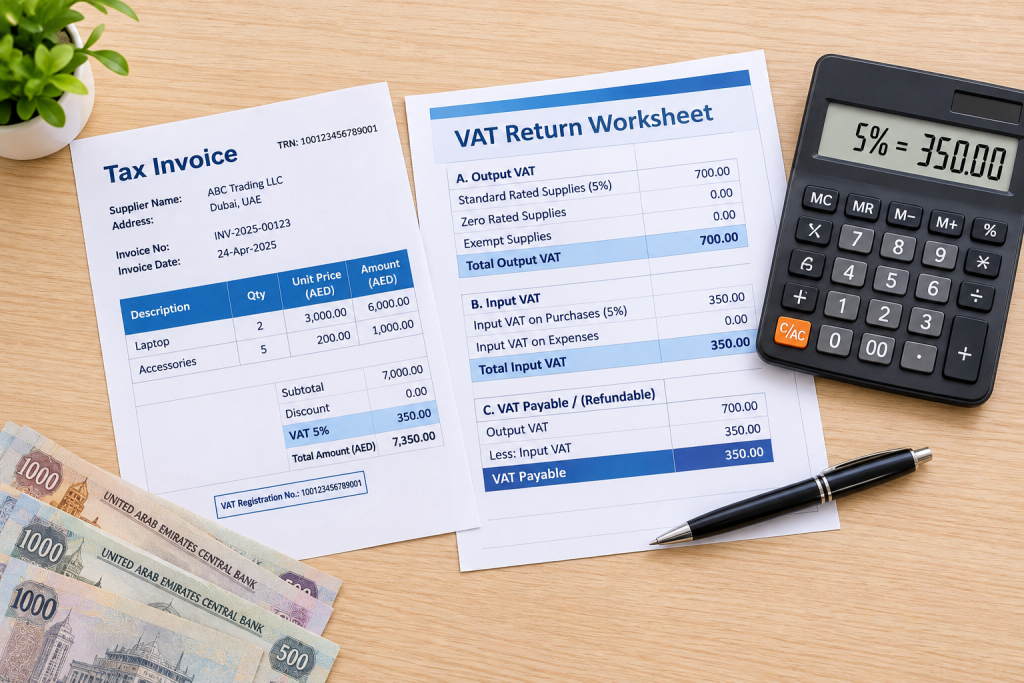
Tax invoice details, input VAT and the VAT return are the three areas interviewers test most.
Answer: VAT is a consumption tax collected at each stage of the supply chain. The UAE introduced it on 1 January 2018 at a standard rate of 5%. Businesses collect it from customers and pass it to the Federal Tax Authority (FTA), after deducting the VAT paid on eligible purchases.
Answer: Output tax is VAT charged on sales; input tax is VAT paid on purchases. Example: output VAT AED 5,000 less recoverable input VAT AED 3,200 means AED 1,800 payable to the FTA. If input exceeds output, the business can claim a refund or carry the credit forward.
Answer: Registration is mandatory when taxable supplies and imports exceed AED 375,000 over the previous 12 months, or are expected to in the next 30 days. Businesses above AED 187,500 can register voluntarily. The application must be made within 30 days of crossing the mandatory threshold, and late registration carries a fixed AED 10,000 penalty.
Answer: Key items are:
Missing fields can block input VAT recovery. Our guide to common UAE VAT mistakes lists the errors we see most.
Answer: Both produce no VAT charge to the customer, but they differ for the supplier:
| Feature | Zero-Rated (0%) | Exempt |
|---|---|---|
| VAT charged | 0% | None |
| Input VAT recovery | Yes | No |
| Included in VAT return | Yes, as a taxable supply | Reported separately |
| Examples | Exports outside the GCC, international transport | Residential leasing, local passenger transport |
The mistake to avoid is saying zero-rated supplies cannot recover input VAT. They can.
Answer: The return (VAT 201) is submitted through the FTA’s EmaraTax portal within 28 days of the end of the tax period, and payment is due by the same date. Tax periods are generally quarterly, though the FTA can assign monthly periods. My process: reconcile VAT accounts to the ledger, review invoices, prepare the return, get approval, file early and keep records.
Answer: It shifts responsibility to account for VAT from the supplier to the recipient, typically on services imported from abroad. The recipient reports output VAT and, if entitled, the input VAT on the same return. I flag the supplier invoice so the transaction is not missed.
Answer: When a supply is cancelled, the price is reduced or goods are returned after a tax invoice was issued. The credit note reduces the supplier’s output VAT and the customer’s input VAT, and is reflected in the return for the period it is issued. Amounts must be shown in AED.
Answer: Input VAT is generally recoverable only on expenses wholly for business purposes. Categories such as entertainment for clients or other non-employees, and motor vehicles made available to employees, are generally blocked. I check the category before claiming, because the exact rules have conditions.
Answer: I quantify the impact, tell my manager, and correct it through the route the FTA currently allows, such as a voluntary disclosure. The rules and thresholds were revised for 2026, so I check the latest FTA guidance. The FTA penalty table was also amended in April 2026, so I confirm current amounts rather than quote old ones.
From registration and invoicing to reverse charge and penalties: learn it the way the interview asks it.
Answer: The UAE applies 0% on taxable income up to AED 375,000 and 9% on the portion above it, for financial years starting on or after 1 June 2023. Example: taxable income of AED 1,000,000 means tax on AED 625,000 × 9% = AED 56,250. Our guide on calculating taxable income under UAE Corporate Tax walks through the adjustments.
Answer: Companies incorporated on or after 1 March 2024 must register within three months of incorporation. Late registration carries an AED 10,000 penalty, which the FTA may waive if the first return is filed within seven months of the end of the first tax period. I confirm the position in current FTA guidance.
Answer: Within nine months of the end of the financial year, through EmaraTax, and payment is due by the same date. For a 31 December 2025 year-end, the deadline is 30 September 2026. I build the timeline backwards so audit and tax computation finish well before it.
Answer: Start with accounting profit under IFRS, then adjust: remove exempt income, add back non-deductible items, apply limits such as the 50% entertainment rule and interest cap, then deduct eligible carried-forward losses. The result is taxable income. I keep a reconciliation schedule for the auditor.
Answer: An eligible resident person with revenue of AED 3 million or less in the current and previous tax periods can elect to be treated as having no taxable income. It is an election, not automatic, and does not apply to Qualifying Free Zone Persons. The relief covers a limited number of tax periods, so I confirm the current end date with the Ministry of Finance.
Answer: A Qualifying Free Zone Person pays 0% on qualifying income and 9% on non-qualifying income, provided it meets the conditions, including maintaining adequate substance. Free zone companies must still register and file returns, and I check the entity’s status before assuming 0% applies.
Answer: Business expenses such as salaries, rent, professional fees and depreciation are generally deductible. Fines and penalties, bribes, dividends, personal expenses and the Corporate Tax itself are not. Expenses must be incurred wholly and exclusively for business, with supporting documents.
Answer: Only 50% of entertainment, amusement and recreation expenses for customers, suppliers, shareholders and other business contacts is deductible. Entertainment of the company’s own staff is outside that 50% rule. I record the business purpose and attendees.
Answer: Tax losses can be carried forward, but the offset in any year is limited to 75% of taxable income. With AED 1,000,000 of taxable income, only AED 750,000 can be offset, leaving AED 250,000 taxable. I track a loss schedule by year.
Answer: Corporate Tax is charged on profit (0% to AED 375,000, 9% above) and filed annually. VAT is charged on supplies at 5% and filed periodically, with a 28-day deadline. VAT is passed to consumers; Corporate Tax is a cost to the business. Our VAT vs Corporate Tax course comparison explains both.
Cover taxable income, tax planning and tax accounting in a structured Basic, Intermediate and Advanced programme.

Practising with real software and mock questions builds the confidence interviews reward.
Answer: VLOOKUP searches the first column and returns a value to its right; XLOOKUP can look in any direction, defaults to exact match and has a built-in “not found” option. I use XLOOKUP where the version allows it and VLOOKUP when sharing with older files.
Answer: INDEX-MATCH returns a value from any column and keeps working if columns are inserted. I use it to pull invoice values from a ledger by invoice number when the lookup column is not on the left.
Answer: SUMIFS totals values that meet several conditions, such as sales by customer and month. COUNTIFS counts matching rows, useful for checking how many invoices are overdue. They give quick control totals for reconciliations.
Answer: I turn ledger data into summaries, such as expenses by category and month, and refresh after new data. A pivot quickly shows unusual spikes and ties back to the trial balance, so I use it for variance analysis.
Answer: Relative references (A1) shift when copied; absolute references ($A$1) stay fixed. For a VAT rate in one cell, I write =B2*$F$1 so the rate stays locked when the formula is copied down.
Answer: I add a lookup or COUNTIF column that flags items found in the other list, then filter the unmatched ones. Amounts, dates and references are all compared, and every unmatched item is explained before sign-off.
Answer: I calculate days outstanding as report date minus invoice date, group them into buckets (0–30, 31–60, 61–90, 90+), and summarise with SUMIFS or a PivotTable. I check that the total agrees to the receivables control account.
Answer: SLN gives straight-line depreciation, DB gives fixed-declining balance, and DDB gives double-declining. For cost AED 50,000, salvage AED 5,000 and five years, =SLN(50000,5000,5) returns AED 9,000 per year.
Answer: To add 5% VAT: =Net5%. To extract VAT from a VAT-inclusive amount: =Gross/1.050.05, so AED 10,500 gives AED 500. I round to two decimals and cross-check against the invoice.
Answer: I use Power Query to combine monthly files, clean columns and refresh reports in one click instead of copying data manually. This reduces errors and frees time for review. Alifbyte’s CMCA course lists Power Query among its Excel topics.
Build PivotTables, financial statements and error-checking skills with a dedicated Excel course for accounting.
Answer (STAR): Situation: during a review I noticed input VAT claimed on an invoice missing the supplier’s TRN. Task: correct it without delay. Action: I informed my manager, quantified the impact, and prepared the correction through the FTA route that applied under its current rules. Result: the error was corrected before any audit, and I added an invoice checklist to stop it recurring.
Answer: My checklist is:
I time-box each step so reporting is delivered on the agreed working day.
Answer: I give a 60-second summary: current role, years of experience, software (Tally, QuickBooks, Excel), UAE compliance work such as VAT filing, one achievement with a number, and why this role fits. I avoid reading my CV aloud.
Answer (STAR): Situation: a manager wanted an expense booked in the wrong period. Task: protect accuracy without damaging the relationship. Action: I showed the invoice date and the relevant accounting policy, and proposed an accrual instead. Result: the entry was corrected, and we agreed a cut-off checklist. I stay respectful, factual and escalate only if integrity is at risk.
Good questions show commercial awareness:
Hold salary questions until the employer raises them or the later rounds. For benchmarks, see our accountant salary in Dubai guide.
| Your Gap | Alifbyte Course | Course Facts |
|---|---|---|
| Foundations plus software, Excel and tax (Q1–Q10) | CMCA | 70 hours; 5 modules |
| Tally Prime and UAE VAT in software (Q11–Q20) | Tally Prime Training | 24 hours; 7 modules |
| QuickBooks (Q21–Q30) | QuickBooks Training | 8 modules; 3 levels |
| VAT theory and returns (Q31–Q40) | UAE VAT Training | 3 levels |
| Corporate Tax (Q41–Q50) | Corporate Tax Training | 4 modules; 3 levels |
| Excel for accountants (Q51–Q60) | MS Excel for Accounting | 8 modules; 3 levels |
Courses run from Alifbyte’s Dubai (Al Karama) and Sharjah (Al Qasba) centres, and the institute states that it offers online and offline learning with flexible schedules.
It varies by employer. A common pattern is CV screening, a technical test or interview, an HR round and a final managerial round.
It depends on the company. Job posts and recruiter guides list both, alongside SAP, Oracle and Zoho Books. Learn one deeply and understand the other.
Alifbyte’s Tally Prime course is 24 hours across seven modules, according to the course page.
Lookup functions such as VLOOKUP, pivot tables and data cleaning are commonly mentioned. Our MS Excel for Accounting course covers PivotTables and financial statements.
The standard rate is 5%.
The mandatory threshold is AED 375,000 and the voluntary threshold is AED 187,500.
Within 28 days after the end of the tax period.
0% on taxable income up to AED 375,000 and 9% above that amount.
Qualifying Free Zone Persons pay 0% on qualifying income, while non-qualifying income is taxed at 9%. Free zone companies must still register and file.
Alifbyte describes its CMCA course as designed to turn non-accountants into professional accountants in 70 hours. It combines business accounting, software, Excel, VAT and Corporate Tax.
Revise journal entries, bank reconciliation, input vs output VAT, zero-rated vs exempt supplies, the VAT filing deadline and your own software examples.
Research market ranges first, give a realistic range tied to your skills and certifications, and stay flexible. Our salary guide above is a good starting point.
Strong answers combine three layers: the accounting concept, the UAE rule and the software step. Practise these accounting interview questions UAE employers use, say each answer aloud with a number, and back it with one real example. If a topic feels thin, whether Tally, QuickBooks, VAT, Corporate Tax or Excel, close the gap with focused training before the interview, not after the rejection.