


The UAE’s data analytics industry is experiencing unprecedented growth, creating thousands of opportunities for aspiring professionals. Yet many talented individuals struggle to break into this lucrative field, unsure of the exact skills and qualifications needed to succeed in the competitive Middle Eastern market.
Without the right roadmap, you risk investing time and money in irrelevant certifications while competitors with focused training secure high-paying positions in Dubai’s thriving tech sector. The gap between your current skills and employer expectations continues to widen each day.
This comprehensive guide reveals the proven pathway to becoming a successful data analyst in the UAE, covering everything from essential technical skills to certification requirements, salary expectations, and practical job search strategies tailored specifically for the Emirates market.
Data analysts in the UAE serve as the bridge between raw business data and actionable insights that drive strategic decision-making. The role has evolved significantly across Dubai, Abu Dhabi, and Sharjah, with organizations increasingly relying on data-driven approaches to maintain competitive advantages in sectors ranging from finance to healthcare.
In the UAE context, data analysts are expected to understand both global analytics standards and regional business practices. The finance career landscape in UAE provides valuable context for data professionals, as many analytics roles intersect with financial services.
UAE employers particularly value analysts who can work with Arabic and English datasets, understand GCC market dynamics, and adapt international analytics frameworks to regional requirements. The role encompasses data collection, cleaning, analysis, visualization, and reporting, with increasing emphasis on predictive analytics and machine learning fundamentals.

While many UAE companies prefer candidates with bachelor’s degrees, the field has become increasingly flexible regarding educational backgrounds. The most valued degree programs include:
Computer Science and Information Technology: Provides strong programming foundations essential for modern data analytics, with emphasis on database management and algorithm design.
Statistics and Mathematics: Offers the analytical rigor needed for advanced statistical modeling and hypothesis testing that forms the backbone of data-driven insights.
Economics and Business Analytics: Combines quantitative skills with business acumen, particularly valuable for roles in financial services and consulting firms across Dubai and Abu Dhabi.
Engineering Programs: Especially industrial, systems, or software engineering, which develop problem-solving capabilities and technical proficiency highly transferable to analytics roles.
For professionals without technical degrees, career transitions into data analytics remain entirely achievable through focused skill development. Similar to changing careers to accounting, success in data analytics requires dedication to learning rather than specific educational credentials.
Professional Certifications: Industry-recognized credentials from Google, Microsoft, and IBM often carry equal or greater weight than traditional degrees, particularly when combined with demonstrable skills.
Bootcamp Programs: Intensive 12-16 week programs focusing on practical skills have gained acceptance among UAE employers, especially for entry-level positions in startups and tech companies.
Self-Directed Learning: With dedication and structured approach, professionals can develop necessary competencies through online platforms, open-source projects, and portfolio development without formal education.

Success as a data analyst in the Emirates requires mastery of specific technical competencies that UAE employers consistently demand across industries.
Python has emerged as the dominant language for data analysis in the UAE market. The versatility and extensive library ecosystem make it indispensable for modern analytics workflows. Learning Python provides competitive advantages across virtually all analytics positions in the region.
Critical Python libraries include Pandas for data manipulation, NumPy for numerical computing, Matplotlib and Seaborn for visualization, and Scikit-learn for basic machine learning implementations.
R Programming maintains relevance particularly in academic research, pharmaceutical analytics, and advanced statistical modeling, though Python has overtaken it in business applications.
SQL proficiency represents the single most critical technical skill for UAE data analysts. Every role requires the ability to query relational databases, manipulate data structures, and optimize query performance.
UAE companies extensively use SQL Server, Oracle, MySQL, and PostgreSQL. Mastery involves not just basic SELECT statements but complex joins, subqueries, window functions, and performance optimization techniques.
Microsoft Power BI dominates the UAE business intelligence landscape due to its seamless integration with Microsoft’s ecosystem widely adopted across Emirates organizations. The Power BI vs Tableau comparison reveals why Power BI holds particular advantages in the UAE market.
Tableau maintains strong presence in consulting firms and multinational corporations, offering powerful visualization capabilities for complex data storytelling.
Both tools require proficiency in dashboard design, interactive reporting, data modeling, and understanding user experience principles for effective communication of insights.
Microsoft Excel remains foundational despite advanced analytics tools. UAE employers expect mastery of pivot tables, VLOOKUP/XLOOKUP, Power Query for data transformation, and advanced formulas. Advanced MS Excel skills continue delivering measurable career advantages.
Understanding how to use Excel for accounting purposes proves particularly valuable for analysts working in finance and auditing sectors prevalent across the UAE.
Strong statistical foundations enable proper interpretation of results and avoid common analytical pitfalls. Essential concepts include hypothesis testing, regression analysis, probability distributions, correlation versus causation, and experimental design.
Understanding these principles ensures analysts deliver accurate insights rather than misleading conclusions that could drive poor business decisions.

Professional certifications significantly enhance employment prospects and earning potential in the UAE data analytics market. Employers view these credentials as validation of practical competencies beyond theoretical knowledge.
This certification holds exceptional value in the UAE due to Power BI’s market dominance. It validates abilities in data preparation, modeling, visualization, and deployment using Power BI Desktop and Service.
The certification requires passing the PL-300 exam, covering data transformation with Power Query, DAX formula creation, dashboard development, and workspace management. UAE employers actively seek candidates with this credential for business intelligence roles.
Offered through Coursera, this entry-level program provides comprehensive coverage of the analytics process from data collection through visualization. The certificate program teaches spreadsheet fundamentals, SQL basics, R programming for analysis, and Tableau for visualization.
The credential offers particular value for career changers and fresh graduates entering the UAE market, providing structured learning paths and industry-recognized validation.
This certification emphasizes Python-based analytics, covering data collection methodologies, data wrangling with Pandas, exploratory data analysis, visualization with Matplotlib, and basic machine learning concepts.
The program’s hands-on approach aligns well with UAE employer preferences for demonstrated practical skills over purely theoretical knowledge.
This vendor-neutral certification attests to comprehensive understanding of the entire analytics process, from problem definition through model deployment and business integration. The certification carries significant weight for senior-level positions and consulting roles.
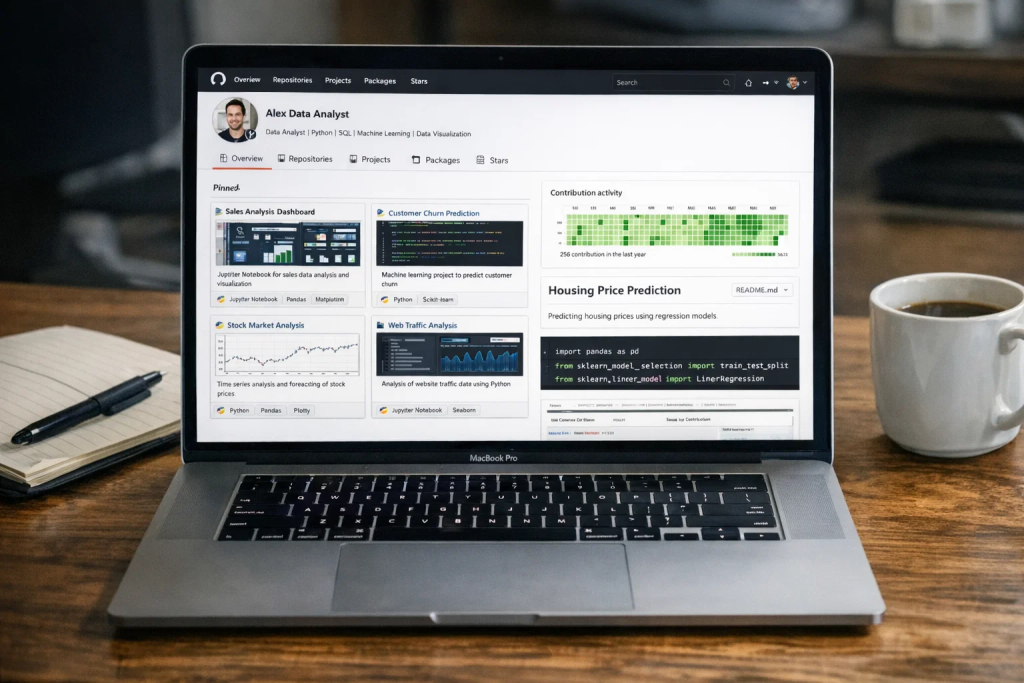
Practical experience significantly increases hiring prospects in the competitive UAE market. Employers consistently prioritize candidates who demonstrate ability to solve real-world problems with data.
Business Analytics Projects: Analyze publicly available datasets from UAE government open data portals, examining patterns in tourism, real estate, or economic indicators. Present findings through interactive dashboards addressing genuine business questions.
Customer Segmentation Analysis: Use clustering algorithms to segment customers based on purchasing behavior, demographic data, or engagement patterns, demonstrating understanding of marketing analytics applications.
Financial Analysis Dashboard: Create comprehensive financial performance dashboards tracking KPIs, revenue trends, and profitability metrics, particularly relevant for the strong accounting and finance sector in UAE.
Predictive Modeling: Build forecasting models for sales, inventory, or demand planning, showcasing ability to deliver forward-looking insights beyond descriptive analytics.
Host projects on GitHub demonstrating version control proficiency, clear documentation, and collaborative development practices. Create interactive dashboards on Power BI Service or Tableau Public allowing potential employers to explore your analytical thinking.
Develop case studies explaining business context, analytical approach, key findings, and recommendations for each project. This storytelling demonstrates business acumen alongside technical capabilities.
Understanding the difference between data analyst and data scientist roles helps in tailoring portfolio projects to appropriate complexity levels for the positions you target.

The UAE data analytics job market demonstrates robust growth with strong demand across Emirates, particularly in Dubai’s free zones and Abu Dhabi’s government and oil sectors.
Entry-level data analysts in UAE earn between AED 8,000 to AED 12,000 monthly, with variations based on qualifications, company size, and industry sector. Fresh graduates with strong technical skills and certifications typically command higher starting salaries.
Mid-level analysts with 3-5 years experience earn AED 15,000 to AED 25,000 monthly, especially those demonstrating expertise in specific industries or advanced analytical techniques. Senior data analysts and team leads earn AED 25,000 to AED 40,000+ monthly, with additional benefits including housing allowances, health insurance, and performance bonuses.
For detailed data analyst salary information in UAE, including breakdowns by experience level and city, refer to comprehensive market research specific to the Emirates.
UAE positions typically include housing allowances, health insurance, annual flight tickets, performance bonuses, and professional development budgets. Tax-free income significantly increases take-home earnings compared to many international markets.
Dubai and Abu Dhabi’s position as regional financial hubs creates extensive opportunities in banking, insurance, and investment management. Data analysts work on fraud detection, risk assessment, customer behavior analysis, and regulatory compliance reporting.
Abu Dhabi’s energy sector employs data analysts for exploration optimization, production efficiency, predictive maintenance, and supply chain analytics. These roles often command premium salaries with extensive benefits.
Growing healthcare infrastructure across UAE requires analysts for patient outcome improvement, hospital operations optimization, clinical trial analysis, and public health monitoring.
Rapid e-commerce growth drives demand for customer analytics, inventory optimization, pricing strategy, and marketing effectiveness measurement. Companies seek analysts who understand both online and offline retail dynamics.
Smart city initiatives in Dubai and Abu Dhabi create opportunities in policy analysis, resource management, citizen service optimization, and urban planning analytics.
UAE’s growing startup ecosystem, particularly in Dubai Internet City and Abu Dhabi’s Hub71, seeks analysts for product analytics, user behavior tracking, and growth optimization.
Tailor resumes to UAE employer expectations by highlighting relevant technical skills prominently, quantifying achievements with specific metrics, and emphasizing certifications and practical projects. Include visa status clearly, as this impacts hiring decisions.
Format resumes professionally with clear sections, avoiding excessive graphics that may not parse well through applicant tracking systems. Emphasize any experience with tools and platforms common in UAE markets.
LinkedIn Optimization: Maintain active presence with UAE-focused keywords, engage with local data analytics groups, and connect with recruiters specializing in analytics placements across Emirates.
Job Portals: Regular applications on Bayt, GulfTalent, Naukrigulf, and Indeed UAE, filtering for data analyst positions matching your skill level and interests.
Direct Applications: Research companies in target industries and apply directly through career pages, often avoiding competition from mass applications on job boards.
Networking: Attend Dubai and Abu Dhabi data science meetups, participate in analytics conferences, and engage with professional communities on LinkedIn and local forums.
Prepare for technical assessments involving SQL queries, Excel tasks, case studies requiring data interpretation, and behavioral questions about analytical problem-solving approaches.
Practice explaining technical concepts to non-technical audiences, demonstrating business acumen alongside technical proficiency. Understand the company’s industry and prepare questions showing genuine interest in their data challenges.
The data analytics career path in UAE offers clear progression from junior analyst to senior leadership positions.
Years 1-2: Focus on mastering fundamental skills, gaining exposure to different analytical tools and techniques, and understanding specific industry dynamics.
Years 3-5: Develop specialization in particular industries or analytical techniques, begin mentoring junior analysts, and take ownership of larger analytical projects.
Years 5+: Progress to senior analyst roles with team leadership responsibilities, transition into data science positions requiring advanced machine learning, or move into management focusing on analytics strategy and team development.
Strong analytical skills enable transitions into business intelligence development, data engineering focusing on pipeline creation, product management leveraging user analytics, or management consulting applying analytical frameworks to business problems.
Understanding career opportunities in Power Query and related technologies opens additional specialization paths within the analytics field.
With focused learning, individuals can develop essential skills within 6-12 months through intensive study and practical project work. However, mastery develops over years of applied experience. The timeline varies based on existing background, daily time commitment, and learning approach.
Python has become the dominant programming language for data analytics in UAE due to its versatility, extensive libraries, and application beyond analytics into automation and web development. While R maintains relevance in specific sectors like pharmaceuticals and academic research, Python proficiency opens more opportunities across UAE industries.
Absolutely. Many successful UAE data analysts come from non-technical backgrounds including business, economics, and humanities. The key involves developing technical competencies through structured learning, earning relevant certifications, and building portfolios demonstrating practical analytical capabilities.
Financial services and banking dominate data analytics hiring in UAE, followed by retail and e-commerce, government and public sector, oil and gas, healthcare, and technology startups. Dubai’s diversified economy creates opportunities across virtually all sectors for skilled analysts.
Arabic language skills are not required for most data analyst positions in UAE, though they provide advantages for certain government and local market-focused roles. English serves as the primary business language, and proficiency in English communication both written and verbal proves essential.
Microsoft Certified Power BI Data Analyst Associate holds exceptional value due to Power BI’s market dominance in UAE. Google Data Analytics Professional Certificate provides strong foundation for entry-level candidates. IBM Data Analyst and Certified Analytics Professional credentials also command respect, particularly for specialized or senior positions.
The UAE data analytics market remains highly competitive but simultaneously experiences strong demand. Well-prepared candidates with relevant skills, certifications, and portfolios consistently find opportunities, while those lacking practical demonstrated abilities face challenges despite educational credentials.
Begin with Microsoft Excel including Power Query, then SQL for database querying, followed by Power BI for visualization. After mastering these foundations, add Python with Pandas library. This sequence addresses immediate UAE market demands while building toward more advanced analytical capabilities.
Yes, though competition remains intense. Fresh graduates succeed by combining relevant certifications, strong technical skills, impressive portfolio projects, and strategic job search approaches. Some companies specifically recruit fresh graduates for junior analyst positions with training programs.
Work culture varies by company but typically includes standard office hours with some flexibility, collaborative team environments, emphasis on continuous learning and professional development, and exposure to international best practices. Larger organizations offer structured career development programs.
Extremely important. Power BI has become the dominant business intelligence platform across UAE organizations due to Microsoft ecosystem integration. Most job descriptions specifically require Power BI proficiency, making it near-essential for employment in the Emirates analytics market.
Specialization offers advantages once you’ve developed foundational skills. Healthcare, finance, and retail analytics each require industry-specific knowledge beyond technical capabilities. Starting with broad analytics skills then specializing based on interests and opportunities provides balanced career development.
Becoming a successful data analyst in UAE requires strategic development of technical skills, relevant certifications, and practical portfolio projects that demonstrate your analytical capabilities. The Emirates market rewards professionals who combine technical proficiency with business acumen and cultural awareness.
Start by mastering foundational tools like Excel, SQL, and Power BI while pursuing recognized certifications. Build impressive portfolio projects showcasing real-world problem-solving abilities. Network actively within UAE’s analytics community and maintain persistent, strategic job search approaches.
Ready to launch your data analytics career in UAE? Explore comprehensive data analytics training programs at Alifbyte Education designed specifically for professionals targeting the Emirates market. Our industry-aligned courses provide the exact skills UAE employers demand, from foundational Excel to advanced Python analytics and Power BI mastery.