


You keep updating your CV but the callbacks aren’t coming. Meanwhile, someone with a 6-week QuickBooks certificate just landed the accounts assistant role you applied for. That’s the reality of the UAE job market right now — employers here are increasingly hiring for proven, specific skills rather than general qualifications. The right short courses in UAE can close that gap faster than you think, without spending years back in a classroom.
Not every short course deserves your time or money. In the UAE context, a course is genuinely worth pursuing when it meets three conditions:
The UAE’s professional landscape has another unique advantage — a huge proportion of the workforce is mid-career expatriate professionals looking to upskill or pivot. This means the market for professional development courses in Dubai is mature, competitive in pricing, and well-structured for working adults.
These are among the highest-demand short courses in UAE because almost every SME, trading company, and construction firm needs someone who can operate accounting software and handle UAE-specific compliance.
1. QuickBooks Training QuickBooks is the most widely used accounting software among small and medium businesses in Dubai and Sharjah. A QuickBooks training course typically runs 4–6 weeks and covers everything from setting up a company file to generating VAT-compliant financial reports. If you’re applying for bookkeeper, accounts assistant, or junior accountant roles, QuickBooks proficiency is often listed as a non-negotiable requirement.
2. Tally Prime Tally Prime dominates the accounting software market among Indian-managed businesses across the UAE — a demographic that represents a significant share of the UAE’s business ecosystem. A Tally Prime training course in Dubai covers ledger management, payroll, inventory, and GST/VAT handling. It’s one of the most cost-effective certifications available, and the career paths after a Tally course are broader than most people realize.
3. UAE VAT Training Since VAT was introduced in the UAE in 2018, businesses have needed professionals who understand VAT registration, filing, and compliance. A dedicated UAE VAT training course is typically 2–3 days and is a sharp differentiator on any finance or accounts CV. Pair this with the UAE Corporate Tax training, introduced in 2023, and you’ve built a compliance skill set that very few entry-level candidates possess.
4. MS Excel for Accounting (CMCA) Underestimated but genuinely powerful. The Computerised and Manual Accounting (CMCA) course using Excel combines manual bookkeeping fundamentals with Excel-based financial reporting. For anyone entering the accounting field in the UAE without a formal accounting degree, this is a solid starting foundation.

5. Power BI If you want to break into data analytics or make yourself more valuable in a finance or operations role, Power BI training is the most direct path. Microsoft’s business intelligence tool is used across sectors — banking, retail, logistics, real estate — and a short course of 4–8 weeks gives you enough hands-on experience to build dashboards and present data insights. When comparing options, understanding the difference between Power BI and Tableau helps you decide which to learn first for the UAE market (Power BI generally edges ahead for corporate roles).
6. Advanced MS Excel Before jumping to Power BI, many employers in the UAE still screen candidates for Excel proficiency. Advanced MS Excel training covers PivotTables, VLOOKUP, Power Query, and financial modelling — skills that directly translate to productivity gains that hiring managers can measure. This is a 3–4 week course with immediate, visible job market impact.
7. Digital Marketing The UAE’s e-commerce and retail sectors have expanded rapidly, creating consistent demand for professionals who understand SEO, paid advertising, email marketing, and social media management. A digital marketing short course in Dubai typically spans 6–8 weeks and covers both organic and paid digital channels. This is one of the few short courses in UAE where you can build a visible portfolio during the course itself, which directly strengthens your CV.
8. AutoCAD / Revit / BIM Training For anyone in construction, architecture, or engineering — sectors that are booming across Dubai and Abu Dhabi — AutoCAD and BIM certifications are genuinely job-critical. These aren’t long-term degrees; short courses run 4–8 weeks and are directly tied to project roles in UAE infrastructure development.
9. Python Programming Python has become the go-to entry point for professionals wanting to move into data science, automation, or AI-adjacent roles. A focused beginner-to-intermediate Python course won’t make you a developer in 6 weeks, but it gives you enough to automate Excel tasks, work with data sets, and apply for junior data analyst roles — especially when combined with a Power BI or data analytics background.

10. Business English & Spoken English In the UAE’s multicultural work environment, communication is a core competency. Many professionals — especially those who studied in their home country and are now working in English-speaking corporate environments — find that improving their spoken English and business English skills directly accelerates their career growth. These courses typically run 4–8 weeks and can be attended on weekends.
11. IELTS / TOEFL For professionals planning to pursue further international qualifications, a work visa for an English-speaking country, or a KHDA-recognized certification, IELTS and TOEFL preparation courses are worthwhile short-term investments. Most preparation courses run 4–6 weeks.
Yes — but with an important condition. A short course works as a job-search tool when it teaches something specific that the employer needs right now. It doesn’t work when it’s too generic to signal actual capability.
Here’s the practical reality of the UAE hiring market:
For entry-level roles, a short course certificate combined with even one or two real-world projects (a sample QuickBooks company file, a Power BI dashboard you built during training) gives you something tangible to show. That’s more persuasive to a Dubai recruiter than a broad qualification with no applied component.
For mid-career professionals, a short course demonstrates initiative. A finance professional who completes a UAE Corporate Tax short course is signalling to their employer or future employer that they’re keeping pace with regulatory changes — that’s directly bankable.
For career changers, short courses are particularly effective when they’re stacked strategically. For example, combining a QuickBooks certificate with a UAE VAT training certificate positions you for accounts assistant roles in ways that either certificate alone would not.
What short courses cannot do is replace foundational qualifications for regulated professions. If you want to become a licensed auditor or CPA, a short course is a stepping stone, not a destination. But for the majority of business support, finance, data, and technology roles available in the UAE right now, the right short course in the right field genuinely does move the needle.

This is the question that matters most for people starting fresh. If you’re in Dubai with no direct work experience in your target field, you need certifications that are:
Here are the certifications that genuinely check all three boxes for entry-level positions in the UAE:
For Accounting/Finance Entry-Level Jobs: The most effective combination is a QuickBooks or Tally Prime certificate + UAE VAT awareness training. This positions you for accounts assistant, bookkeeper, and payroll assistant roles — the three most frequently advertised entry-level finance positions in Dubai and Sharjah. You can explore the full range of accounting courses and pick the combination that fits your timeline. Those interested in how to actually begin should read the detailed guide on how to start an accounting career in the UAE.
For Data/Analytics Entry-Level Jobs: Advanced Excel + Power BI is the most cost-effective two-course stack for breaking into data roles. Together, they cover data cleaning, visualization, and reporting — the three tasks that junior data analyst job descriptions almost universally list. Browse the available data analytics courses to compare formats and durations.
For Tech/Digital Entry-Level Jobs: A Digital Marketing certificate is one of the few short courses in UAE where you can simultaneously build your portfolio as you learn. By the time you finish, you should have worked on mock campaigns that you can show to employers.
For Construction/Engineering Entry-Level Jobs: An AutoCAD short course is the single most direct path to draughting and design support roles in the UAE construction sector. Combined with a Revit or BIM basics certificate, it opens doors to CAD technician positions.
One important note: if you’re changing careers entirely rather than entering at entry-level, the bar is higher. Read more about how to change careers to accounting for a realistic step-by-step view of what that transition actually looks like in the UAE market.
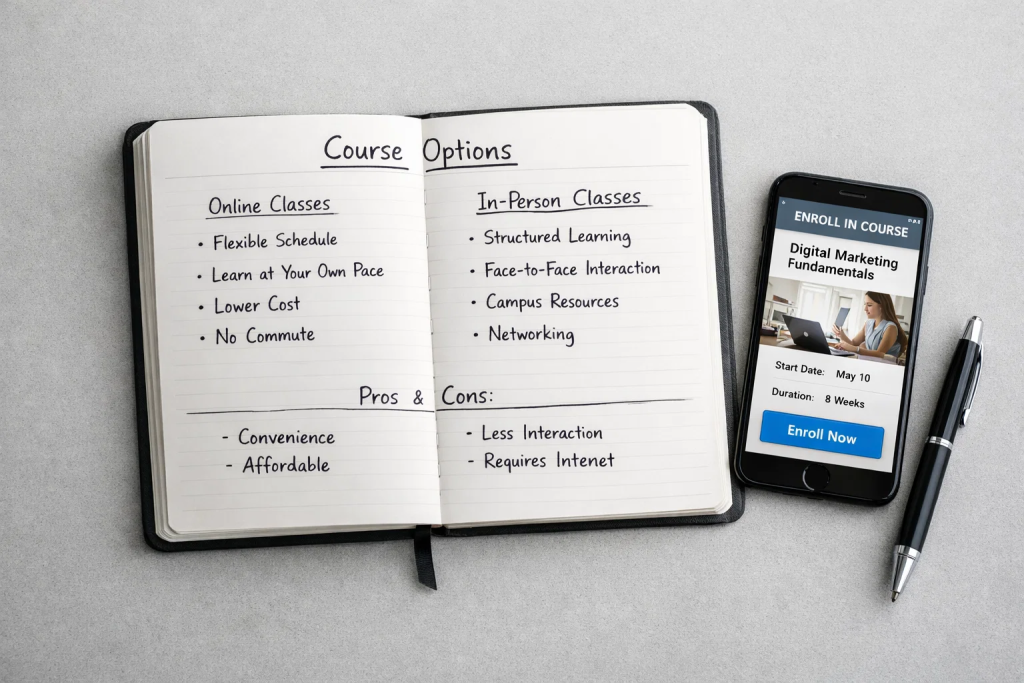
Three questions to run through before enrolling:
1. Does it appear on job descriptions? Search LinkedIn or Bayt for the role you want. If the course you’re considering isn’t mentioned — directly or indirectly — in at least 30–40% of relevant job ads, it may not move your application.
2. Is the training provider KHDA-approved? The Knowledge and Human Development Authority (KHDA) regulates private training providers in Dubai. A certificate from a KHDA-registered institute carries more credibility with UAE employers than an unregulated provider, particularly for government-related or semi-government sector roles.
3. Do you get hands-on practice, not just theory? The best short courses in UAE give you live software access, real data sets to work with, or real campaign simulations. Theory-only courses rarely translate into the kind of practical confidence that shows in an interview. Check the professional courses in Dubai available and look for those with hands-on lab components.
QuickBooks, Tally Prime, Power BI, Advanced Excel, UAE VAT Training, Corporate Tax, Digital Marketing, and AutoCAD are consistently in demand across Dubai, Abu Dhabi, and Sharjah.
Yes, particularly for roles in accounting support, data analysis, digital marketing, and IT. Employers in the UAE’s SME sector especially prioritize practical skills over formal degrees for entry-level and mid-level positions.
Instructor-led online courses from recognized providers are generally accepted. However, a certificate from a KHDA-approved physical training institute carries more weight for UAE government-related or corporate roles.
Yes. Most professional training providers in Dubai and Sharjah offer weekend and evening batches specifically for working professionals.
If you’re already in finance, UAE Corporate Tax and Advanced Excel are the two highest-return short courses to add to your profile right now. If you’re entering finance for the first time, QuickBooks or Tally Prime combined with UAE VAT training is the more strategic starting point. Also read our guide on whether finance is a good career in the UAE.
Power BI is one of the most transferable data skills you can have in the UAE right now. It’s used across banking, real estate, logistics, and retail — sectors that are all actively hiring in the UAE.
The Accounting for Non-Accounting Professionals course and the CMCA (Computerised and Manual Accounting) course are both designed specifically for professionals who need accounting literacy without becoming full accountants.
Check for KHDA registration (for Dubai), check if they have verifiable physical premises, look for reviews on Google Maps from past students, and verify whether the certificate they issue is accepted by employers in your target industry.
Start with Advanced Excel, then move to Power BI. This two-stage path gives you foundational data handling skills followed by visualization and reporting capability — the combination most data analyst job listings in the UAE look for at entry level.
Short courses in UAE work — but only when you choose them deliberately. The professionals who see real results aren’t the ones who enrolled in the most courses. They’re the ones who identified exactly what skill their target employer was paying for, built that skill with a hands-on course, and showed up to the interview with proof of it.
If you’re starting out, pick one course that maps directly to job listings in your target field and finish it properly. If you’re looking to pivot, stack two complementary short courses that together tell a clear story about the role you’re moving into.
The UAE job market rewards specific, applied skills. A QuickBooks certificate doesn’t just look good on paper — it means you can sit down on day one and actually do the job. That’s what employers here are hiring for.
Explore the professional courses in Dubai available at Alifbyte Education, or browse by category — accounting, data analytics, IT, and language courses — to find the right fit for where you want to go next.