
Most accounting professionals in the UAE know VAT exists. Far fewer actually understand how to handle it correctly — and that gap is costing businesses real money and real penalties. If you’re working in finance, accounting, or even business management and you haven’t pursued structured VAT training, you’re carrying more risk than you realise. This guide breaks down every genuine benefit of VAT training in UAE, who needs it, and how to get started.
The UAE introduced Value Added Tax (VAT) at a standard rate of 5% on January 1, 2018. Since then, every business registered with the Federal Tax Authority (FTA) is required to file accurate VAT returns, maintain proper records, and stay on the right side of UAE tax law.
VAT training teaches you exactly how to do all of that — correctly, consistently, and with confidence. It isn’t just a course for accountants. It’s practical knowledge for anyone who touches invoices, financial records, expense reports, or business transactions in the UAE.
A structured UAE VAT training course typically covers the mechanics of the VAT law, how to calculate input and output tax, how to file returns through the FTA portal, and how to handle exemptions, zero-rated supplies, and common compliance errors.
Before you assume this is only for tax specialists, here is the reality: VAT errors happen most often because non-specialists are handling VAT tasks without proper guidance.
If your work in the UAE involves money moving in or out of a business, VAT training gives you a critical advantage. You can explore the full range of accounting courses available in the UAE to see how VAT fits into a broader skill set.
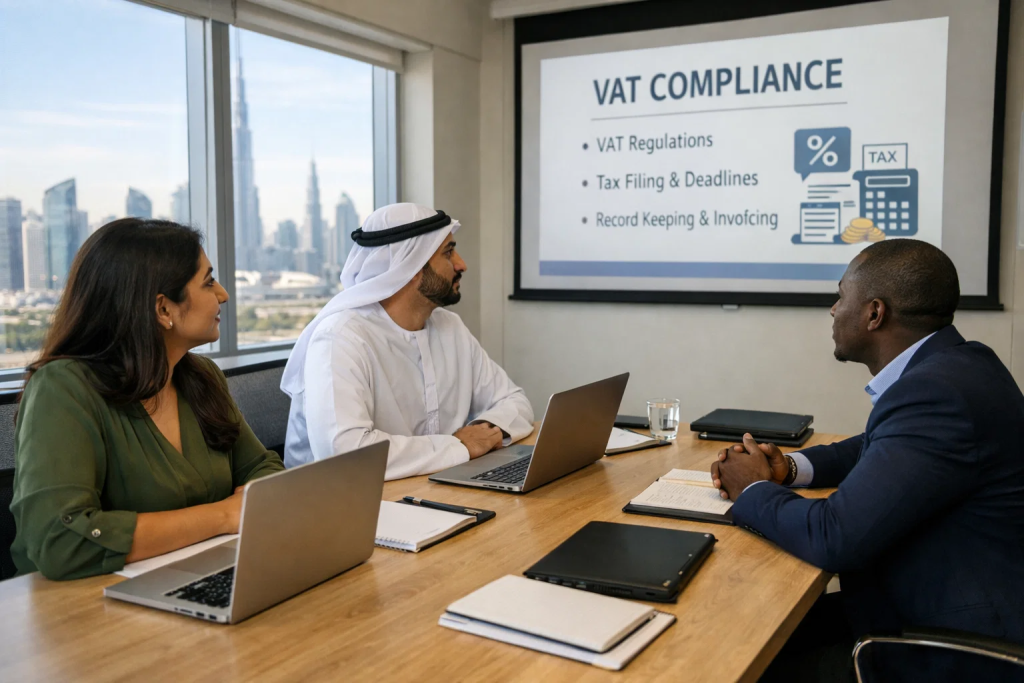
The FTA doesn’t distinguish between deliberate violations and honest mistakes — penalties apply either way. Common errors include miscategorising exempt vs. zero-rated supplies, failing to issue tax invoices properly, and missing VAT return deadlines.
Training eliminates the guesswork. You learn the exact rules, the exact formats, and the exact timelines — so you file correctly the first time, every time.
UAE employers are actively looking for finance professionals who can handle VAT compliance in-house. If you’re applying for accounting roles or trying to get promoted, holding a recognised VAT certification tells hiring managers you can be trusted with something most candidates fumble.
If you’re starting an accounting career in the UAE or looking to level up from a junior position, VAT knowledge is one of the fastest and most practical ways to differentiate yourself.
This is directly tied to point two. Professionals who can manage VAT independently — without needing to hire an outside consultant every quarter — are more valuable to their employers. That value translates into better compensation packages, especially in Dubai, Abu Dhabi, and Sharjah where the demand for tax-compliant finance staff remains strong.
For a clear picture of what the market pays, check out this accountant salary guide for Dubai to see where VAT expertise fits in the pay scale.
An FTA audit is one of the most stressful events a business can face — unless the team knows exactly what records to produce, how they’re organised, and why every figure is what it is. VAT training prepares you for this. You learn audit-ready documentation practices from day one, so if the FTA comes calling, you’re ready rather than scrambling.
When your company’s VAT returns are accurate and filed on time, you avoid penalties that quietly eat into profitability. Beyond compliance, a business that understands VAT can make smarter pricing decisions, recover more input tax, and structure transactions to minimise unnecessary tax exposure.
Finance professionals who can deliver this kind of strategic clarity are far more than compliance officers — they become genuine business assets.
The UAE’s push toward digital tax compliance means e-invoicing is becoming part of everyday financial operations. If you already understand what e-invoicing is and how it works alongside VAT, you’re ahead of most of your colleagues and ready for where the market is heading.
VAT training doesn’t exist in isolation. The UAE now has corporate tax in effect since June 2023. Professionals who understood VAT first found the transition to corporate tax concepts significantly easier. If you want to expand further, the beginner’s guide to corporate tax training is a natural next step.
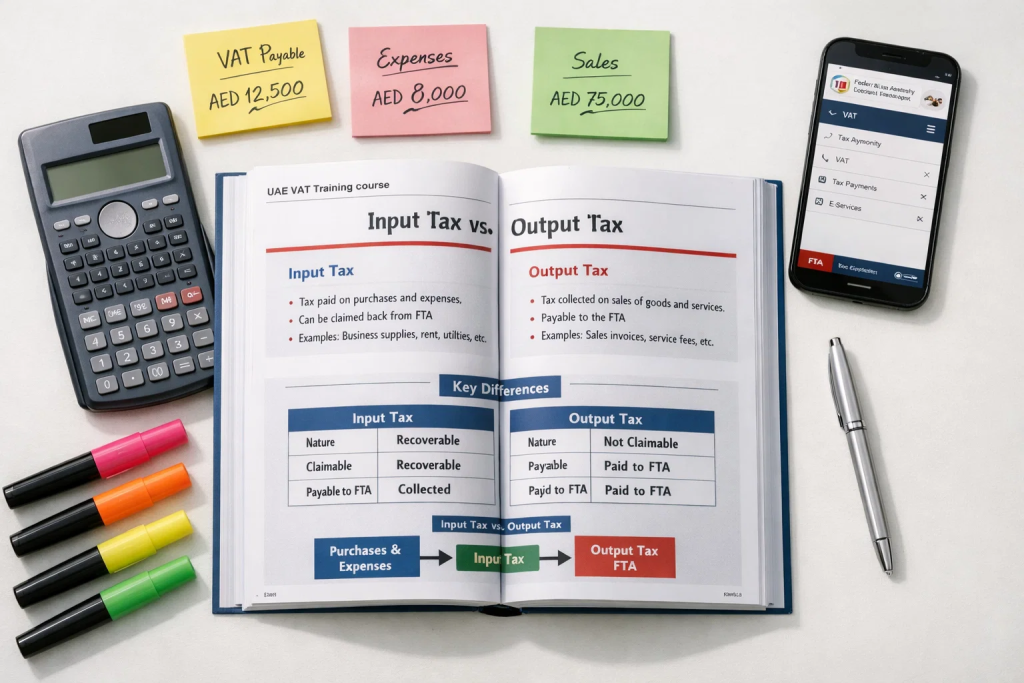
Not all VAT courses are equal. Here is what a genuinely useful course should include:
The UAE VAT training course at Alifbyte covers all of these areas with a focus on practical, hands-on application rather than just theory.
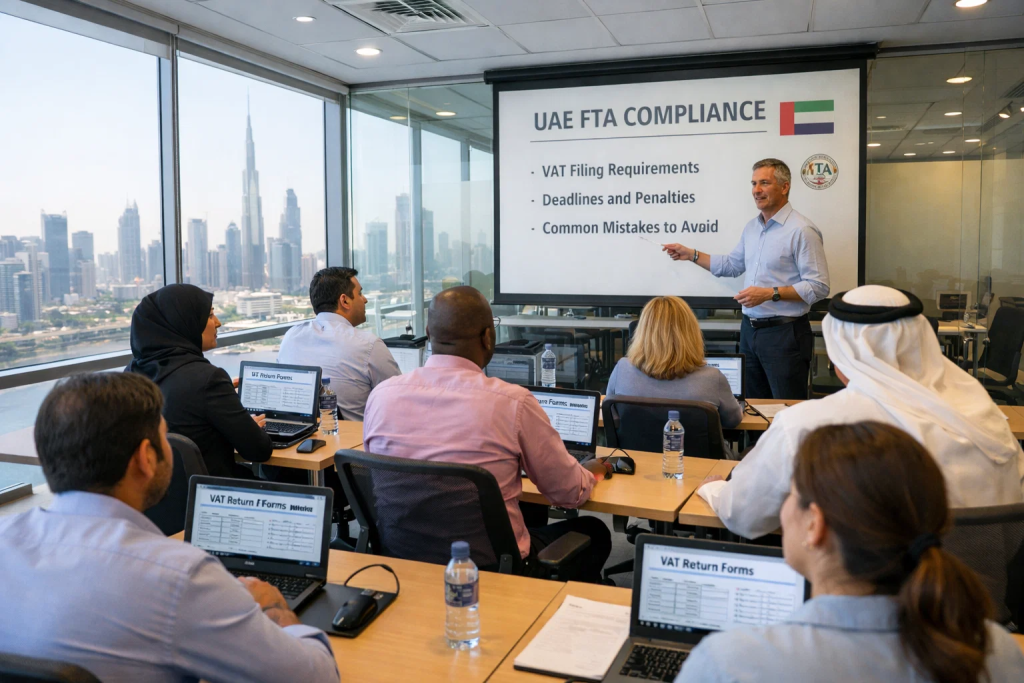
VAT knowledge doesn’t sit on its own shelf in your career. It connects directly to your ability to use accounting software, understand financial reporting standards, and support business decisions.
If you’re working with tools like QuickBooks or Tally Prime, VAT configuration is part of daily operations. If you’re pursuing a qualification like ACCA, understanding how VAT fits into financial statements is directly tested. For a broader view of what the UAE market looks for, this guide on qualifications required for accountants in the UAE shows exactly where VAT expertise sits in the hiring picture.
Professionals who combine VAT knowledge with skills in areas like advanced Excel for accounting or data analysis become significantly harder to replace. The combination signals that you are not just following instructions — you are genuinely managing financial information.
If you are wondering whether finance is a good career path in the UAE, the short answer is yes — and VAT competency is one of the fastest ways to strengthen your position within it.
Not every training provider delivers what they promise. Here is what to look for before you enrol:
For professionals looking at a range of career-boosting options alongside VAT, the top short courses in the UAE to boost your career list is a solid reference to plan your next move.
The main benefits include avoiding costly FTA penalties, improving your career prospects, qualifying for higher-paying roles, and being able to handle VAT returns accurately without relying on external consultants.
It is not legally mandatory for individuals, but it is effectively required for anyone responsible for a company’s VAT compliance. Businesses that file incorrect or late VAT returns face financial penalties from the FTA.
Accountants, bookkeepers, finance managers, small business owners, payroll professionals, and anyone who handles invoices or financial records in the UAE should seriously consider VAT training.
Zero-rated supplies are subject to VAT at 0% — the seller can still recover input tax. Exempt supplies fall completely outside the VAT system, meaning no VAT is charged and no input tax can be recovered. Understanding this distinction is critical for accurate filing.
Yes. Employers specifically look for candidates who can handle VAT compliance without needing supervision. A VAT certification strengthens your CV and shows practical readiness for UAE-based roles.
Absolutely. Business owners who understand VAT can manage their own compliance, make smarter pricing decisions, and avoid the kind of errors that attract FTA audits.
The FTA can impose administrative penalties for errors, late submissions, and non-compliance. The amounts vary depending on the nature of the violation, which is exactly why accurate VAT knowledge is so important.
The UAE VAT rate has been 5% since 2018. While there is no announced increase as of early 2026, staying trained ensures you can adapt quickly if the regulatory landscape changes.
Both are part of the UAE’s evolving tax framework. Many of the compliance principles — documentation, return filing, record-keeping — overlap between VAT and corporate tax. VAT training gives you a strong foundation that makes corporate tax easier to understand.
Both formats exist. In-person training tends to be more effective for hands-on filing practice, but online options can work well for understanding the theoretical framework. Alifbyte offers structured options suited to UAE professionals.
VAT training in the UAE is not a box to tick — it is a skill that directly protects your employer, strengthens your career, and makes you genuinely useful in a market where tax compliance is non-negotiable.
The professionals who struggle with VAT are almost always the ones who picked it up on the job without any structured foundation. They rely on guesswork, miss recoverable input tax, and live in quiet anxiety every time a return is due. That does not have to be you.
The benefits of VAT training in UAE are straightforward: you become more hireable, more confident, more valuable to your organisation, and far better equipped to handle the UAE’s evolving tax environment — whether that means today’s VAT obligations or tomorrow’s corporate tax requirements.
If you are serious about building a finance career in the UAE, start with what the market actually demands. Join the UAE VAT Training Course at Alifbyte and walk away with practical skills you can use from day one.
If you have been putting off VAT training because it felt optional, this is the moment to reconsider. The UAE’s tax environment is only becoming more regulated, and the professionals who get trained now are the ones who will be indispensable when it matters most.
Whether you’re an accountant who wants to handle VAT with confidence, a business owner trying to stay compliant, or a finance professional positioning for a promotion — structured training is the most direct route to getting there.
Enrol in the UAE VAT Training Course at Alifbyte →Have questions about what’s right for you? Contact the Alifbyte team or explore all available professional courses in Dubai to find the right path for your goals.
UAE VAT Training available in:
Abu Dhabi ·
Dubai ·
Ajman ·
Sharjah ·
Fujairah ·
Ras Al Khaimah ·
Umm Al Quwain