
Passing ACCA exams feels impossible when you’re juggling work deadlines, struggling with complex syllabus, and watching fellow candidates fail repeatedly despite months of preparation. The pressure intensifies in UAE’s competitive finance sector where employers demand ACCA credentials, yet the exam pass rates hover around 40-50%. Without the right strategy, you’ll waste thousands of dirhams on repeated exam fees, sacrifice precious weekends, and watch career opportunities slip away while competitors advance. This comprehensive guide reveals 15 battle-tested strategies used by successful ACCA candidates in Dubai, Abu Dhabi, and Sharjah to crack their exams on the first attempt, save money, and fast-track their accounting careers.
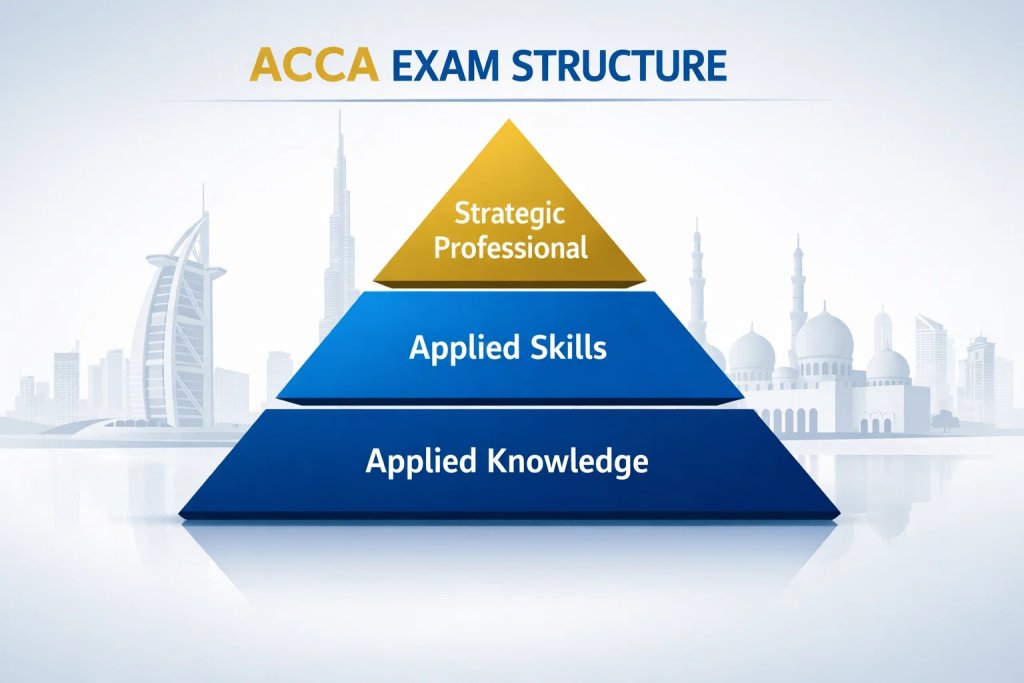
Before diving into preparation, understanding the ACCA qualification framework is crucial for UAE candidates. The ACCA examination structure consists of three progressive levels: Applied Knowledge (3 papers), Applied Skills (6 papers), and Strategic Professional (4 papers), totaling 13 mandatory exams.
In UAE, ACCA exams are conducted through Computer-Based Exams (CBE) for Applied Knowledge and Applied Skills papers, while Strategic Professional papers are offered four times annually in March, June, September, and December. Understanding qualifications required for accountants in UAE helps you appreciate how ACCA fits into your broader career trajectory.
The exam format varies by level. Applied Knowledge papers are objective test format (OTF) with multiple-choice questions, while Applied Skills and Strategic Professional papers combine multiple-choice, short-form, and long-form questions requiring detailed written responses. Each paper tests different competencies, from technical knowledge to professional judgment and analysis.
For beginners in UAE, recognizing that you can claim up to 9 exemptions based on your previous qualifications significantly reduces the total papers you need to attempt. Many UAE universities offer degrees that grant ACCA exemptions, potentially saving you thousands of dirhams in exam fees and months of study time.

Creating a realistic study schedule is the foundation of ACCA success in UAE’s demanding work environment. Most working professionals in Dubai, Abu Dhabi, and Sharjah struggle to balance 9-hour workdays with exam preparation, making structured planning non-negotiable.
Start by conducting an honest time audit. Calculate available study hours per week considering your work commitments, family responsibilities, and necessary personal time. A typical working professional in UAE can realistically allocate 15-20 hours weekly for ACCA studies, translating to approximately 2-3 hours on weekdays and 5-6 hours on weekends.
Design your study schedule working backward from exam dates. For Applied Skills papers, allocate minimum 12-14 weeks of preparation time, while Strategic Professional papers require 14-16 weeks. Break down the syllabus into weekly targets, ensuring you complete the full curriculum with 3-4 weeks remaining for comprehensive revision.
Incorporate flexibility into your schedule to accommodate UAE’s unique circumstances. Ramadan requires schedule adjustments as energy levels fluctuate, while summer months offer longer daylight hours for extended study sessions. Learning how to start an accounting career in UAE provides additional context on managing professional development alongside work commitments.
Use time-blocking techniques to protect study hours. Treat these blocks as non-negotiable appointments, just like important work meetings. Early morning sessions before work (5:30 AM – 7:30 AM) work exceptionally well in UAE’s climate, offering quiet, cool study time before the day’s heat and distractions begin.
Selecting appropriate study materials determines your ACCA success trajectory more than any other single factor. UAE candidates face overwhelming choices from international publishers, local coaching centers, and digital platforms, making informed selection critical.
The approved ACCA learning partners’ materials—BPP, Kaplan, and OpenTuition—form your primary resource foundation. These publishers align precisely with ACCA syllabus requirements and exam format expectations. For Applied Knowledge papers, OpenTuition’s free resources provide excellent value, particularly beneficial for budget-conscious candidates paying for exams in expensive UAE markets.
For Applied Skills and Strategic Professional levels, invest in comprehensive study texts from BPP or Kaplan. These texts cost approximately AED 200-300 per paper in UAE bookstores, but second-hand copies from previous candidates can reduce costs by 40-50%. Many UAE-based ACCA study groups on Facebook and LinkedIn facilitate textbook exchanges.
Supplement primary texts with practice and revision kits from the same publisher for consistency in approach and terminology. These kits contain hundreds of exam-standard questions with detailed marking schemes, invaluable for understanding examiners’ expectations. Exploring accounting short courses in Dubai can complement ACCA preparation with practical skills.
Digital resources have revolutionized ACCA preparation in UAE. ACCA’s official study hub, accessible through MyACCA account, provides syllabus guides, examiner reports, and technical articles. YouTube channels like ACCA X and OpenTuition offer free video lectures, particularly useful for visual learners tackling complex topics like consolidated financial statements or taxation.

Time management during ACCA exams separates passing candidates from those who fall short despite thorough preparation. UAE test centers in Dubai, Abu Dhabi, and Sharjah report that approximately 30% of candidates fail to complete all exam questions due to poor time allocation.
During preparation, practice the “50-minute rule” for three-hour exams. Allocate exactly 50 minutes per 50-mark section, regardless of difficulty. This rigid time discipline prevents spending excessive time on challenging questions while neglecting easier marks elsewhere. Use a timer during every practice session to build this habit before exam day.
Develop quick decision-making skills for multiple-choice questions. Allocate 1.8 minutes per mark (90 seconds for a 1-mark question, 3 minutes for a 2-mark question). If you cannot determine the answer within this timeframe, mark your best guess and move forward. Return to flagged questions only if time permits after completing all others.
For constructed response questions in Applied Skills papers, spend the first 5-10 minutes reading requirements carefully and planning your answers. Many candidates in UAE rush into writing without understanding what examiners specifically ask, resulting in irrelevant responses that earn zero marks despite demonstrating knowledge.
The “parking lot” technique proves invaluable for lengthy scenario-based questions. When encountering unfamiliar terminology or complex calculations, note the issue, make reasonable assumptions, and continue. This prevents time wastage on single roadblocks while ensuring you attempt all question parts. Document your assumptions in answers to demonstrate professional judgment, which may earn method marks even if final answers are incorrect.
Past exam papers constitute the single most valuable resource for ACCA preparation, yet many UAE beginners neglect this critical study component until weeks before exams. Strategic use of past papers throughout your preparation journey dramatically improves pass probability.
Begin practicing past papers after completing each syllabus section rather than waiting until full curriculum coverage. This approach provides immediate feedback on knowledge gaps while content remains fresh in memory. For example, after studying financial reporting standards, attempt all related questions from the past 5 years of exams.
ACCA typically releases specimen exams and past papers on the official website, freely accessible through your MyACCA account. Download papers from the past 3-4 exam sittings minimum, focusing on papers from the current syllabus version to ensure relevance. Examiners frequently recycle question types and topics, making pattern recognition crucial for exam success.
Practice under strict exam conditions at least monthly. Find a quiet location, set timer for exact exam duration, and complete papers without referring to notes or textbooks. This simulation builds mental stamina for 3-hour examination sessions and identifies time management weaknesses before they cost you marks in actual exams.
After completing each past paper, invest equal time in thorough self-assessment using official marking schemes. Compare your answers against examiner reports, available on ACCA’s website, which explain common candidate mistakes and examiner expectations. Understanding how to become a certified accounting specialist provides broader perspective on professional certification strategies.
Join ACCA-focused forums like ACCA X discussion boards where UAE candidates share insights on frequently tested topics and examiner preferences. These communities often highlight regional variations in exam difficulty and provide peer support during challenging preparation periods.
Collaborative learning through study groups accelerates ACCA success by providing accountability, diverse perspectives, and emotional support during challenging preparation periods. UAE’s multicultural environment offers unique advantages for forming effective study networks.
Identify potential study partners through several channels. ACCA institutes in UAE often facilitate study group formation, connecting students attempting similar papers in the same exam session. LinkedIn groups like “ACCA Students UAE” and “ACCA Professionals Dubai” host regular networking events and study meetups.
Effective study groups maintain 3-5 members attempting the same exam level simultaneously. Larger groups become unmanageable, while smaller pairings lack diverse viewpoints. Ensure group members demonstrate similar commitment levels to prevent frustration from unequal effort contribution.
Structure study sessions with clear objectives rather than open-ended discussions. Dedicate each 2-hour session to specific topics, with different members presenting prepared summaries on assigned chapters. This teaching approach reinforces presenter knowledge while exposing others to alternative explanatory methods.
Virtual study groups work exceptionally well for UAE’s geographically dispersed candidates. Platforms like Zoom, Microsoft Teams, and Google Meet enable regular sessions without commuting time across Dubai’s traffic or between emirates. Record sessions for members unable to attend live, creating valuable revision resources.
Exchange resources strategically within your network. Members might share purchased question banks, summarized notes, or flashcards, reducing individual costs while expanding resource access. However, respect copyright and only share materials legitimately obtained. Changing careers to accounting benefits significantly from peer networks during transition periods.

Modern ACCA preparation in UAE increasingly relies on digital tools that enhance learning efficiency, track progress, and simulate exam environments. Strategic technology adoption provides competitive advantages over traditional study methods alone.
Mobile apps revolutionize ACCA learning by enabling study during UAE’s long commutes. Open Tuition app offers free video lectures and practice questions accessible during Metro journeys or taxi rides across Dubai. ACCA Learning app provides official study resources, while Quizlet flashcard apps facilitate memorization of accounting standards, formulas, and key definitions.
Cloud storage platforms like Google Drive, Dropbox, and OneDrive ensure study materials remain accessible across devices. Sync notes between desktop, tablet, and smartphone for seamless transitions between home, office, and café study sessions. This flexibility proves crucial for UAE professionals managing unpredictable work schedules.
Excel mastery accelerates Financial Reporting and Performance Management preparation. Build practice spreadsheets for complex calculations like consolidated statements, variance analysis, and NPV calculations. These templates become invaluable during exams, as muscle memory speeds calculation processes under time pressure.
Note-taking apps like Notion, Evernote, and OneNote organize vast ACCA content systematically. Create searchable databases of accounting standards, tagged by topic and exam relevance. Digital notes enable quick searches for specific concepts during revision, far faster than flipping through hundreds of handwritten pages.
YouTube channels provide free supplementary instruction for difficult topics. ACCA X (official), Accounting Lectures, and OpenTuition publish comprehensive video courses covering entire syllabuses. Watch lectures at 1.5x speed during revision phases to maximize time efficiency.
Virtual practice platforms simulate CBE exam environments. ACCA offers practice CBE platform access through MyACCA, essential for familiarizing yourself with interface, navigation, and time pressure before attending actual exam centers in UAE. Data analyst career paths similarly benefit from technology-enhanced learning approaches.

Memorization-based approaches fail catastrophically in ACCA exams, which test application, analysis, and professional judgment rather than rote recall. UAE candidates from educational systems emphasizing memorization must consciously shift toward conceptual learning.
Every accounting standard, business model, or financial concept exists for specific reasons rooted in economic reality or regulatory requirements. Understanding these underlying principles enables you to reason through unfamiliar scenarios during exams rather than panicking when questions don’t match memorized formats.
For example, when studying IFRS 15 Revenue Recognition, don’t simply memorize the five-step model. Understand why revenue recognition matters for financial statement users, how premature recognition misleads investors, and what economic substance means in different industries. This deep understanding lets you apply the standard to novel scenarios confidently.
Use the “teach-back” method to verify conceptual mastery. After studying a topic, explain it to a study partner, family member, or even your reflection as if teaching a complete beginner. Inability to simplify complex concepts into understandable explanations reveals knowledge gaps requiring further study.
Connect theoretical concepts to real-world UAE business examples. When studying consolidated accounts, research UAE-listed companies like Emirates NBD or Emaar that publish consolidated financial statements. Analyze their actual reports to see how theoretical standards apply in practice, making abstract concepts tangible.
Question “why” continuously during studies. Why does goodwill arise in business combinations? Why do companies hedge foreign exchange risk? Why must financial statements present fair view? These “why” questions force deeper thinking beyond surface-level facts, building mental frameworks that support complex problem-solving under exam pressure.
Finance career opportunities in UAE reward conceptual thinkers who can apply knowledge flexibly rather than simply recall facts, making this approach valuable beyond exam success.
Professional exam writing distinguishes competent accountants from knowledgeable students. ACCA examiners award marks based not only on correct answers but also on clarity, structure, and professionalism in presenting those answers.
Adopt the “requirement-led” writing approach for all constructed response questions. Before writing anything, carefully read question requirements and number each one. Structure your answer matching these numbered requirements exactly, using clear headers like “Requirement 1: Calculation of…” This organization prevents missing requirements and helps examiners locate your answers quickly.
The professional memo or report format appears frequently in Strategic Professional papers. Master this structure: Executive summary (2-3 sentences), Analysis (numbered points addressing requirements), Conclusion (brief summary), and Recommendations (actionable next steps). This format demonstrates business communication skills alongside technical knowledge.
Write concisely using professional business language. Avoid unnecessary words, flowery descriptions, or conversational tone. ACCA exams reward candidates who communicate maximum information in minimum words, reflecting real-world business writing where executives value brevity.
For numerical questions, show all calculation workings even when final answers are correct. Partial marks for method can rescue otherwise zero-scoring questions when computational errors occur. Layout calculations clearly with labeled rows and columns, using consistent formatting that examiners can follow easily.
Address all question parts proportionally to their mark allocation. A 5-mark requirement deserves approximately 5-7 distinct points, while 15-mark sections require 15-20 separate points with depth. Many UAE candidates lose marks by writing extensively on 5-mark sections while inadequately addressing 15-mark requirements.
Exam anxiety affects ACCA candidates globally, but UAE’s high-pressure work environment and expensive exam fees intensify stress levels. Effective stress management preserves mental clarity and performance during crucial examination periods.
Physical wellness directly impacts cognitive performance during intense study phases. Maintain regular exercise routines—30 minutes daily walking, swimming, or gym sessions—to reduce cortisol levels and improve sleep quality. UAE’s excellent fitness infrastructure in Dubai, Abu Dhabi, and Sharjah makes this easily achievable.
Sleep discipline becomes non-negotiable during exam preparation. Target 7-8 hours nightly, maintaining consistent sleep schedule even on weekends. Sleep deprivation impairs memory consolidation and problem-solving abilities, sabotaging exam performance despite thorough preparation. Avoid all-night study sessions, which create illusion of productivity while destroying actual learning.
Nutrition significantly affects concentration and energy levels during lengthy exams. Prioritize protein-rich foods, complex carbohydrates, and adequate hydration. UAE’s restaurant culture makes healthy eating accessible through numerous options offering nutritious meals delivery. Avoid excessive caffeine dependency, which causes energy crashes and increased anxiety.
Practice relaxation techniques specifically for exam situations. Deep breathing exercises—inhale for 4 counts, hold for 4, exhale for 4—quickly reduce acute stress during exams when encountering unexpected questions. Progressive muscle relaxation before sleep improves rest quality during preparation periods.
Maintain perspective on exam outcomes. ACCA allows unlimited resit attempts, and single exam failures don’t define career trajectories. Many successful finance professionals in UAE’s accounting sector required multiple attempts on challenging papers before achieving qualification.
Seek professional support if anxiety becomes overwhelming. UAE’s healthcare system offers accessible mental health services through institutions like American Hospital Dubai or Cleveland Clinic Abu Dhabi, with many insurance plans covering psychological consultations.
Mock examinations serve as the most accurate predictor of actual exam performance, yet many UAE candidates approach mocks incorrectly, diminishing their value. Strategic mock exam usage transforms these assessments from anxiety-inducing hurdles into powerful learning tools.
Schedule three full mock exams during final preparation month, spacing them at 10-day intervals. This frequency provides sufficient practice without causing burnout or consuming excessive revision time. Complete the first mock exam 4 weeks before actual exam date, second mock 2 weeks before, and final mock 7-10 days before.
Replicate exact exam conditions for every mock attempt. Use the same 3-hour duration, work in quiet environment without distractions, and avoid any reference materials. For CBE papers, use ACCA’s practice platform to familiarize yourself with digital interface, as unfamiliarity with exam software has derailed many technically competent UAE candidates.
Most ACCA coaching institutes in Dubai, Sharjah, and Abu Dhabi offer mock exam facilities simulating actual test center environments. These professionally invigilated mocks cost AED 100-200 but provide invaluable experience managing examination pressure in formal settings.
Analyze mock results systematically within 48 hours of completion. Don’t simply check overall score; dissect performance section by section, question by question. Create detailed error log categorizing mistakes: calculation errors, misread requirements, knowledge gaps, time management failures, etc. This categorization reveals patterns requiring targeted remediation.
Treat weak mock performance as valuable feedback rather than demotivating failure. Mock exams exist precisely to expose weaknesses while time remains for correction. Candidates scoring 45-48% on mock exams frequently pass actual exams after addressing identified gaps, while those avoiding mocks often fail despite feeling prepared.
Preparing for ACCA in UAE involves unique considerations beyond standard international requirements. Understanding these local factors prevents unnecessary complications and maximizes opportunities available in Emirates’ business environment.
Exam registration in UAE operates through British Council for Computer-Based Exams (CBE) and direct ACCA for paper-based exams. CBE sessions for Applied Knowledge and some Applied Skills papers run continuously year-round at British Council centers in Dubai, Abu Dhabi, and Sharjah, offering flexibility unavailable in many countries.
Register for exams minimum 3-4 weeks before preferred date to secure desired time slots, as UAE’s large ACCA candidate population quickly fills popular sessions. Late registration incurs additional fees (approximately £60 extra), unnecessarily increasing already substantial examination costs.
UAE exam fees differ slightly from global pricing due to local currency conversion and administrative costs. Budget AED 600-800 per Applied Knowledge paper, AED 800-1,100 per Applied Skills paper, and AED 1,200-1,500 per Strategic Professional paper, including British Council processing fees where applicable.
Work visa considerations affect ACCA pursuit for expatriate candidates. Ensure your employment visa status permits part-time study, particularly if attending regular coaching classes. Most UAE employers support professional development, but confirming this alignment prevents future complications.
ACCA salary expectations in Dubai vary significantly based on experience, industry, and nationality. Qualified ACCA members earn AED 8,000-15,000 monthly in entry-level positions, increasing to AED 20,000-40,000+ for senior finance roles after 5-7 years experience.
Networking opportunities in UAE’s ACCA community provide career advancement pathways unavailable in smaller markets. Attend ACCA networking events, CPD seminars, and professional mixers organized by local chapters in Dubai and Abu Dhabi. These gatherings connect you with hiring managers, experienced professionals, and potential employers before qualification completion.
Most UAE-based ACCA candidates pursue qualification while maintaining full-time employment, creating challenging work-study balance requirements. Successful candidates develop sustainable routines preventing burnout while advancing both career and qualification simultaneously.
Communicate openly with employers about your ACCA pursuit. Many UAE companies value professional development and may offer study leave, flexible working hours, or exam fee reimbursement for successful attempts. However, employers can only accommodate your needs if they understand them—silence guarantees zero support.
Negotiate exam leave strategically. Request 2-3 days off immediately before each exam sitting rather than extended leaves earlier in preparation cycle. These final pre-exam days prove most valuable for intensive revision when material is freshest, while earlier study proceeds effectively alongside work commitments.
Identify and protect high-productivity study periods within your personal energy cycle. Some candidates study most effectively in early mornings before work (5:00-7:30 AM), while others concentrate better in evenings (8:00-11:00 PM). Experiment during non-critical study phases to discover your optimal focus windows, then schedule demanding topics during these periods.
Set boundaries protecting study time from work encroachment. Unless genuine emergencies arise, avoid checking work emails or taking business calls during designated study hours. This separation prevents task-switching inefficiency and maintains focus necessary for complex accounting concepts.
Accept that social life temporarily contracts during intensive exam preparation periods, particularly in final 4-6 weeks before exams. Communicate this reality to friends and family to manage expectations and prevent guilt when declining social invitations. Quality relationships survive temporary absences for career advancement.
Maintain strict work-study separation by designating specific physical spaces for each activity. Study at home desk, library, or café—never in bed or on living room sofa where relaxation associations reduce concentration. This environmental separation creates psychological boundaries supporting focus.
Career paths after Tally courses and other accounting qualifications face similar work-study balance challenges, making these strategies broadly applicable to UAE’s finance professionals.
Strategic exam booking maximizes pass probability by aligning attempt timing with optimal preparation completion, work schedule compatibility, and personal energy cycles. Poor booking decisions undermine months of diligent study.
Choose exam session dates working backward from realistic preparation timeline. Never book exams optimistically assuming ideal study pace; always add 2-week buffer accommodating inevitable life disruptions, work urgencies, or illness. This buffer prevents last-minute cramming under pressure that sabotages exam performance.
Consider UAE’s weather patterns when selecting exam dates. June-August sessions coincide with summer heat exceeding 45°C, making travel to exam centers uncomfortable and potentially affecting concentration. March and December sessions occur during pleasant weather, enabling comfortable commutes and better energy management.
Ramadan presents unique considerations for Muslim candidates. While permissible to attempt exams during Ramadan, fasting potentially affects concentration and energy levels during afternoon exam sessions. Consider scheduling exams before or after Ramadan if possible, or opt for early morning slots if attempting during fasting month.
Space multiple exam attempts across different sessions rather than cramming several papers into single sitting. ACCA permits maximum 4 Strategic Professional exams per session, but attempting 3-4 simultaneously dramatically reduces pass probability unless you can dedicate 30+ weekly study hours.
Book exams in progressive difficulty sequence, building confidence through earlier successes. For Applied Skills level, many candidates begin with Taxation (TX) or Performance Management (PM) before attempting Financial Reporting (FR) or Audit and Assurance (AA), which typically require more intensive preparation.
Avoid exam centers during first few days after session opening when technical glitches occasionally occur. Similarly, avoid final booking dates when nervous energy peaks among mass candidates. Mid-session dates typically offer smoothest examination experiences.
Self-study succeeds for disciplined candidates with strong foundational knowledge, but many UAE aspirants benefit significantly from structured coaching support. Knowing when and how to seek professional guidance prevents wasted time and money on ineffective approaches.
Choosing the best ACCA institute in UAE requires evaluating several factors: teaching quality, pass rates, flexibility, cost, and location. Reputable institutes like alifbyteedu.com offer experienced instructors, comprehensive materials, and flexible scheduling accommodating working professionals’ constraints.
Assess your learning style honestly before committing to expensive coaching programs. Visual learners benefit most from video-based or classroom instruction with extensive use of diagrams and examples. Auditory learners excel with lecture-based approaches, while kinesthetic learners prefer practice-intensive methods with minimal passive listening.
Consider hybrid approaches combining self-study with targeted professional support. Rather than enrolling in full coaching programs costing AED 15,000-25,000 for complete qualification, purchase support for specifically challenging papers like Strategic Business Leader (SBL) or Advanced Financial Management (AFM) where professional guidance offers highest value.
Individual tutoring provides customized support for candidates struggling with particular topics despite general competence. Private tutors in UAE charge AED 150-300 per hour, making this option expensive for comprehensive coverage but cost-effective for targeted weakness remediation.
Join online coaching platforms offering global instruction at reduced costs compared to UAE’s premium-priced local institutes. Platforms like OpenTuition, LSBF, and Kaplan Online provide comprehensive courses for £200-500 per paper, though lacking the personal interaction and local UAE context of physical institutes.
Don’t hesitate seeking help early when struggling with topics. Attempting to self-resolve fundamental misunderstandings wastes weeks while compounding confusion. Professional instructors quickly identify and correct conceptual errors that would otherwise persist through ineffective self-study.
The average completion time ranges from 2-4 years depending on prior qualifications, study intensity, and exemptions. Full-time students with no exemptions typically complete in 2-2.5 years, while working professionals require 3-4 years. UAE candidates benefit from year-round CBE availability, potentially accelerating timeline compared to countries with limited exam sessions.
Global ACCA pass rates average 45-50% across all papers, with UAE-specific rates closely mirroring these figures. Applied Knowledge papers show 70-80% pass rates, Applied Skills papers 40-50%, and Strategic Professional papers 35-45%. Papers like Audit and Assurance (AA) and Strategic Business Leader (SBL) historically show lowest pass rates around 35-40%.
Yes, the vast majority of UAE-based ACCA candidates maintain full-time employment while studying. With proper time management, allocating 15-20 hours weekly for studies, working professionals successfully balance both commitments. Many UAE employers support ACCA pursuit through study leave, flexible hours, or fee reimbursement, recognizing qualification’s value to business operations.
Audit and Assurance (AA), Strategic Business Leader (SBL), and Advanced Financial Management (AFM) consistently rank as most challenging based on pass rates and candidate feedback. AA’s complexity stems from conceptual nature and extensive application requirements, while SBL demands integrated thinking across multiple business areas. AFM’s advanced technical content and calculations challenge even experienced candidates.
ACCA qualification offers excellent value in UAE’s competitive finance sector, opening doors to multinational corporations, Big 4 firms, and government entities that specifically seek ACCA-qualified professionals. Starting salaries for ACCA members average AED 8,000-12,000 monthly, increasing to AED 25,000-40,000+ with 5-10 years experience. The qualification’s global recognition provides career mobility beyond UAE borders.
Yes, UAE residents holding relevant academic qualifications can claim ACCA exemptions. Bachelor’s degrees in accounting or finance typically grant 5-9 exemptions depending on institution accreditation and curriculum alignment. Many UAE universities like University of Wollongong Dubai, Middlesex University Dubai, and Manipal University offer ACCA-accredited degrees providing maximum exemptions, significantly reducing qualification timeline and cost.
BPP and Kaplan study texts remain gold standard resources, available at major UAE bookstores or through online platforms. OpenTuition provides excellent free resources for Applied Knowledge papers, while Strategic Professional level benefits from premium materials investment. ACCA’s official materials through MyACCA portal, including examiner reports and practice questions, complement commercial resources effectively. Local UAE institutes often provide comprehensive study kits included in tuition fees.
Begin preparation minimum 12-14 weeks before Applied Skills exam dates and 14-16 weeks before Strategic Professional exams. This timeline allows thorough syllabus coverage, adequate practice, revision, and buffer for unexpected delays. UAE’s flexible CBE scheduling enables strategic timing aligned with work commitments rather than forcing preparation into arbitrary cycles.
Focus on three critical areas: comprehensive past paper practice under timed conditions, thorough understanding of examiner reports identifying common mistakes, and structured answer writing technique demonstrating professional communication skills. Additionally, maintain consistent study routine, join active study groups, leverage digital learning tools, and seek coaching support for challenging papers. Regular mock exams 4 weeks before actual exams provide crucial performance feedback enabling targeted improvement.
ACCA-qualified professionals remain in high demand across UAE’s diverse economy. Major employers include banking sector (Emirates NBD, First Abu Dhabi Bank), Big 4 accounting firms (Deloitte, PwC, KPMG, EY), multinational corporations (Unilever, Johnson & Johnson), government entities, and real estate companies (Emaar, Aldar). Dubai and Abu Dhabi particularly seek ACCA professionals for financial reporting, audit, taxation, and management accounting roles with competitive salary packages and career progression opportunities.
Successfully cracking ACCA exams in UAE demands more than academic intelligence—it requires strategic planning, disciplined execution, and resilient mindset throughout the 2-4 year qualification journey. The 15 pro tips outlined in this guide provide comprehensive framework addressing every critical success factor from initial exam structure understanding through final exam booking strategy.
Remember that ACCA qualification represents significant investment of time, money, and emotional energy, but the returns in UAE’s thriving finance sector justify this commitment. Qualified ACCA professionals command premium salaries, enjoy excellent career mobility, and access opportunities across industries that remain closed to non-qualified candidates.
Your success ultimately depends on consistent daily action rather than sporadic intense efforts. Implement these strategies systematically, adjust approaches based on personal learning style and circumstances, and persist through inevitable setbacks that every ACCA candidate experiences. The accounting and finance landscape in UAE rewards qualified professionals who demonstrate determination, technical competence, and professional judgment that ACCA qualification develops.
Ready to accelerate your ACCA journey with expert guidance and comprehensive resources? Explore professional accounting training programs at alifbyteedu.com designed specifically for UAE-based candidates balancing work, study, and career advancement. Our experienced instructors, flexible schedules, and proven methodologies help ambitious professionals like you achieve ACCA qualification efficiently while maintaining professional commitments.