
You’ve decided to upskill in accounting — smart move. But here’s what most people don’t realize: picking the wrong course wastes not just money, but months of your time and momentum. Dozens of learners enroll in a certification that’s either too advanced, too basic, or simply irrelevant to their specific career situation. The result? Dropped courses, missed job opportunities, and a CV that still looks the same. This guide gives you a clear, no-fluff framework to choose the right accounting course — so your investment actually pays off.
The UAE’s financial sector is one of the most demanding and credential-conscious markets in the world. Employers in Dubai, Abu Dhabi, and Sharjah don’t just want candidates who “know accounting” — they want professionals who can demonstrate specific, verifiable skills from day one.
Choosing the right accounting course aligns your learning with what the market actually values. It affects:
Whether you’re a fresh graduate, a professional switching careers, or someone re-entering the workforce, understanding how to start an accounting career in the UAE is the first step — and choosing the right course is the foundation of that journey.
This is the step most people skip, and it’s the most important one.
Before you look at any course, answer these three questions honestly:
1. What role do I want in 12 months?
Are you aiming for bookkeeper, accounts assistant, financial analyst, or CFO-track? Each destination requires a different starting point.
2. Am I starting from scratch or upskilling?
A complete beginner needs foundational courses first. A working professional might only need to add a specific software skill or a recognized certification to their existing knowledge.
3. Do I need a globally recognized qualification or a practical job-ready skill?
Both are valuable — but they serve different timelines and goals.
Take time to honestly assess your current qualifications as an accountant in the UAE before committing to any program. Knowing exactly where you stand makes your course decision far clearer.
Not all accounting courses are created equal. Here’s a breakdown of the main categories so you know what you’re actually choosing between.
These cover the basics: debits and credits, journal entries, financial statements, and bookkeeping principles. Ideal for complete beginners or non-accountants who need accounting literacy. If you’ve ever wondered why non-accountants should learn basic accounting, this type of course answers that question directly.
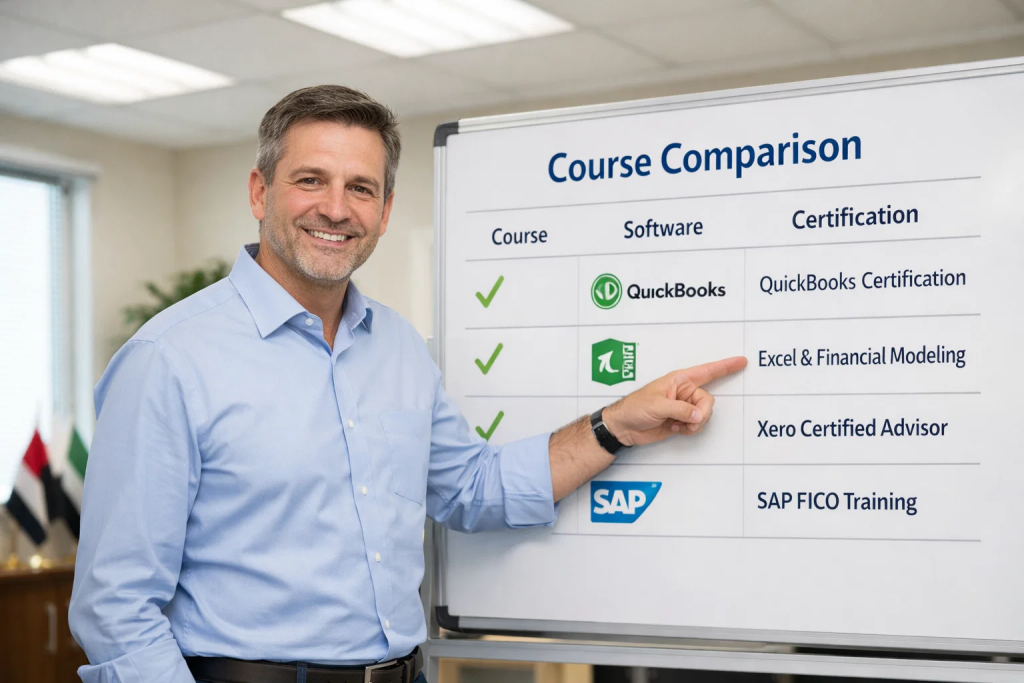
These are the fastest-growing category in UAE training demand. They teach you to operate industry-standard accounting platforms:
These courses are practical, short, and directly employable. You can explore the main types of accounting software to understand which one aligns with your target industry before enrolling.
These are longer, globally recognized qualifications:
These include Advanced Excel for financial modelling, Power BI for financial reporting, and e-invoicing compliance training — skills that complement core accounting expertise and position you for higher-value roles.
This is the question most candidates agonize over — and the answer depends entirely on your situation, not on what sounds more impressive.
Short courses in the UAE have become increasingly credible and valued by employers, especially when delivered by accredited institutes. The best accounting short courses in Dubai can take you from zero to job-ready in as little as 6–10 weeks.
Understanding the ACCA vs CMA career comparison can help you decide which long-form certification is worth your investment if you’re going the professional qualification route.
Pro Tip: You don’t have to choose one or the other from day one. Many professionals start with a software course to land their first role, then pursue ACCA while working. This staggered approach is practical, financially sustainable, and increasingly common in the UAE market.

Here’s a reality check: in the UAE job market, theoretical accounting knowledge alone is rarely enough. Hiring managers consistently shortlist candidates who can operate accounting software on day one — no handholding required.
Before finalizing any accounting course, verify whether it includes hands-on software training. The most in-demand tools in the UAE right now are:
QuickBooks — If you’re targeting SMEs, tech startups, or e-commerce businesses, learning QuickBooks as a beginner is one of the highest-ROI accounting investments you can make. It’s the most widely used cloud accounting platform for small businesses globally.
Tally Prime — Dominant in trading, retail, and manufacturing sectors across the UAE and GCC. Completing a Tally Prime training course adds immediate value if you’re targeting roles in Sharjah’s industrial belt or Dubai’s trading hub.
Sage 50 — Preferred by mid-market firms, accounting firms, and service businesses. Knowing Sage sets you apart in competitive shortlists.
MS Excel for Accounting — Non-negotiable. Even with dedicated accounting software, every employer expects proficiency in Excel. Knowing how to use Excel for accounting purposes is a baseline competency, not a bonus.

Your course is only as good as the institute delivering it. In the UAE, credentials and accreditation matter — both for your learning experience and for how employers perceive your certificate.
Here’s what to look for when evaluating a training provider:
Accreditation and Recognition
Look for institutes recognized by KHDA (Knowledge and Human Development Authority) in Dubai, or holding ISO certification. These aren’t just badges — they indicate quality assurance, qualified trainers, and reliable curriculum standards.
Industry-Relevant Curriculum
UAE-specific knowledge matters. Does the course cover UAE VAT, FTA compliance, and UAE corporate tax regulations alongside global accounting principles? Generic international content without local context leaves you underprepared for UAE employer expectations.
Trainer Expertise
Are trainers working professionals with real industry experience, or purely academic instructors? The best accounting training combines theoretical grounding with practical, real-world scenarios.
Mode of Delivery
Flexible timing matters for working professionals. Look for options across weekday, weekend, and evening batches. Online and blended learning is increasingly common and effective for software-based courses.
Career Support
Does the institute offer post-course support — CV assistance, interview prep, or industry networking? This signals commitment beyond just delivering hours and handing out certificates.

This is the question behind the question — and it deserves an honest, balanced answer rather than a sales pitch.
Job Security and Demand
Accounting is one of the most consistently in-demand professional fields in the UAE. Every business — from a Deira trading company to a DIFC financial institution — needs accountants. The UAE’s growing regulatory environment, including VAT implementation, corporate tax, and mandatory e-invoicing, has only increased the need for finance professionals.
Strong Salary Potential
The accountant salary in Dubai ranges significantly based on qualification and experience, but certified professionals consistently earn above-market packages. ACCA-qualified finance managers can command salaries well above AED 15,000–25,000 per month in senior roles.
International Portability
Qualifications like ACCA are recognized across 180+ countries. If you ever want to work outside the UAE, your credential travels with you.
Diverse Career Paths
Accounting isn’t just one career — it’s a gateway. You can move into financial analysis, auditing, tax consulting, CFO roles, or even entrepreneurship with a strong accounting foundation. Exploring the range of accounting career paths shows just how wide the field really is.
Growing Need for Tech-Savvy Accountants
The rise of cloud accounting, automated reporting, and data analytics has created a premium on accountants who combine financial knowledge with software skills — a combination that commands higher salaries and greater job security.
Entry-Level Competition
The UAE attracts a large pool of international accounting talent, particularly from South Asia, making entry-level positions competitive. Standing out requires recognized certifications or demonstrable software skills.
Long Path to Senior Roles
Full professional qualifications like ACCA take time and consistent effort. If you’re expecting a fast shortcut to a CFO role, accounting isn’t that path.
Regulatory Learning Curve
UAE-specific rules — VAT, corporate tax, FTA filings — add complexity for professionals trained in other markets. Local upskilling is non-negotiable.
Continuous Professional Development
Accounting standards, tax laws, and software tools evolve. You’ll need to keep learning throughout your career — which is either a pro or a con, depending on your mindset.
The Verdict: For most people in the UAE — whether freshers or mid-career professionals — accounting remains one of the most reliable investments you can make in your professional future. The key is choosing the right entry point and pairing your course with practical, software-ready skills.
Knowing what to look for is half the battle. Knowing what to avoid is the other half.
Mistake 1: Choosing Based on Price Alone
The cheapest course is rarely the best investment. A poorly structured program can leave you with a certificate that carries no weight in the job market.
Mistake 2: Ignoring UAE-Specific Content
Global accounting principles are important, but if the course doesn’t cover UAE VAT, corporate tax, or FTA compliance, you’ll be underprepared for local employer expectations.
Mistake 3: Skipping the Software Component
Theoretical knowledge without hands-on software training is increasingly inadequate. Employers want candidates who can work in QuickBooks, Tally, or Sage from day one.
Mistake 4: Overcommitting to a Qualification You Can’t Complete
Enrolling in a full ACCA program without realistic time and financial planning leads to abandoned studies and wasted fees. Honest self-assessment first.
Mistake 5: Not Checking Institute Credentials
Always verify KHDA recognition, ISO certification, or other accreditation before enrolling. An unrecognized certificate may not add value to your CV.
Mistake 6: Treating a Course as the Finish Line
A course gives you the foundation — but employers want to see application. Complement your training with Excel skills, data tools, and an understanding of top accounting skills required in the finance sector.
For complete beginners, a foundational accounting course combined with software training (QuickBooks or Tally Prime) is the most practical starting point. It builds core knowledge while making you immediately employable.
Yes — ACCA is widely respected by UAE employers, particularly in multinational firms, Big 4 audit firms, and DIFC-based financial institutions. It offers strong salary prospects and international career mobility.
Short courses typically range from 4 to 12 weeks. Full professional certifications like ACCA can take 3–5 years depending on your pace and prior exemptions.
Yes. Many accredited institutes in Dubai and Sharjah now offer blended and fully online accounting courses, making it practical for working professionals.
ACCA is a globally recognized professional qualification suited to senior finance career paths. A short course delivers specific, job-ready skills — like operating QuickBooks or filing UAE VAT returns — in a much shorter timeframe.
Not necessarily. Many practical accounting and software courses have no degree prerequisites. However, full professional qualifications like ACCA do have entry requirements.
QuickBooks is the most widely used in SMEs. Tally Prime is dominant in trading sectors. Sage 50 is common in mid-market firms. Learning at least one of these significantly improves your employability.
Certified accountants in Dubai can earn between AED 6,000 to AED 25,000+ per month depending on their qualification level, experience, and the size of the employer.
Absolutely. With VAT firmly established in the UAE, professionals who understand FTA compliance, VAT return filing, and input/output tax treatment are consistently preferred by employers.
Yes — many professionals successfully transition into accounting from other fields. A focused combination of foundational training and UAE-specific certification makes the transition achievable and credible.
Choosing the right accounting course comes down to your goals, timeline, and skill level. Whether you start with a practical short course or aim for a certification like ACCA, the key is picking a path that aligns with real UAE job market demand.
Explore Alifbyte’s full range of accounting courses and find a program matched to your career goals — backed by KHDA-recognized, ISO-certified training.