
Still spending hours on manual reconciliations and spreadsheet formulas? UAE finance teams are quietly being outpaced — not by offshore talent, but by Python for accounting. If you have been wondering whether finance is a good career in UAE, the answer is a strong yes — but only for those who keep their skills sharp. The professionals upskilling now are cutting reporting time by 80%, automating invoices, and building real-time dashboards. This guide shows you exactly how to get there.
Excel is not going away. But in a UAE economy increasingly shaped by Vision 2031 digital mandates, free-zone compliance requirements, and real-time VAT reporting, Excel’s ceiling has become painfully visible. Accountants who understand Python for financial analysis alongside Excel are not just more productive — they are genuinely hard to replace. For a deeper look at why Python stands out, read our blog on learning Python over other programming languages.
Here is the honest difference. Excel is reactive: you clean data, paste it, build a formula, and repeat. Python is proactive: you write a script once and it runs automatically — forever — on any volume of data. The shift is not just technical; it is strategic.
The question is no longer whether accountants should learn Python — it is how soon they can start. Understanding the career benefits of learning Advanced MS Excel first shows you exactly where Excel ends and Python begins. An Advanced Excel course builds a strong bridge, but Python is the logical next step for serious career growth.
You do not need to master every Python library. You need the right five. These are the libraries that make Python accounting automation real — not theoretical. Before diving in, it also helps to be across the top Excel skills for accountants — understanding Excel deeply makes your Python transition significantly smoother.
| Library | Primary Use Case in Finance | Difficulty |
|---|---|---|
| Pandas | Data cleaning, manipulation, journal entry analysis, GL reconciliation | Beginner |
| NumPy | Financial calculations, array operations, statistical analysis | Beginner |
| Matplotlib | Visualising P&L trends, cash flow graphs, KPI dashboards | Intermediate |
| OpenPyXL | Reading/writing Excel files programmatically, report generation | Beginner |
| ReportLab | Generating professional PDF financial reports and invoices | Intermediate |
💡 Pro Tip: Start with pandas and openpyxl. These two libraries alone will let you automate 60% of repetitive month-end tasks within your first 30 days of learning. Python pandas for finance is the single most valuable skill for an accountant entering the Python world.
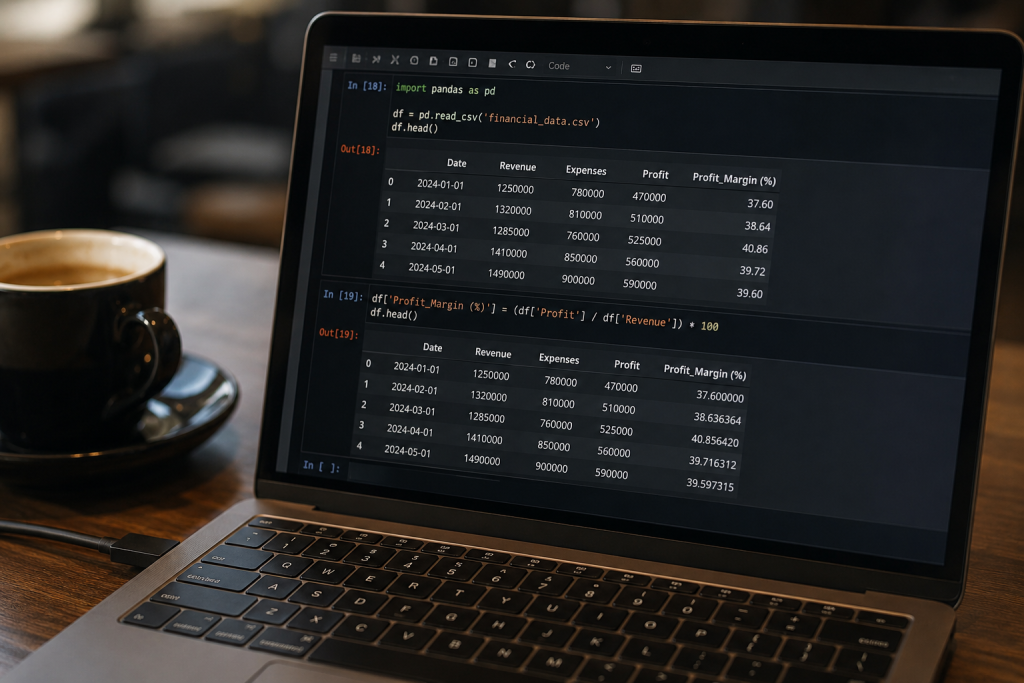
Let us get specific. This is what automate accounting with Python actually looks like in practice for a UAE-based finance team. If you are still evaluating which types of accounting software best suit your business, Python can complement or even replace parts of several of those tools:
💼 Key Takeaway: A task that takes a UAE finance team 3 days at month-end can often be reduced to a 10-minute automated Python script. That is not an exaggeration — it is a documented outcome for teams that have made the switch.
If your team is also exploring the tax dimension, our beginner’s guide to corporate tax training paired with the structured Corporate Tax Training programme ensures you are automating the right processes in a compliant way.

Beyond automation, Python for data analysis unlocks a category of financial insight that spreadsheets simply cannot provide at scale. If you are considering a broader data career, our guide on how to become a data analyst in UAE maps out exactly how finance skills overlap with data analytics roles.
Using pandas, you can pull five years of financial statements, compute liquidity, profitability, and leverage ratios across all periods simultaneously, and visualise trends in seconds. What once required a dedicated analyst afternoon now runs in under a minute.
Python’s statistical libraries allow you to build rolling 13-week cash flow models using historical patterns, seasonality adjustments, and scenario analysis. This is genuine Python financial modeling — not just formatted spreadsheet projections.
Load budget vs. actual data from multiple sources, calculate variances by department or cost centre, flag anything outside defined thresholds, and generate a formatted PDF management report — all in one automated pipeline.
📊 Explore Further: Finance professionals looking to combine Python with broader data strategy should explore the Data Science and AI course at Alifbyte — purpose-built for professionals transitioning from traditional finance roles. For context on where data science is heading in the region, our blog on the data science trend in UAE provides useful market perspective.
The answer is both — but for different jobs. If you want to go deeper on Excel’s role, read our guide on how to learn MS Excel accounting. Here is an honest comparison:
| Factor | Python | Excel |
|---|---|---|
| Data Volume | Unlimited (millions of rows) | Limited (~1M rows, slow above 100k) |
| Automation | Full automation, scheduling | Macros only, manual triggers |
| Reproducibility | Fully auditable scripts | Prone to formula errors |
| Learning Curve | Moderate (3–6 months) | Familiar, low barrier |
| Collaboration | Git, version control | Shared files, version risk |
| Visualisation | Advanced, interactive dashboards | Charts only, limited interactivity |
| Cost | Free (open source) | Microsoft 365 licence required |
For day-to-day transactional work and stakeholder-facing models, Excel remains the right tool. For anything that needs to run repeatedly, handle large datasets, or integrate with external systems — Python wins every time. Teams that want to master both should look at the MS Excel Accounting course alongside Python training. For further reading, see manual vs computerised accounting which covers the full spectrum of modern accounting approaches.

The UAE’s finance sector has shifted significantly since the introduction of corporate tax and increased regulatory scrutiny. The accountants advancing fastest in 2025 combine traditional expertise with digital capability. For a comprehensive overview, read our blog on top accounting skills to excel in a finance career and qualifications required for accountants in UAE.
Structured training through the accounting courses in UAE at Alifbyte helps professionals systematically develop these skills. If you are just starting out, also read how to start an accounting career in UAE for a complete roadmap.
Based on current hiring trends across Dubai, Abu Dhabi, and Sharjah, the most in-demand competencies for accounting professionals in the UAE are:
⚠️ Market Reality Check: Job listings in the UAE for senior finance roles increasingly list Python or data skills as “preferred” — and within 18–24 months, analysts expect this to shift to “required.” The time to build this skill is before it becomes a prerequisite.
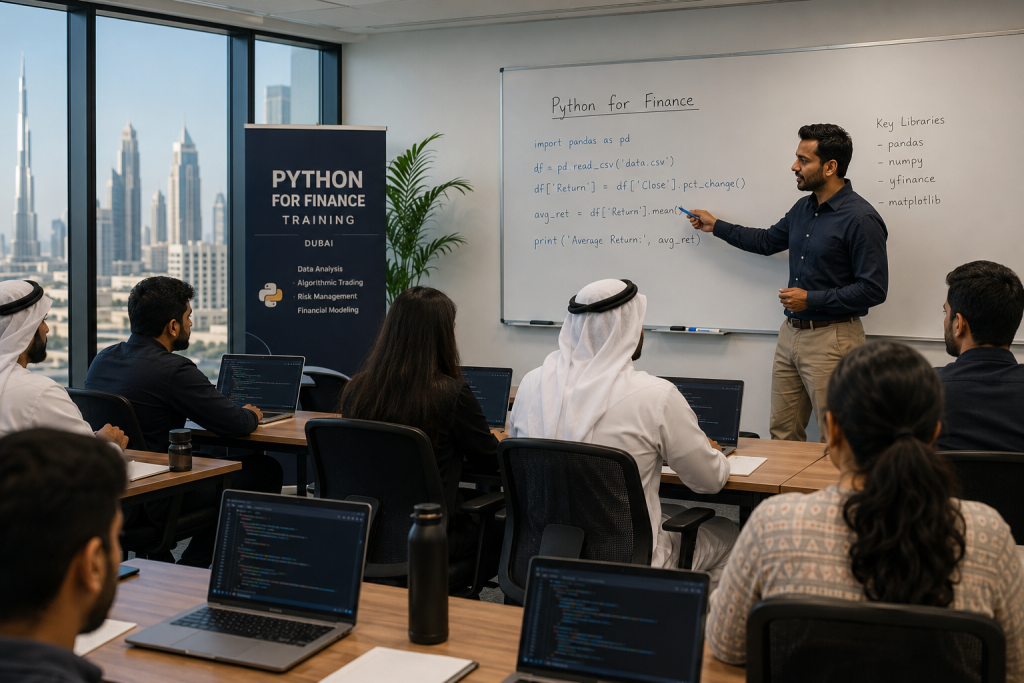
A practical roadmap designed for Python for finance beginners who are already working in accounting and do not have time for a full computer science degree. Before you begin, it helps to know the best accounting short courses in Dubai available so you can plan your full learning path.
Step 1 — Audit your current tasks List every recurring task you do monthly. Rank them by time consumed. These are your automation targets. The highest-ROI Python projects are always the most repetitive existing workflows.
Step 2 — Set up your Python environment Install Anaconda (free). This bundles Python, Jupyter Notebook, and key libraries including pandas and NumPy. You can be running your first script within 20 minutes of installation.
Step 3 — Learn Python fundamentals (2–4 weeks) Focus on variables, loops, functions, and file handling. Skip abstract computer science concepts. You need programming logic applied to financial data — nothing more at this stage.
Step 4 — Master pandas for financial data Spend 3–4 weeks exclusively on pandas. Load an Excel file, filter transactions, group by account, calculate totals. This skill alone will transform your month-end close process.
Step 5 — Automate your first real task Choose the most time-consuming task from Step 1. Build a Python script that does it automatically. Even an imperfect first automation delivers immediate value and accelerates your confidence.
Step 6 — Enrol in structured training Self-learning has limits. A structured Python programming course in UAE with finance-context mentorship compresses your learning curve significantly and ensures you build professional-grade skills, not just workarounds.
Python is widely considered the most beginner-friendly programming language. For accountants, the learning curve is further reduced because the logic you already use in Excel — IF statements, lookups, aggregations — maps directly to Python concepts. Most finance professionals reach productive automation skills within 2–3 months of structured learning.
Accounting automation tools range from dedicated software like Zapier, UiPath, or ERP automation modules to custom-built solutions. Python sits at the custom-built end — it gives you the flexibility to automate exactly what your team needs, without being locked into a vendor’s workflow or paying per-seat licensing fees.
For Python financial modeling specifically — building DCF models, forecasting, and scenario analysis — expect 4–6 months of consistent learning if you are starting from scratch. With structured training and daily practice of 45–60 minutes, many finance professionals reach a working proficiency level in 3 months.
Not entirely — nor should it. Excel remains superior for ad hoc analysis, stakeholder-facing models, and quick calculations that need to be shared widely. Python excels at automation, data processing at scale, and integration with external systems. The optimal finance team uses both strategically.
Yes. Alifbyte Education offers a Python programming course in UAE structured specifically for working professionals, with finance-context case studies and flexible scheduling to accommodate full-time work commitments.
Based on current UAE job market data, finance professionals with verified Python and automation skills command a salary premium of 25–45% over peers with equivalent accounting experience but no technical skills. The premium is highest in Dubai’s financial services sector and within multinational companies.
Python can automate transaction classification, VAT calculation, and the generation of FTA-format summary reports. Combined with structured Corporate Tax Training, this allows finance teams to build compliant, auditable automation pipelines that reduce manual error risk significantly.
Absolutely not. The Python skills required for accounting automation are a subset of full data science. You need programming fundamentals, pandas proficiency, and basic visualisation skills. These are achievable through focused short-form training — not a multi-year degree programme.
Start with bank reconciliation, monthly summary reports, and payment reminders. These three use cases provide immediate ROI and are achievable within your first month of practical Python application.
Dedicated software is faster to deploy for standard tasks but rigid in customisation and expensive at scale. Python requires upfront learning investment but delivers complete flexibility, zero per-use cost, and the ability to automate virtually any workflow — including ones your accounting software vendor has never considered.
Alifbyte Education offers a full suite of finance upskilling programmes including accounting courses in UAE, MS Excel Accounting, and Python programming — all designed for working professionals in the UAE market.
Join hundreds of UAE accounting professionals who have already upskilled with Alifbyte’s industry-focused Python training. Flexible schedules. Finance-context curriculum. Real results.
Enrol now: alifbyteedu.com/python-programming/
Flexible batches · UAE-based instructors · Certificate upon completion